

546
12 Species Case Studies
females caring for eggs. Pair-spawning occurred for about 1 week around new and
full moon, with some females spawning as many as three times during that time.
Spawning took place around sunrise with eggs hatching just after sunset on the same
day. For Xanthichthys Kawase ( 2003 ) reported females to aerate eggs by blowing
water at them, and both sexes guarded the eggs. Kawase and Nakazono ( 1994 ) as
well as Ishihara and Kuwamura ( 1996 ) reported on spawning in halfmoon triggerfi sh, Suffl amen chrysopterus. Sahayak ( 2005 ) reported on reproductive biology of
bridle triggerfi sh, Suffl amen fraenatus , but did not have any observations of spawning behaviour. The clown triggerfi sh, Balistoides conspicillum , appears to spawn as
individuals, as isolated fi sh (males?) have been encountered guarding nests.
For western Atlantic species even less is known. Nellis ( 1980 ) briefl y noted that
ocean triggerfi sh, Canthidermis suffl amen , constructed benthic nests at 15–20 m
depth on the edge of reef and sand during August–September 1973 in St. Croix,
USVI. It appears nothing has been published on the spawning of the queen triggerfi sh, Balistes vetula , the largest balistid in the Atlantic Ocean (Robertson 1988a, b ) .
For the circumtropical black durgeon, Melichthys niger , which can be exceptionally common on outer reef faces, apparently nothing has been published. In some
areas, such as Palau, there are millions of juveniles and small adults on the outer
reef faces, and their ecological importance is certainly very high (Fig. 12.80 ). Vast
shoals of them can be found in the water column over reef dropoffs, and they are a
major predator on newly spawned fi sh eggs. How there can be virtually nothing
known of the reproduction of such a ubiquitous species is surprising, but also an
excellent opportunity to advance knowledge.
Finescale triggerfi sh, Balistes polylepis , aggregate to spawn and nest from May
to September in the southern Gulf of California, Mexico (Sanchez-Velasco et al. 2009 ;
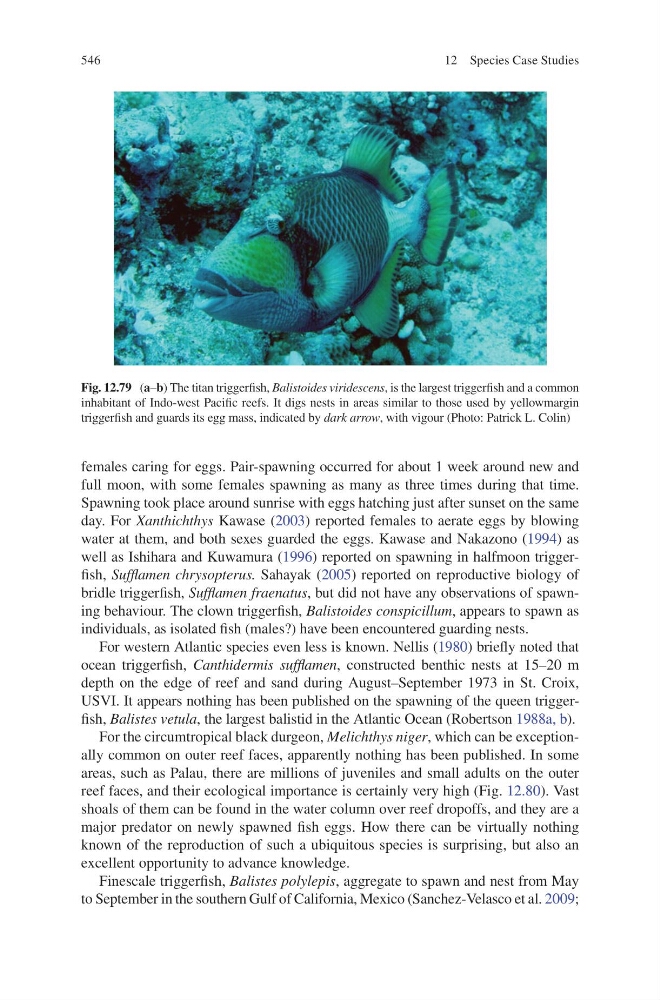
Fig. 12.79 ( a – b ) The titan triggerfi sh, Balistoides viridescens , is the largest triggerfi sh and a common
inhabitant of Indo-west Pacifi c reefs. It digs nests in areas similar to those used by yellowmargin
triggerfi sh and guards its egg mass, indicated by dark arrow , with vigour (Photo: Patrick L. Colin)
12 Species Case Studies
females caring for eggs. Pair-spawning occurred for about 1 week around new and
full moon, with some females spawning as many as three times during that time.
Spawning took place around sunrise with eggs hatching just after sunset on the same
day. For Xanthichthys Kawase ( 2003 ) reported females to aerate eggs by blowing
water at them, and both sexes guarded the eggs. Kawase and Nakazono ( 1994 ) as
well as Ishihara and Kuwamura ( 1996 ) reported on spawning in halfmoon triggerfi sh, Suffl amen chrysopterus. Sahayak ( 2005 ) reported on reproductive biology of
bridle triggerfi sh, Suffl amen fraenatus , but did not have any observations of spawning behaviour. The clown triggerfi sh, Balistoides conspicillum , appears to spawn as
individuals, as isolated fi sh (males?) have been encountered guarding nests.
For western Atlantic species even less is known. Nellis ( 1980 ) briefl y noted that
ocean triggerfi sh, Canthidermis suffl amen , constructed benthic nests at 15–20 m
depth on the edge of reef and sand during August–September 1973 in St. Croix,
USVI. It appears nothing has been published on the spawning of the queen triggerfi sh, Balistes vetula , the largest balistid in the Atlantic Ocean (Robertson 1988a, b ) .
For the circumtropical black durgeon, Melichthys niger , which can be exceptionally common on outer reef faces, apparently nothing has been published. In some
areas, such as Palau, there are millions of juveniles and small adults on the outer
reef faces, and their ecological importance is certainly very high (Fig. 12.80 ). Vast
shoals of them can be found in the water column over reef dropoffs, and they are a
major predator on newly spawned fi sh eggs. How there can be virtually nothing
known of the reproduction of such a ubiquitous species is surprising, but also an
excellent opportunity to advance knowledge.
Finescale triggerfi sh, Balistes polylepis , aggregate to spawn and nest from May
to September in the southern Gulf of California, Mexico (Sanchez-Velasco et al. 2009 ;
Fig. 12.79 ( a – b ) The titan triggerfi sh, Balistoides viridescens , is the largest triggerfi sh and a common
inhabitant of Indo-west Pacifi c reefs. It digs nests in areas similar to those used by yellowmargin
triggerfi sh and guards its egg mass, indicated by dark arrow , with vigour (Photo: Patrick L. Colin)