

536
12 Species Case Studies
Woliae and possibly Pohnpei. It is a member of the family Siganidae, which contains
2 genera and 25 species, 12 of which are found in Palau (Myers 1999 ) . Palauan fi sh
were previously confused with S. canaliculatus , an Indian Ocean and Southeast
Asian species, (Woodland 1990 ) . The family is known for their venomous dorsal,
anal pelvic spines which can infl ict a painful wound, and as an important food fi sh
in some areas. Species in the family for which there is information have adhesive
demersal eggs which are shed by the females and externally fertilized by males.
In Palau the dusky rabbitfi sh (Siganidae) is an important grazer inhabiting
lagoons, coastal reefs, bays and shallow seagrass fl ats. In the latter habitat adults
and juveniles feed diurnally on the epiphytes of seagrasses and often school with
juvenile parrotfi shes, surgeon fi shes, and goatfi shes. Juvenile dusky rabbitfi sh
(2.5–10 cm) are found year round with greater numbers during January and May in
some areas. Newly settled juveniles form large schools on seagrass beds and school
sizes decrease with age. Subadults and adults roam the seagrass fl ats during high
tide and retreat to deep lagoon waters as the tide ebbs.
12.22.2 Reproduction and Aggregation
The species is known for forming large “pre-spawning aggregations” (PSA), in
which fi sh ready to spawn congregate as groups in areas inshore or inside shallow
reefs and then migrate en masse across the reef in late afternoon just prior to spawning which occurs later in the afternoon or early evening on the outer reef face.
At this time tides are usually at or near low water.
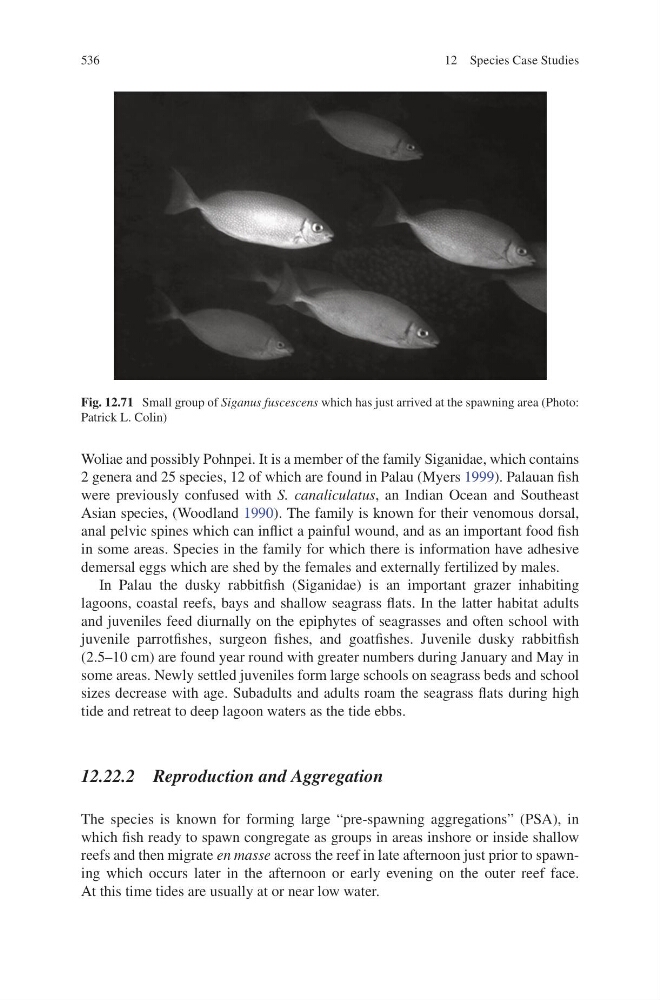
Fig. 12.71 Small group of Siganus fuscescens which has just arrived at the spawning area (Photo:
Patrick L. Colin)
12 Species Case Studies
Woliae and possibly Pohnpei. It is a member of the family Siganidae, which contains
2 genera and 25 species, 12 of which are found in Palau (Myers 1999 ) . Palauan fi sh
were previously confused with S. canaliculatus , an Indian Ocean and Southeast
Asian species, (Woodland 1990 ) . The family is known for their venomous dorsal,
anal pelvic spines which can infl ict a painful wound, and as an important food fi sh
in some areas. Species in the family for which there is information have adhesive
demersal eggs which are shed by the females and externally fertilized by males.
In Palau the dusky rabbitfi sh (Siganidae) is an important grazer inhabiting
lagoons, coastal reefs, bays and shallow seagrass fl ats. In the latter habitat adults
and juveniles feed diurnally on the epiphytes of seagrasses and often school with
juvenile parrotfi shes, surgeon fi shes, and goatfi shes. Juvenile dusky rabbitfi sh
(2.5–10 cm) are found year round with greater numbers during January and May in
some areas. Newly settled juveniles form large schools on seagrass beds and school
sizes decrease with age. Subadults and adults roam the seagrass fl ats during high
tide and retreat to deep lagoon waters as the tide ebbs.
12.22.2 Reproduction and Aggregation
The species is known for forming large “pre-spawning aggregations” (PSA), in
which fi sh ready to spawn congregate as groups in areas inshore or inside shallow
reefs and then migrate en masse across the reef in late afternoon just prior to spawning which occurs later in the afternoon or early evening on the outer reef face.
At this time tides are usually at or near low water.
Fig. 12.71 Small group of Siganus fuscescens which has just arrived at the spawning area (Photo:
Patrick L. Colin)