

527
12 Species Case Studies
12.21.1 General
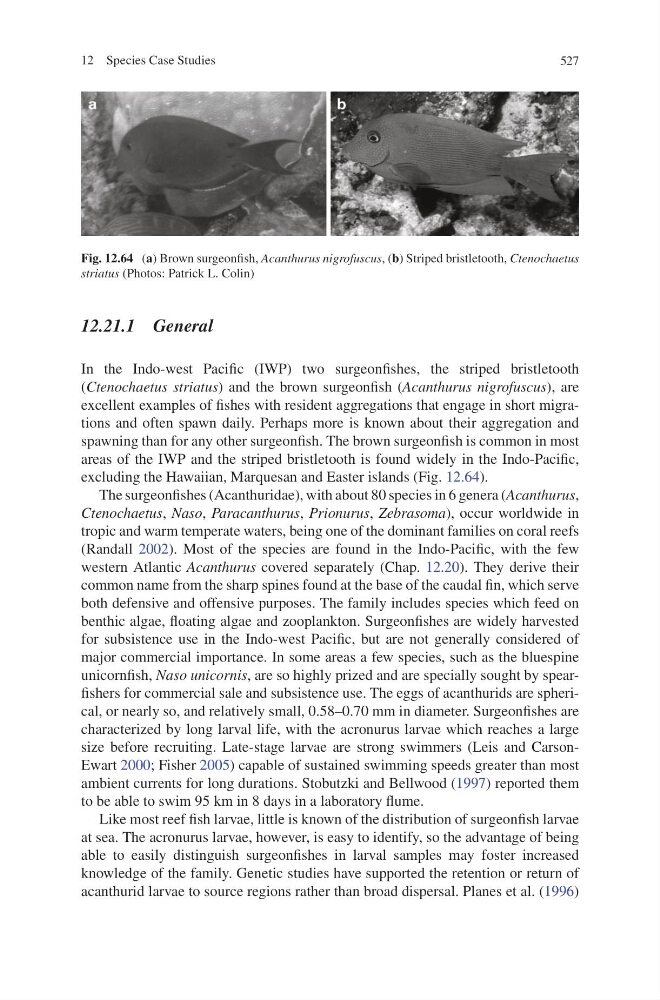
In the Indo-west Pacifi c (IWP) two surgeonfi shes, the striped bristletooth
( Ctenochaetus striatus ) and the brown surgeonfi sh ( Acanthurus nigrofuscus ), are
excellent examples of fi shes with resident aggregations that engage in short migrations and often spawn daily. Perhaps more is known about their aggregation and
spawning than for any other surgeonfi sh. The brown surgeonfi sh is common in most
areas of the IWP and the striped bristletooth is found widely in the Indo-Pacifi c,
excluding the Hawaiian, Marquesan and Easter islands (Fig. 12.64 ).
The surgeonfi shes (Acanthuridae), with about 80 species in 6 genera ( Acanthurus ,
Ctenochaetus , Naso , Paracanthurus , Prionurus , Zebrasoma ), occur worldwide in
tropic and warm temperate waters, being one of the dominant families on coral reefs
(Randall 2002 ) . Most of the species are found in the Indo-Pacifi c, with the few
western Atlantic Acanthurus covered separately (Chap. 12.20 ). They derive their
common name from the sharp spines found at the base of the caudal fi n, which serve
both defensive and offensive purposes. The family includes species which feed on
benthic algae, fl oating algae and zooplankton. Surgeonfi shes are widely harvested
for subsistence use in the Indo-west Pacifi c, but are not generally considered of
major commercial importance. In some areas a few species, such as the bluespine
unicornfi sh, Naso unicornis , are so highly prized and are specially sought by spearfi shers for commercial sale and subsistence use. The eggs of acanthurids are spherical, or nearly so, and relatively small, 0.58–0.70 mm in diameter. Surgeonfi shes are
characterized by long larval life, with the acronurus larvae which reaches a large
size before recruiting. Late-stage larvae are strong swimmers (Leis and CarsonEwart 2000 ; Fisher 2005 ) capable of sustained swimming speeds greater than most
ambient currents for long durations. Stobutzki and Bellwood ( 1997 ) reported them
to be able to swim 95 km in 8 days in a laboratory fl ume.
Like most reef fi sh larvae, little is known of the distribution of surgeonfi sh larvae
at sea. The acronurus larvae, however, is easy to identify, so the advantage of being
able to easily distinguish surgeonfi shes in larval samples may foster increased
knowledge of the family. Genetic studies have supported the retention or return of
acanthurid larvae to source regions rather than broad dispersal. Planes et al. ( 1996 )
Fig. 12.64 ( a ) Brown surgeonfi sh, Acanthurus nigrofuscus , ( b ) Striped bristletooth, Ctenochaetus
striatus (Photos: Patrick L. Colin)
12 Species Case Studies
12.21.1 General
In the Indo-west Pacifi c (IWP) two surgeonfi shes, the striped bristletooth
( Ctenochaetus striatus ) and the brown surgeonfi sh ( Acanthurus nigrofuscus ), are
excellent examples of fi shes with resident aggregations that engage in short migrations and often spawn daily. Perhaps more is known about their aggregation and
spawning than for any other surgeonfi sh. The brown surgeonfi sh is common in most
areas of the IWP and the striped bristletooth is found widely in the Indo-Pacifi c,
excluding the Hawaiian, Marquesan and Easter islands (Fig. 12.64 ).
The surgeonfi shes (Acanthuridae), with about 80 species in 6 genera ( Acanthurus ,
Ctenochaetus , Naso , Paracanthurus , Prionurus , Zebrasoma ), occur worldwide in
tropic and warm temperate waters, being one of the dominant families on coral reefs
(Randall 2002 ) . Most of the species are found in the Indo-Pacifi c, with the few
western Atlantic Acanthurus covered separately (Chap. 12.20 ). They derive their
common name from the sharp spines found at the base of the caudal fi n, which serve
both defensive and offensive purposes. The family includes species which feed on
benthic algae, fl oating algae and zooplankton. Surgeonfi shes are widely harvested
for subsistence use in the Indo-west Pacifi c, but are not generally considered of
major commercial importance. In some areas a few species, such as the bluespine
unicornfi sh, Naso unicornis , are so highly prized and are specially sought by spearfi shers for commercial sale and subsistence use. The eggs of acanthurids are spherical, or nearly so, and relatively small, 0.58–0.70 mm in diameter. Surgeonfi shes are
characterized by long larval life, with the acronurus larvae which reaches a large
size before recruiting. Late-stage larvae are strong swimmers (Leis and CarsonEwart 2000 ; Fisher 2005 ) capable of sustained swimming speeds greater than most
ambient currents for long durations. Stobutzki and Bellwood ( 1997 ) reported them
to be able to swim 95 km in 8 days in a laboratory fl ume.
Like most reef fi sh larvae, little is known of the distribution of surgeonfi sh larvae
at sea. The acronurus larvae, however, is easy to identify, so the advantage of being
able to easily distinguish surgeonfi shes in larval samples may foster increased
knowledge of the family. Genetic studies have supported the retention or return of
acanthurid larvae to source regions rather than broad dispersal. Planes et al. ( 1996 )
Fig. 12.64 ( a ) Brown surgeonfi sh, Acanthurus nigrofuscus , ( b ) Striped bristletooth, Ctenochaetus
striatus (Photos: Patrick L. Colin)