

525
12 Species Case Studies
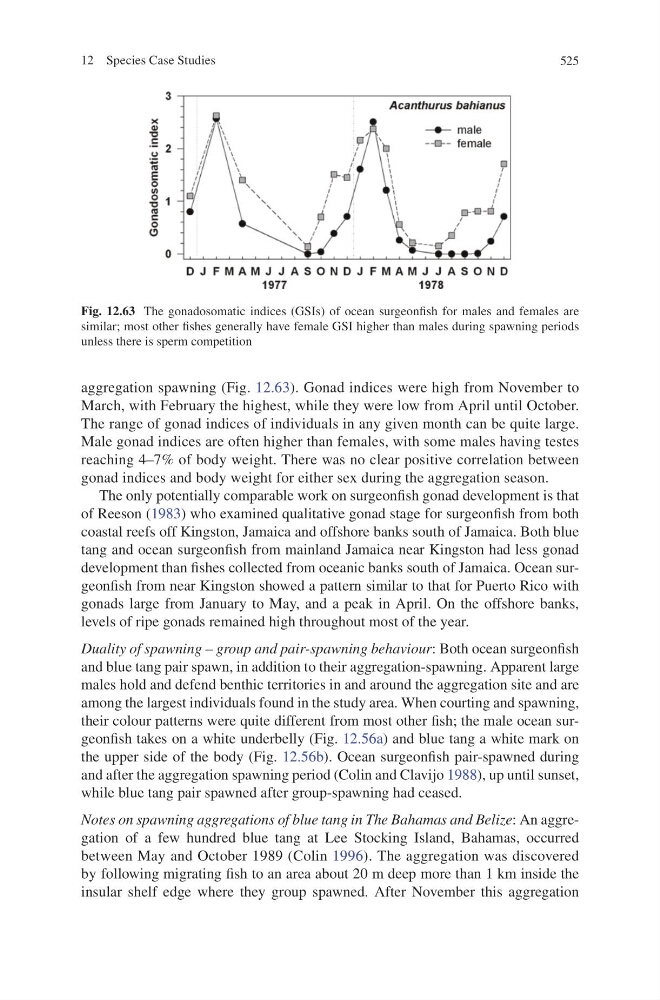
aggregation spawning (Fig. 12.63 ). Gonad indices were high from November to
March, with February the highest, while they were low from April until October.
The range of gonad indices of individuals in any given month can be quite large.
Male gonad indices are often higher than females, with some males having testes
reaching 4–7% of body weight. There was no clear positive correlation between
gonad indices and body weight for either sex during the aggregation season.
The only potentially comparable work on surgeonfi sh gonad development is that
of Reeson ( 1983 ) who examined qualitative gonad stage for surgeonfi sh from both
coastal reefs off Kingston, Jamaica and offshore banks south of Jamaica. Both blue
tang and ocean surgeonfi sh from mainland Jamaica near Kingston had less gonad
development than fi shes collected from oceanic banks south of Jamaica. Ocean surgeonfi sh from near Kingston showed a pattern similar to that for Puerto Rico with
gonads large from January to May, and a peak in April. On the offshore banks,
levels of ripe gonads remained high throughout most of the year.
Duality of spawning – group and pair-spawning behaviour: Both ocean surgeonfi sh
and blue tang pair spawn, in addition to their aggregation-spawning. Apparent large
males hold and defend benthic territories in and around the aggregation site and are
among the largest individuals found in the study area. When courting and spawning,
their colour patterns were quite different from most other fi sh; the male ocean surgeonfi sh takes on a white underbelly (Fig. 12.56a ) and blue tang a white mark on
the upper side of the body (Fig. 12.56b ). Ocean surgeonfi sh pair-spawned during
and after the aggregation spawning period (Colin and Clavijo 1988 ) , up until sunset,
while blue tang pair spawned after group-spawning had ceased.
Notes on spawning aggregations of blue tang in The Bahamas and Belize: An aggregation of a few hundred blue tang at Lee Stocking Island, Bahamas, occurred
between May and October 1989 (Colin 1996 ) . The aggregation was discovered
by following migrating fi sh to an area about 20 m deep more than 1 km inside the
insular shelf edge where they group spawned. After November this aggregation
Fig. 12.63 The gonadosomatic indices (GSIs) of ocean surgeonfi sh for males and females are
similar; most other fi shes generally have female GSI higher than males during spawning periods
unless there is sperm competition
12 Species Case Studies
aggregation spawning (Fig. 12.63 ). Gonad indices were high from November to
March, with February the highest, while they were low from April until October.
The range of gonad indices of individuals in any given month can be quite large.
Male gonad indices are often higher than females, with some males having testes
reaching 4–7% of body weight. There was no clear positive correlation between
gonad indices and body weight for either sex during the aggregation season.
The only potentially comparable work on surgeonfi sh gonad development is that
of Reeson ( 1983 ) who examined qualitative gonad stage for surgeonfi sh from both
coastal reefs off Kingston, Jamaica and offshore banks south of Jamaica. Both blue
tang and ocean surgeonfi sh from mainland Jamaica near Kingston had less gonad
development than fi shes collected from oceanic banks south of Jamaica. Ocean surgeonfi sh from near Kingston showed a pattern similar to that for Puerto Rico with
gonads large from January to May, and a peak in April. On the offshore banks,
levels of ripe gonads remained high throughout most of the year.
Duality of spawning – group and pair-spawning behaviour: Both ocean surgeonfi sh
and blue tang pair spawn, in addition to their aggregation-spawning. Apparent large
males hold and defend benthic territories in and around the aggregation site and are
among the largest individuals found in the study area. When courting and spawning,
their colour patterns were quite different from most other fi sh; the male ocean surgeonfi sh takes on a white underbelly (Fig. 12.56a ) and blue tang a white mark on
the upper side of the body (Fig. 12.56b ). Ocean surgeonfi sh pair-spawned during
and after the aggregation spawning period (Colin and Clavijo 1988 ) , up until sunset,
while blue tang pair spawned after group-spawning had ceased.
Notes on spawning aggregations of blue tang in The Bahamas and Belize: An aggregation of a few hundred blue tang at Lee Stocking Island, Bahamas, occurred
between May and October 1989 (Colin 1996 ) . The aggregation was discovered
by following migrating fi sh to an area about 20 m deep more than 1 km inside the
insular shelf edge where they group spawned. After November this aggregation
Fig. 12.63 The gonadosomatic indices (GSIs) of ocean surgeonfi sh for males and females are
similar; most other fi shes generally have female GSI higher than males during spawning periods
unless there is sperm competition