

508
12 Species Case Studies
The Carangidae are a family of strong swimming schooling open-water carnivores, with muscular bodies and highly forked caudal fi ns with heavy supporting
elements (scutes, etc.) at its base. There are about 150 species, of which several
dozen occur in most coral reef areas. The species in the genus Caranx range in size
from a few 10s of cm to confi rmed lengths of over 1.7 m length, with weights up to
80 k for the giant trevally ( Caranx ignobilis ). They are highly prized sport fi shes, the
giant trevally a legendary fi ghting fi sh. There are only a few published reports of
spawning by family members, and thus only a modest amount is known about
spawning in the family. One question is whether carangids truly have spawning
aggregations, or do they have what is known as “simple migratory spawning”?
12.18.2 Reproduction and Aggregation
Carangids are gonochorists and the sexes are not easily distinguished. For the species included in the Appendix the observations of spawning are not questioned, but
whether the species engage in true aggregation or simple migratory spawning is not
positively known. Hence they are listed in Appendix as “probable” aggregation
spawners. Domeier and Colin ( 1997 ) , as well as Domeier (Chap. 1 ), defi nes simple
migratory spawning as “migration and spawning of pairs or small groups of fi shes
from a non-spawning area to a spawning area”. A true spawning aggregation is that
of “a unique phenomenon of behavioural ecology where an entire sub-population of
individuals halt their normal routine, migrate, gather and spawn” (Chap. 1 ). Since
many species of carangids normally school in large numbers, the density of fi sh that
might occur when spawning is taking place may not be higher than normal, just the
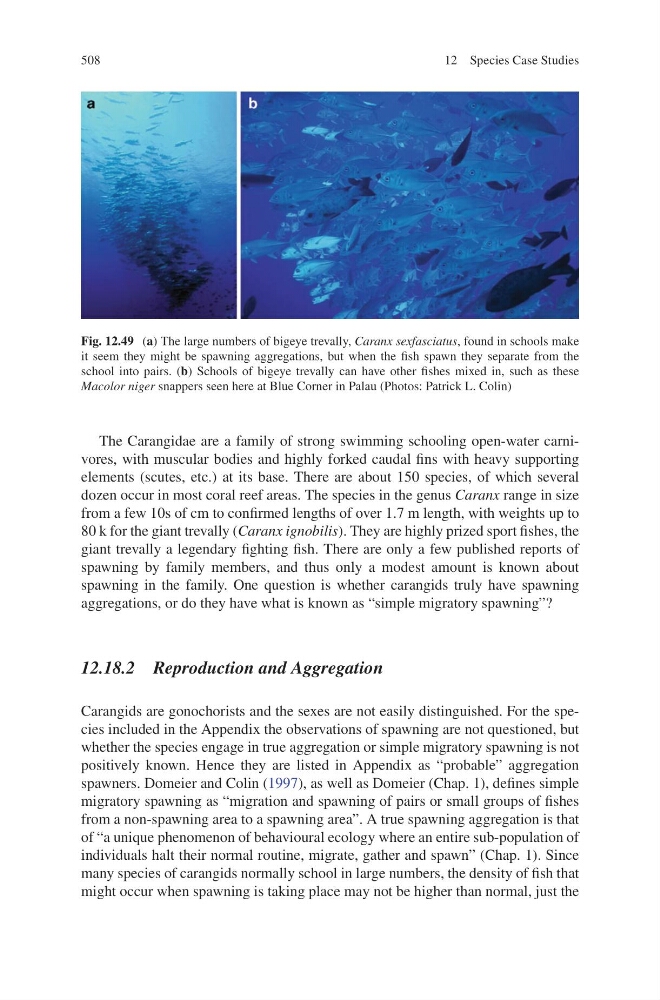
Fig. 12.49 ( a ) The large numbers of bigeye trevally, Caranx sexfasciatus , found in schools make
it seem they might be spawning aggregations, but when the fi sh spawn they separate from the
school into pairs. ( b ) Schools of bigeye trevally can have other fi shes mixed in, such as these
Macolor niger snappers seen here at Blue Corner in Palau (Photos: Patrick L. Colin)
12 Species Case Studies
The Carangidae are a family of strong swimming schooling open-water carnivores, with muscular bodies and highly forked caudal fi ns with heavy supporting
elements (scutes, etc.) at its base. There are about 150 species, of which several
dozen occur in most coral reef areas. The species in the genus Caranx range in size
from a few 10s of cm to confi rmed lengths of over 1.7 m length, with weights up to
80 k for the giant trevally ( Caranx ignobilis ). They are highly prized sport fi shes, the
giant trevally a legendary fi ghting fi sh. There are only a few published reports of
spawning by family members, and thus only a modest amount is known about
spawning in the family. One question is whether carangids truly have spawning
aggregations, or do they have what is known as “simple migratory spawning”?
12.18.2 Reproduction and Aggregation
Carangids are gonochorists and the sexes are not easily distinguished. For the species included in the Appendix the observations of spawning are not questioned, but
whether the species engage in true aggregation or simple migratory spawning is not
positively known. Hence they are listed in Appendix as “probable” aggregation
spawners. Domeier and Colin ( 1997 ) , as well as Domeier (Chap. 1 ), defi nes simple
migratory spawning as “migration and spawning of pairs or small groups of fi shes
from a non-spawning area to a spawning area”. A true spawning aggregation is that
of “a unique phenomenon of behavioural ecology where an entire sub-population of
individuals halt their normal routine, migrate, gather and spawn” (Chap. 1 ). Since
many species of carangids normally school in large numbers, the density of fi sh that
might occur when spawning is taking place may not be higher than normal, just the
Fig. 12.49 ( a ) The large numbers of bigeye trevally, Caranx sexfasciatus , found in schools make
it seem they might be spawning aggregations, but when the fi sh spawn they separate from the
school into pairs. ( b ) Schools of bigeye trevally can have other fi shes mixed in, such as these
Macolor niger snappers seen here at Blue Corner in Palau (Photos: Patrick L. Colin)