

29
2 Ecosystem Aspects of Species That Aggregate to Spawn
and red hind (Samoilys 1997 ; Nemeth 2005 ; Nemeth et al. 2007 ) . In Pohnpei, the
camoufl age grouper spawning population size, as estimated from Rhodes and Sadovy
( 2002a ), was at least fi ve-fold greater than in the Seychelles (i.e. ca. 10,000 vs.
2,000 fi sh), and were distributed over a much larger staging area (25,000 m
2
) before
spawning but occupied a spawning area of similar size (ca. 5000 m
2
). In the Caribbean,
yellowfi n grouper ( Mycteroperca venenosa ) were observed in groups of 50 or more
fi sh briefl y occupying (< week) isolated patch reefs up to 5 km away from the spawning aggregation site several weeks before spawning (RSN personal observation).
Transient aggregating species may use staging areas prior to spawning or during
the several weeks between monthly spawning peaks (Nemeth 2005 ; Nemeth et al.
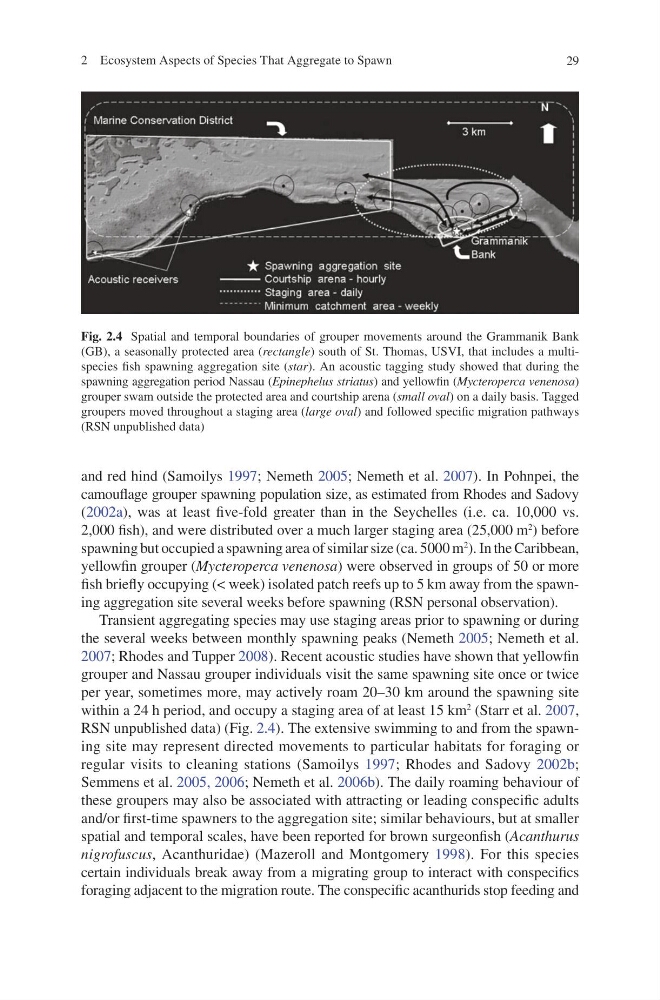
2007 ; Rhodes and Tupper 2008 ) . Recent acoustic studies have shown that yellowfi n
grouper and Nassau grouper individuals visit the same spawning site once or twice
per year, sometimes more, may actively roam 20–30 km around the spawning site
within a 24 h period, and occupy a staging area of at least 15 km
2 (Starr et al. 2007 ,
RSN unpublished data) (Fig. 2.4 ). The extensive swimming to and from the spawning site may represent directed movements to particular habitats for foraging or
regular visits to cleaning stations (Samoilys 1997 ; Rhodes and Sadovy 2002b ;
Semmens et al. 2005, 2006 ; Nemeth et al. 2006b ) . The daily roaming behaviour of
these groupers may also be associated with attracting or leading conspecifi c adults
and/or fi rst-time spawners to the aggregation site; similar behaviours, but at smaller
spatial and temporal scales, have been reported for brown surgeonfi sh ( Acanthurus
nigrofuscus , Acanthuridae) (Mazeroll and Montgomery 1998 ) . For this species
certain individuals break away from a migrating group to interact with conspecifi cs
foraging adjacent to the migration route. The conspecifi c acanthurids stop feeding and
Fig. 2.4 Spatial and temporal boundaries of grouper movements around the Grammanik Bank
(GB), a seasonally protected area ( rectangle ) south of St. Thomas, USVI, that includes a multispecies fi sh spawning aggregation site ( star ). An acoustic tagging study showed that during the
spawning aggregation period Nassau ( Epinephelus striatus ) and yellowfi n ( Mycteroperca venenosa )
grouper swam outside the protected area and courtship arena ( small oval ) on a daily basis. Tagged
groupers moved throughout a staging area ( large oval ) and followed specifi c migration pathways
(RSN unpublished data)
2 Ecosystem Aspects of Species That Aggregate to Spawn
and red hind (Samoilys 1997 ; Nemeth 2005 ; Nemeth et al. 2007 ) . In Pohnpei, the
camoufl age grouper spawning population size, as estimated from Rhodes and Sadovy
( 2002a ), was at least fi ve-fold greater than in the Seychelles (i.e. ca. 10,000 vs.
2,000 fi sh), and were distributed over a much larger staging area (25,000 m
2
) before
spawning but occupied a spawning area of similar size (ca. 5000 m
2
). In the Caribbean,
yellowfi n grouper ( Mycteroperca venenosa ) were observed in groups of 50 or more
fi sh briefl y occupying (< week) isolated patch reefs up to 5 km away from the spawning aggregation site several weeks before spawning (RSN personal observation).
Transient aggregating species may use staging areas prior to spawning or during
the several weeks between monthly spawning peaks (Nemeth 2005 ; Nemeth et al.
2007 ; Rhodes and Tupper 2008 ) . Recent acoustic studies have shown that yellowfi n
grouper and Nassau grouper individuals visit the same spawning site once or twice
per year, sometimes more, may actively roam 20–30 km around the spawning site
within a 24 h period, and occupy a staging area of at least 15 km
2 (Starr et al. 2007 ,
RSN unpublished data) (Fig. 2.4 ). The extensive swimming to and from the spawning site may represent directed movements to particular habitats for foraging or
regular visits to cleaning stations (Samoilys 1997 ; Rhodes and Sadovy 2002b ;
Semmens et al. 2005, 2006 ; Nemeth et al. 2006b ) . The daily roaming behaviour of
these groupers may also be associated with attracting or leading conspecifi c adults
and/or fi rst-time spawners to the aggregation site; similar behaviours, but at smaller
spatial and temporal scales, have been reported for brown surgeonfi sh ( Acanthurus
nigrofuscus , Acanthuridae) (Mazeroll and Montgomery 1998 ) . For this species
certain individuals break away from a migrating group to interact with conspecifi cs
foraging adjacent to the migration route. The conspecifi c acanthurids stop feeding and
Fig. 2.4 Spatial and temporal boundaries of grouper movements around the Grammanik Bank
(GB), a seasonally protected area ( rectangle ) south of St. Thomas, USVI, that includes a multispecies fi sh spawning aggregation site ( star ). An acoustic tagging study showed that during the
spawning aggregation period Nassau ( Epinephelus striatus ) and yellowfi n ( Mycteroperca venenosa )
grouper swam outside the protected area and courtship arena ( small oval ) on a daily basis. Tagged
groupers moved throughout a staging area ( large oval ) and followed specifi c migration pathways
(RSN unpublished data)