

490
12 Species Case Studies
Because the bluehead wrasse mates daily in large aggregations, is not heavily
exploited and is easily manipulated, we can answer some questions about spawning
aggregations that are very diffi cult to answer in larger, less frequently mating fi shes.
For the bluehead wrasse, at least, we know that the sites of spawning aggregations
are determined by females, and that information on the location of spawning sites is
passed from older females to younger through social learning (or copying). If females
are induced to change spawning sites, males simply follow the female lead.
Spawning aggregations of this species are exceedingly easy to observe and manipulate. However, the lessons learned from this small, abundant prey fi sh may not apply
to the larger commercially important predators that form spawning aggregations.
12.15 Bumphead Parrotfi sh – Bolbometopon muricatum
R. J. Hamilton and J. H. Choat
The Nature Conservancy, Indo-Pacifi c Resource Centre , 51 Edmondstone Street,
South Brisbane , QLD 4101 , Australia
e-mail: rhamilton@tnc.org
School of Marine and Tropical Biology , James Cook University , Townsville ,
QLD 4811 , Australia
e-mail: john.choat@jcu.edu.au
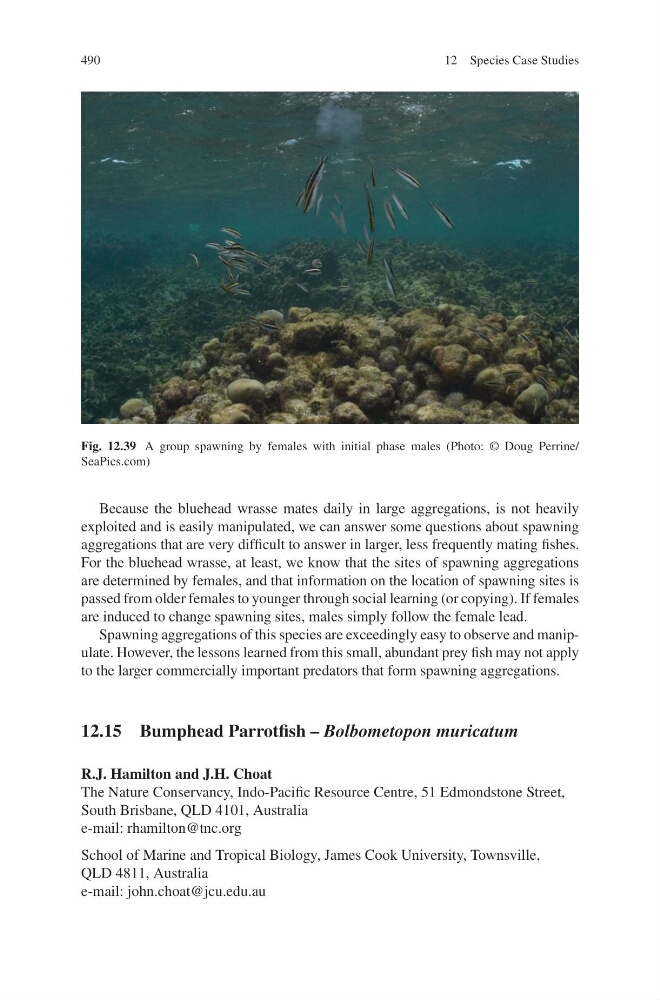
Fig. 12.39 A group spawning by females with initial phase males (Photo: © Doug Perrine/
SeaPics.com)
12 Species Case Studies
Because the bluehead wrasse mates daily in large aggregations, is not heavily
exploited and is easily manipulated, we can answer some questions about spawning
aggregations that are very diffi cult to answer in larger, less frequently mating fi shes.
For the bluehead wrasse, at least, we know that the sites of spawning aggregations
are determined by females, and that information on the location of spawning sites is
passed from older females to younger through social learning (or copying). If females
are induced to change spawning sites, males simply follow the female lead.
Spawning aggregations of this species are exceedingly easy to observe and manipulate. However, the lessons learned from this small, abundant prey fi sh may not apply
to the larger commercially important predators that form spawning aggregations.
12.15 Bumphead Parrotfi sh – Bolbometopon muricatum
R. J. Hamilton and J. H. Choat
The Nature Conservancy, Indo-Pacifi c Resource Centre , 51 Edmondstone Street,
South Brisbane , QLD 4101 , Australia
e-mail: rhamilton@tnc.org
School of Marine and Tropical Biology , James Cook University , Townsville ,
QLD 4811 , Australia
e-mail: john.choat@jcu.edu.au
Fig. 12.39 A group spawning by females with initial phase males (Photo: © Doug Perrine/
SeaPics.com)