

488
12 Species Case Studies
Western Atlantic, from Bermuda, Florida (USA), southeastern Gulf of Mexico and
throughout the Caribbean Sea to northern South America. Maximum recorded
size is about 25 cm total length (TL).
After a pelagic larval phase of about 50 days, bluehead wrasse settle out onto reefs
and metamorphose into small (<10 mm standard length, or SL) juveniles. The fi shes
mature at about 35 mm SL and 3–4 months of age. All small adult fi sh are in the initial
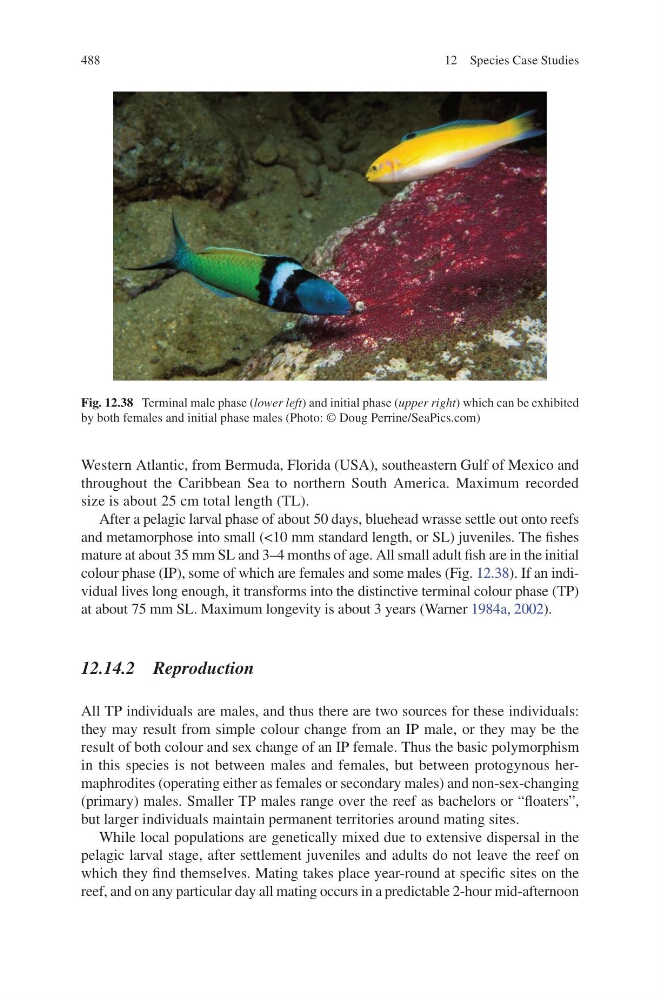
colour phase (IP), some of which are females and some males (Fig. 12.38 ). If an individual lives long enough, it transforms into the distinctive terminal colour phase (TP)
at about 75 mm SL. Maximum longevity is about 3 years (Warner 1984a, 2002 ) .
12.14.2 Reproduction
All TP individuals are males, and thus there are two sources for these individuals:
they may result from simple colour change from an IP male, or they may be the
result of both colour and sex change of an IP female. Thus the basic polymorphism
in this species is not between males and females, but between protogynous hermaphrodites (operating either as females or secondary males) and non-sex-changing
(primary) males. Smaller TP males range over the reef as bachelors or “fl oaters”,
but larger individuals maintain permanent territories around mating sites.
While local populations are genetically mixed due to extensive dispersal in the
pelagic larval stage, after settlement juveniles and adults do not leave the reef on
which they fi nd themselves. Mating takes place year-round at specifi c sites on the
reef, and on any particular day all mating occurs in a predictable 2-hour mid-afternoon
Fig. 12.38 Terminal male phase ( lower left ) and initial phase ( upper right ) which can be exhibited
by both females and initial phase males (Photo: © Doug Perrine/SeaPics.com)
12 Species Case Studies
Western Atlantic, from Bermuda, Florida (USA), southeastern Gulf of Mexico and
throughout the Caribbean Sea to northern South America. Maximum recorded
size is about 25 cm total length (TL).
After a pelagic larval phase of about 50 days, bluehead wrasse settle out onto reefs
and metamorphose into small (<10 mm standard length, or SL) juveniles. The fi shes
mature at about 35 mm SL and 3–4 months of age. All small adult fi sh are in the initial
colour phase (IP), some of which are females and some males (Fig. 12.38 ). If an individual lives long enough, it transforms into the distinctive terminal colour phase (TP)
at about 75 mm SL. Maximum longevity is about 3 years (Warner 1984a, 2002 ) .
12.14.2 Reproduction
All TP individuals are males, and thus there are two sources for these individuals:
they may result from simple colour change from an IP male, or they may be the
result of both colour and sex change of an IP female. Thus the basic polymorphism
in this species is not between males and females, but between protogynous hermaphrodites (operating either as females or secondary males) and non-sex-changing
(primary) males. Smaller TP males range over the reef as bachelors or “fl oaters”,
but larger individuals maintain permanent territories around mating sites.
While local populations are genetically mixed due to extensive dispersal in the
pelagic larval stage, after settlement juveniles and adults do not leave the reef on
which they fi nd themselves. Mating takes place year-round at specifi c sites on the
reef, and on any particular day all mating occurs in a predictable 2-hour mid-afternoon
Fig. 12.38 Terminal male phase ( lower left ) and initial phase ( upper right ) which can be exhibited
by both females and initial phase males (Photo: © Doug Perrine/SeaPics.com)