

467
12 Species Case Studies
young fi sh typically found in inshore mangrove areas and seagrass beds, sometimes
in estuaries and freshwater canals (Lindeman and DeMaria 2005 ) . It spawns in
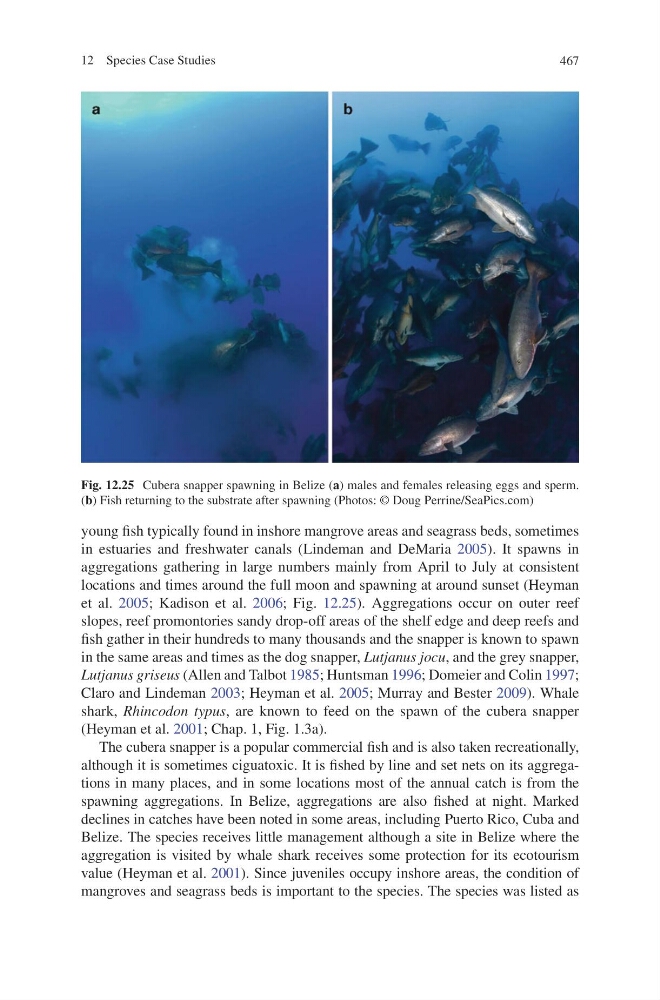
aggregations gathering in large numbers mainly from April to July at consistent
locations and times around the full moon and spawning at around sunset (Heyman
et al. 2005 ; Kadison et al. 2006 ; Fig. 12.25 ). Aggregations occur on outer reef
slopes, reef promontories sandy drop-off areas of the shelf edge and deep reefs and
fi sh gather in their hundreds to many thousands and the snapper is known to spawn
in the same areas and times as the dog snapper, Lutjanus jocu , and the grey snapper,
Lutjanus griseus (Allen and Talbot 1985 ; Huntsman 1996 ; Domeier and Colin 1997 ;
Claro and Lindeman 2003 ; Heyman et al. 2005 ; Murray and Bester 2009 ) . Whale
shark, Rhincodon typus , are known to feed on the spawn of the cubera snapper
(Heyman et al. 2001 ; Chap. 1 , Fig. 1.3a).
The cubera snapper is a popular commercial fi sh and is also taken recreationally,
although it is sometimes ciguatoxic. It is fi shed by line and set nets on its aggregations in many places, and in some locations most of the annual catch is from the
spawning aggregations. In Belize, aggregations are also fi shed at night. Marked
declines in catches have been noted in some areas, including Puerto Rico, Cuba and
Belize. The species receives little management although a site in Belize where the
aggregation is visited by whale shark receives some protection for its ecotourism
value (Heyman et al. 2001 ) . Since juveniles occupy inshore areas, the condition of
mangroves and seagrass beds is important to the species. The species was listed as
Fig. 12.25 Cubera snapper spawning in Belize ( a ) males and females releasing eggs and sperm.
( b ) Fish returning to the substrate after spawning (Photos: © Doug Perrine/SeaPics.com)
12 Species Case Studies
young fi sh typically found in inshore mangrove areas and seagrass beds, sometimes
in estuaries and freshwater canals (Lindeman and DeMaria 2005 ) . It spawns in
aggregations gathering in large numbers mainly from April to July at consistent
locations and times around the full moon and spawning at around sunset (Heyman
et al. 2005 ; Kadison et al. 2006 ; Fig. 12.25 ). Aggregations occur on outer reef
slopes, reef promontories sandy drop-off areas of the shelf edge and deep reefs and
fi sh gather in their hundreds to many thousands and the snapper is known to spawn
in the same areas and times as the dog snapper, Lutjanus jocu , and the grey snapper,
Lutjanus griseus (Allen and Talbot 1985 ; Huntsman 1996 ; Domeier and Colin 1997 ;
Claro and Lindeman 2003 ; Heyman et al. 2005 ; Murray and Bester 2009 ) . Whale
shark, Rhincodon typus , are known to feed on the spawn of the cubera snapper
(Heyman et al. 2001 ; Chap. 1 , Fig. 1.3a).
The cubera snapper is a popular commercial fi sh and is also taken recreationally,
although it is sometimes ciguatoxic. It is fi shed by line and set nets on its aggregations in many places, and in some locations most of the annual catch is from the
spawning aggregations. In Belize, aggregations are also fi shed at night. Marked
declines in catches have been noted in some areas, including Puerto Rico, Cuba and
Belize. The species receives little management although a site in Belize where the
aggregation is visited by whale shark receives some protection for its ecotourism
value (Heyman et al. 2001 ) . Since juveniles occupy inshore areas, the condition of
mangroves and seagrass beds is important to the species. The species was listed as
Fig. 12.25 Cubera snapper spawning in Belize ( a ) males and females releasing eggs and sperm.
( b ) Fish returning to the substrate after spawning (Photos: © Doug Perrine/SeaPics.com)