

465
12 Species Case Studies
blue-lined sea bream and these groups are receiving detailed attention. In fi sher
interviews in Palau, the only snapper consistently identifi ed to aggregate with eggs
was Lutjanus bohar ( L. gibbus, humpback red snapper, was also mentioned by one
fi sher). The time when this species had eggs was reported to vary, from several
days after or before full moon to the new moon phase for many months of the year;
the months of February to August being identifi ed specifi cally. Groups of fi sh with
eggs were particularly located outside channel mouths and outer reef slope. At
these times, thousands of kg of fi sh could be caught; catches were reported to have
been high in the 1980s, but to have since declined (Sadovy 2007 ) . In Johannes
( 1981 ) L. bohar species was reported to gather with eggs at the full moon from April
to July, possibly in more months, at the outer reef slope.
The formation of large aggregations and group-spawning behaviour was
observed for the twin-spot snapper in Palau where, in at least one location, it shares
the same spawning site with the blue-lined sea bream, although the duration of the
annual spawning season appears to be longer in the twin-spot snapper (December–
June), when compared to the blue-lined sea bream (February–May). Aggregation
size is probably no more than 10,000 fi sh and the number of fi sh changes in different months. The twin-spot snapper begins to aggregate 5–6 days before the full
moon and spawning fi nishes at the full moon or the following day. Spawning occurs
for about 3–4 days in any one lunar cycle in the twin-spot snapper, which is shorter
than for the blue-lined sea bream (6 or more days). While spawning occurs during
an easterly current at the tip of a protruding reef, the fi sh will rest in a sheltered
area, where there is no current, 200 m away from the spawning site when not
spawning. At spawning, which occurs at sunrise, a small group of fi sh move
upwards into the water, with a female leading two or more males. Spawning does
not stop, even if a large predator or diver approaches (JS, personal observation,
unpublished data).
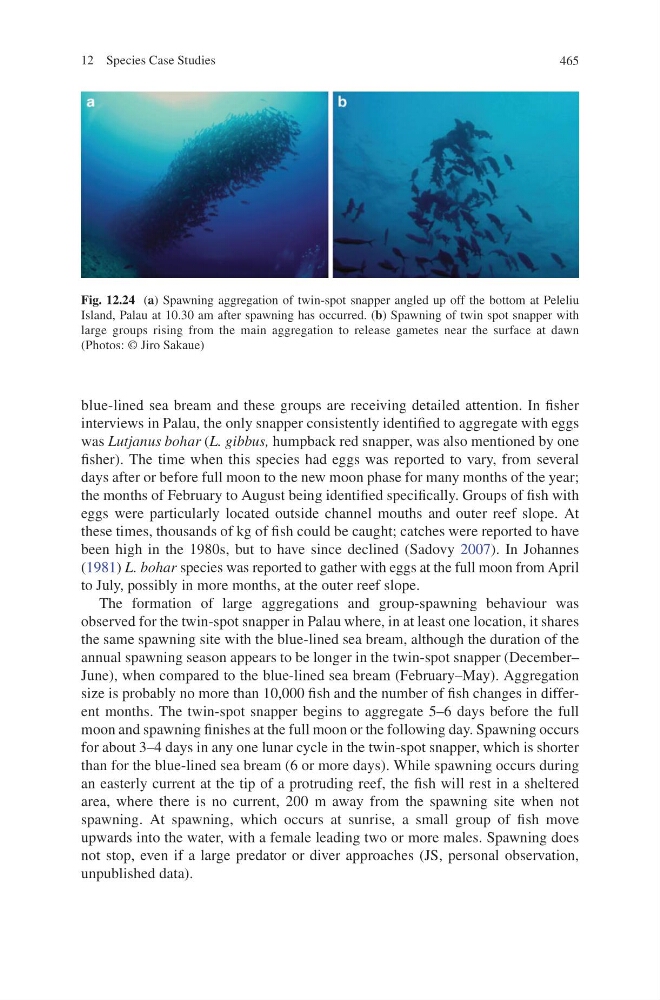
Fig. 12.24 ( a ) Spawning aggregation of twin-spot snapper angled up off the bottom at Peleliu
Island, Palau at 10.30 am after spawning has occurred. ( b ) Spawning of twin spot snapper with
large groups rising from the main aggregation to release gametes near the surface at dawn
(Photos: © Jiro Sakaue)
12 Species Case Studies
blue-lined sea bream and these groups are receiving detailed attention. In fi sher
interviews in Palau, the only snapper consistently identifi ed to aggregate with eggs
was Lutjanus bohar ( L. gibbus, humpback red snapper, was also mentioned by one
fi sher). The time when this species had eggs was reported to vary, from several
days after or before full moon to the new moon phase for many months of the year;
the months of February to August being identifi ed specifi cally. Groups of fi sh with
eggs were particularly located outside channel mouths and outer reef slope. At
these times, thousands of kg of fi sh could be caught; catches were reported to have
been high in the 1980s, but to have since declined (Sadovy 2007 ) . In Johannes
( 1981 ) L. bohar species was reported to gather with eggs at the full moon from April
to July, possibly in more months, at the outer reef slope.
The formation of large aggregations and group-spawning behaviour was
observed for the twin-spot snapper in Palau where, in at least one location, it shares
the same spawning site with the blue-lined sea bream, although the duration of the
annual spawning season appears to be longer in the twin-spot snapper (December–
June), when compared to the blue-lined sea bream (February–May). Aggregation
size is probably no more than 10,000 fi sh and the number of fi sh changes in different months. The twin-spot snapper begins to aggregate 5–6 days before the full
moon and spawning fi nishes at the full moon or the following day. Spawning occurs
for about 3–4 days in any one lunar cycle in the twin-spot snapper, which is shorter
than for the blue-lined sea bream (6 or more days). While spawning occurs during
an easterly current at the tip of a protruding reef, the fi sh will rest in a sheltered
area, where there is no current, 200 m away from the spawning site when not
spawning. At spawning, which occurs at sunrise, a small group of fi sh move
upwards into the water, with a female leading two or more males. Spawning does
not stop, even if a large predator or diver approaches (JS, personal observation,
unpublished data).
Fig. 12.24 ( a ) Spawning aggregation of twin-spot snapper angled up off the bottom at Peleliu
Island, Palau at 10.30 am after spawning has occurred. ( b ) Spawning of twin spot snapper with
large groups rising from the main aggregation to release gametes near the surface at dawn
(Photos: © Jiro Sakaue)