

461
12 Species Case Studies
speared; both sexes were found to be very ripe with hydrated oocytes in females
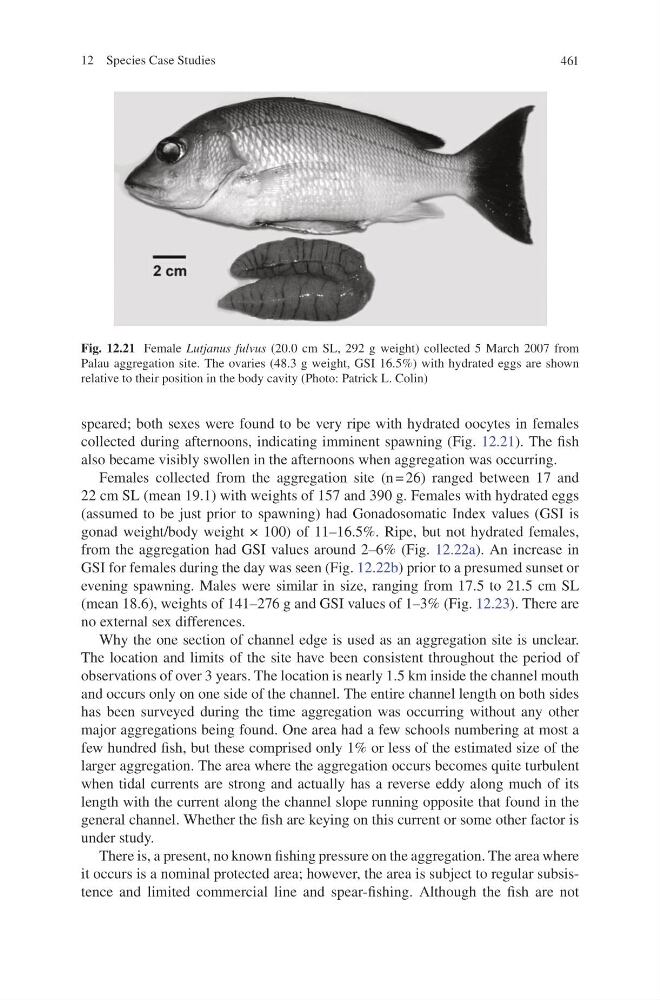
collected during afternoons, indicating imminent spawning (Fig. 12.21 ). The fi sh
also became visibly swollen in the afternoons when aggregation was occurring.
Females collected from the aggregation site (n = 26) ranged between 17 and
22 cm SL (mean 19.1) with weights of 157 and 390 g. Females with hydrated eggs
(assumed to be just prior to spawning) had Gonadosomatic Index values (GSI is
gonad weight/body weight × 100) of 11–16.5%. Ripe, but not hydrated females,
from the aggregation had GSI values around 2–6% (Fig. 12.22a ). An increase in
GSI for females during the day was seen (Fig. 12.22b ) prior to a presumed sunset or
evening spawning. Males were similar in size, ranging from 17.5 to 21.5 cm SL
(mean 18.6), weights of 141–276 g and GSI values of 1–3% (Fig. 12.23 ). There are
no external sex differences.
Why the one section of channel edge is used as an aggregation site is unclear.
The location and limits of the site have been consistent throughout the period of
observations of over 3 years. The location is nearly 1.5 km inside the channel mouth
and occurs only on one side of the channel. The entire channel length on both sides
has been surveyed during the time aggregation was occurring without any other
major aggregations being found. One area had a few schools numbering at most a
few hundred fi sh, but these comprised only 1% or less of the estimated size of the
larger aggregation. The area where the aggregation occurs becomes quite turbulent
when tidal currents are strong and actually has a reverse eddy along much of its
length with the current along the channel slope running opposite that found in the
general channel. Whether the fi sh are keying on this current or some other factor is
under study.
There is, a present, no known fi shing pressure on the aggregation. The area where
it occurs is a nominal protected area; however, the area is subject to regular subsistence and limited commercial line and spear-fi shing. Although the fi sh are not
Fig. 12.21 Female Lutjanus fulvus (20.0 cm SL, 292 g weight) collected 5 March 2007 from
Palau aggregation site. The ovaries (48.3 g weight, GSI 16.5%) with hydrated eggs are shown
relative to their position in the body cavity (Photo: Patrick L. Colin)
12 Species Case Studies
speared; both sexes were found to be very ripe with hydrated oocytes in females
collected during afternoons, indicating imminent spawning (Fig. 12.21 ). The fi sh
also became visibly swollen in the afternoons when aggregation was occurring.
Females collected from the aggregation site (n = 26) ranged between 17 and
22 cm SL (mean 19.1) with weights of 157 and 390 g. Females with hydrated eggs
(assumed to be just prior to spawning) had Gonadosomatic Index values (GSI is
gonad weight/body weight × 100) of 11–16.5%. Ripe, but not hydrated females,
from the aggregation had GSI values around 2–6% (Fig. 12.22a ). An increase in
GSI for females during the day was seen (Fig. 12.22b ) prior to a presumed sunset or
evening spawning. Males were similar in size, ranging from 17.5 to 21.5 cm SL
(mean 18.6), weights of 141–276 g and GSI values of 1–3% (Fig. 12.23 ). There are
no external sex differences.
Why the one section of channel edge is used as an aggregation site is unclear.
The location and limits of the site have been consistent throughout the period of
observations of over 3 years. The location is nearly 1.5 km inside the channel mouth
and occurs only on one side of the channel. The entire channel length on both sides
has been surveyed during the time aggregation was occurring without any other
major aggregations being found. One area had a few schools numbering at most a
few hundred fi sh, but these comprised only 1% or less of the estimated size of the
larger aggregation. The area where the aggregation occurs becomes quite turbulent
when tidal currents are strong and actually has a reverse eddy along much of its
length with the current along the channel slope running opposite that found in the
general channel. Whether the fi sh are keying on this current or some other factor is
under study.
There is, a present, no known fi shing pressure on the aggregation. The area where
it occurs is a nominal protected area; however, the area is subject to regular subsistence and limited commercial line and spear-fi shing. Although the fi sh are not
Fig. 12.21 Female Lutjanus fulvus (20.0 cm SL, 292 g weight) collected 5 March 2007 from
Palau aggregation site. The ovaries (48.3 g weight, GSI 16.5%) with hydrated eggs are shown
relative to their position in the body cavity (Photo: Patrick L. Colin)