

436
12 Species Case Studies
12.6.5 Conservation, Management and Monitoring
Sadovy and Eklund ( 1999 ) and García-Moliner and Sadovy ( 2008 ) concluded that
the Nassau grouper was in urgent need of management throughout much of its
geographic range, at both local and regional levels. Noting that standard fi shery
management measures, such as quotas and size limits are rarely in use for any species throughout the Caribbean, are typically not effective for larger reef species in
multi-species fi sheries, and that enforcement of regulations in tropical reef fi sh
fi sheries is typically weak, they suggested that the greatest protection for such species would likely be afforded by reduction or elimination of fi shing effort or other
controls on effort and gear, especially on spawning aggregations, along with properly sited marine reserves to protect important habitats for juveniles and adult
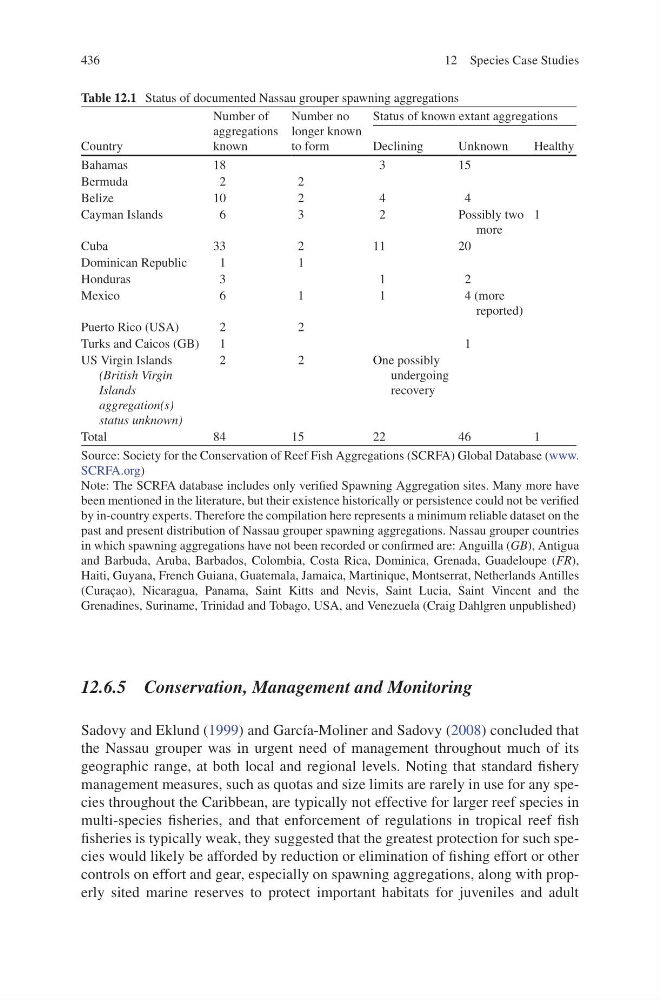
Table 12.1 Status of documented Nassau grouper spawning aggregations
Country
Number of
aggregations
known
Number no
longer known
to form
Status of known extant aggregations
Declining
Unknown
Healthy
Bahamas
18
3
15
Bermuda
2
2
Belize
10
2
4
4
Cayman Islands
6
3
2
Possibly two
more
1
Cuba
33
2
11
20
Dominican Republic
1
1
Honduras
3
1
2
Mexico
6
1
1
4 (more
reported)
Puerto Rico (USA)
2
2
Turks and Caicos (GB)
1
1
US Virgin Islands
(British Virgin
Islands
aggregation(s)
status unknown)
2
2
One possibly
undergoing
recovery
Total
84
15
22
46
1
Source: Society for the Conservation of Reef Fish Aggregations (SCRFA) Global Database ( www.
SCRFA.org )
Note: The SCRFA database includes only verifi ed Spawning Aggregation sites. Many more have
been mentioned in the literature, but their existence historically or persistence could not be verifi ed
by in-country experts. Therefore the compilation here represents a minimum reliable dataset on the
past and present distribution of Nassau grouper spawning aggregations. Nassau grouper countries
in which spawning aggregations have not been recorded or confi rmed are: Anguilla ( GB ), Antigua
and Barbuda, Aruba, Barbados, Colombia, Costa Rica, Dominica, Grenada, Guadeloupe ( FR ),
Haiti, Guyana, French Guiana, Guatemala, Jamaica, Martinique, Montserrat, Netherlands Antilles
(Curaçao), Nicaragua, Panama, Saint Kitts and Nevis, Saint Lucia, Saint Vincent and the
Grenadines, Suriname, Trinidad and Tobago, USA, and Venezuela (Craig Dahlgren unpublished)
12 Species Case Studies
12.6.5 Conservation, Management and Monitoring
Sadovy and Eklund ( 1999 ) and García-Moliner and Sadovy ( 2008 ) concluded that
the Nassau grouper was in urgent need of management throughout much of its
geographic range, at both local and regional levels. Noting that standard fi shery
management measures, such as quotas and size limits are rarely in use for any species throughout the Caribbean, are typically not effective for larger reef species in
multi-species fi sheries, and that enforcement of regulations in tropical reef fi sh
fi sheries is typically weak, they suggested that the greatest protection for such species would likely be afforded by reduction or elimination of fi shing effort or other
controls on effort and gear, especially on spawning aggregations, along with properly sited marine reserves to protect important habitats for juveniles and adult
Table 12.1 Status of documented Nassau grouper spawning aggregations
Country
Number of
aggregations
known
Number no
longer known
to form
Status of known extant aggregations
Declining
Unknown
Healthy
Bahamas
18
3
15
Bermuda
2
2
Belize
10
2
4
4
Cayman Islands
6
3
2
Possibly two
more
1
Cuba
33
2
11
20
Dominican Republic
1
1
Honduras
3
1
2
Mexico
6
1
1
4 (more
reported)
Puerto Rico (USA)
2
2
Turks and Caicos (GB)
1
1
US Virgin Islands
(British Virgin
Islands
aggregation(s)
status unknown)
2
2
One possibly
undergoing
recovery
Total
84
15
22
46
1
Source: Society for the Conservation of Reef Fish Aggregations (SCRFA) Global Database ( www.
SCRFA.org )
Note: The SCRFA database includes only verifi ed Spawning Aggregation sites. Many more have
been mentioned in the literature, but their existence historically or persistence could not be verifi ed
by in-country experts. Therefore the compilation here represents a minimum reliable dataset on the
past and present distribution of Nassau grouper spawning aggregations. Nassau grouper countries
in which spawning aggregations have not been recorded or confi rmed are: Anguilla ( GB ), Antigua
and Barbuda, Aruba, Barbados, Colombia, Costa Rica, Dominica, Grenada, Guadeloupe ( FR ),
Haiti, Guyana, French Guiana, Guatemala, Jamaica, Martinique, Montserrat, Netherlands Antilles
(Curaçao), Nicaragua, Panama, Saint Kitts and Nevis, Saint Lucia, Saint Vincent and the
Grenadines, Suriname, Trinidad and Tobago, USA, and Venezuela (Craig Dahlgren unpublished)