

424
12 Species Case Studies
2008a, b ) . Using sectioned sagittal otoliths from market and aggregation samples,
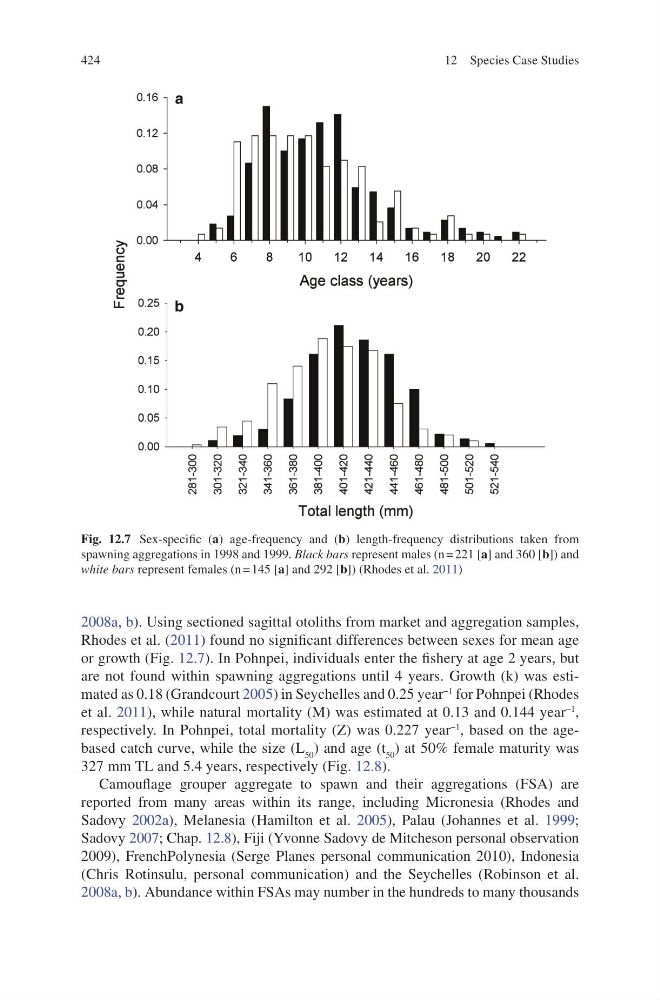
Rhodes et al. ( 2011 ) found no signifi cant differences between sexes for mean age
or growth (Fig. 12.7 ). In Pohnpei, individuals enter the fi shery at age 2 years, but
are not found within spawning aggregations until 4 years. Growth (k) was estimated as 0.18 (Grandcourt 2005 ) in Seychelles and 0.25 year
−1 for Pohnpei (Rhodes
et al. 2011 ) , while natural mortality (M) was estimated at 0.13 and 0.144 year
−1 ,
respectively. In Pohnpei, total mortality (Z) was 0.227 year
−1 , based on the agebased catch curve, while the size (L 50 ) and age (t 50 ) at 50% female maturity was
327 mm TL and 5.4 years, respectively (Fig. 12.8 ).
Camoufl age grouper aggregate to spawn and their aggregations (FSA) are
reported from many areas within its range, including Micronesia (Rhodes and
Sadovy 2002a ) , Melanesia (Hamilton et al. 2005 ) , Palau (Johannes et al. 1999 ;
Sadovy 2007 ; Chap. 12.8 ), Fiji (Yvonne Sadovy de Mitcheson personal observation
2009), FrenchPolynesia (Serge Planes personal communication 2010), Indonesia
(Chris Rotinsulu, personal communication) and the Seychelles (Robinson et al.
2008a, b ) . Abundance within FSAs may number in the hundreds to many thousands
Fig. 12.7 Sex-specifi c ( a ) age-frequency and ( b ) length-frequency distributions taken from
spawning aggregations in 1998 and 1999. Black bars represent males (n = 221 [ a ] and 360 [ b ]) and
white bars represent females (n = 145 [ a ] and 292 [ b ]) (Rhodes et al. 2011 )
12 Species Case Studies
2008a, b ) . Using sectioned sagittal otoliths from market and aggregation samples,
Rhodes et al. ( 2011 ) found no signifi cant differences between sexes for mean age
or growth (Fig. 12.7 ). In Pohnpei, individuals enter the fi shery at age 2 years, but
are not found within spawning aggregations until 4 years. Growth (k) was estimated as 0.18 (Grandcourt 2005 ) in Seychelles and 0.25 year
−1 for Pohnpei (Rhodes
et al. 2011 ) , while natural mortality (M) was estimated at 0.13 and 0.144 year
−1 ,
respectively. In Pohnpei, total mortality (Z) was 0.227 year
−1 , based on the agebased catch curve, while the size (L 50 ) and age (t 50 ) at 50% female maturity was
327 mm TL and 5.4 years, respectively (Fig. 12.8 ).
Camoufl age grouper aggregate to spawn and their aggregations (FSA) are
reported from many areas within its range, including Micronesia (Rhodes and
Sadovy 2002a ) , Melanesia (Hamilton et al. 2005 ) , Palau (Johannes et al. 1999 ;
Sadovy 2007 ; Chap. 12.8 ), Fiji (Yvonne Sadovy de Mitcheson personal observation
2009), FrenchPolynesia (Serge Planes personal communication 2010), Indonesia
(Chris Rotinsulu, personal communication) and the Seychelles (Robinson et al.
2008a, b ) . Abundance within FSAs may number in the hundreds to many thousands
Fig. 12.7 Sex-specifi c ( a ) age-frequency and ( b ) length-frequency distributions taken from
spawning aggregations in 1998 and 1999. Black bars represent males (n = 221 [ a ] and 360 [ b ]) and
white bars represent females (n = 145 [ a ] and 292 [ b ]) (Rhodes et al. 2011 )