

416
12 Species Case Studies
collapse of many spawning aggregations (Olsen and LaPlace 1979 ; Beets and
Friedlander 1992 ; Colin 1992 ) and the resulting commercial extinction of several
important species of groupers throughout the Caribbean (Luckhurst 1996 ; Huntsman
et al. 1999 ; NMFS 1999 ) . Unregulated fi shing on aggregations may have contributed
to a 65–95% decline of commercial grouper landings in Puerto Rico and Bermuda,
respectively (Sadovy and Figuerola 1992 ; Sadovy et al. 1992 ; Luckhurst 1996 ) .
Less dramatic, but equally important, are the subtle effects of fi shing on spawning
aggregations of protogynous species such as decreased average fi sh size, smaller size
at sexual transformation and altered male:female sex ratio to an increased female bias
(Coleman et al. 1996 ) . For example, males of many grouper species, including red
hind, remain higher in the water column defending spawning territories or displaying
to potential mates (Colin et al. 1987 ; Gilmore and Jones 1992 ) . Sex and/or sizeselective fi shing mortality at spawning aggregations will occur when these behaviourally
more dominant males take baited hooks more frequently than females (Gilmore and
Jones 1992 ; Levin and Grimes 2002 ) . Reduced male abundance and mean size may result
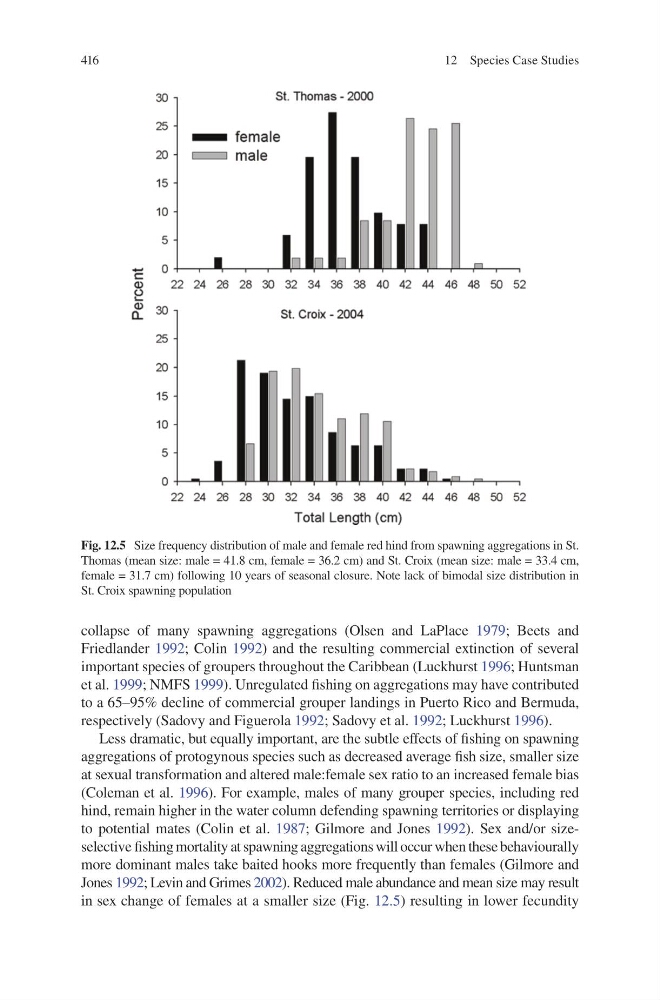
in sex change of females at a smaller size (Fig. 12.5 ) resulting in lower fecundity
Fig. 12.5 Size frequency distribution of male and female red hind from spawning aggregations in St.
Thomas (mean size: male = 41.8 cm, female = 36.2 cm) and St. Croix (mean size: male = 33.4 cm,
female = 31.7 cm) following 10 years of seasonal closure. Note lack of bimodal size distribution in
St. Croix spawning population
12 Species Case Studies
collapse of many spawning aggregations (Olsen and LaPlace 1979 ; Beets and
Friedlander 1992 ; Colin 1992 ) and the resulting commercial extinction of several
important species of groupers throughout the Caribbean (Luckhurst 1996 ; Huntsman
et al. 1999 ; NMFS 1999 ) . Unregulated fi shing on aggregations may have contributed
to a 65–95% decline of commercial grouper landings in Puerto Rico and Bermuda,
respectively (Sadovy and Figuerola 1992 ; Sadovy et al. 1992 ; Luckhurst 1996 ) .
Less dramatic, but equally important, are the subtle effects of fi shing on spawning
aggregations of protogynous species such as decreased average fi sh size, smaller size
at sexual transformation and altered male:female sex ratio to an increased female bias
(Coleman et al. 1996 ) . For example, males of many grouper species, including red
hind, remain higher in the water column defending spawning territories or displaying
to potential mates (Colin et al. 1987 ; Gilmore and Jones 1992 ) . Sex and/or sizeselective fi shing mortality at spawning aggregations will occur when these behaviourally
more dominant males take baited hooks more frequently than females (Gilmore and
Jones 1992 ; Levin and Grimes 2002 ) . Reduced male abundance and mean size may result
in sex change of females at a smaller size (Fig. 12.5 ) resulting in lower fecundity
Fig. 12.5 Size frequency distribution of male and female red hind from spawning aggregations in St.
Thomas (mean size: male = 41.8 cm, female = 36.2 cm) and St. Croix (mean size: male = 33.4 cm,
female = 31.7 cm) following 10 years of seasonal closure. Note lack of bimodal size distribution in
St. Croix spawning population