

390
M.W. Russell et al.
concentrated on a peak aggregation time and location. Since 1988, about 65% of the
annual catch was taken in October from a single spawning aggregation site. Although
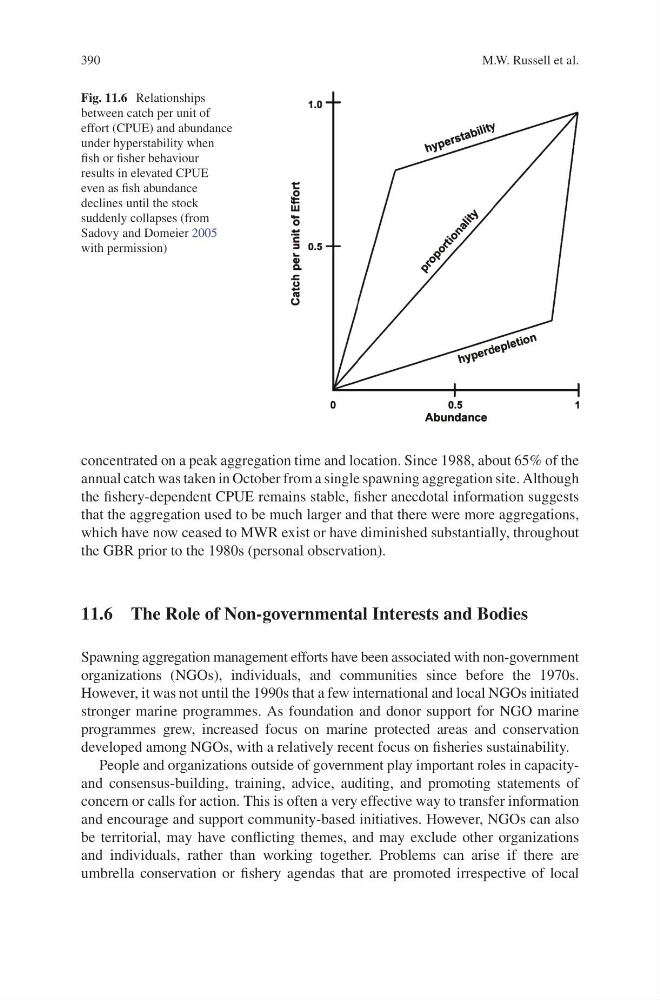
the fi shery-dependent CPUE remains stable, fi sher anecdotal information suggests
that the aggregation used to be much larger and that there were more aggregations,
which have now ceased to MWR exist or have diminished substantially, throughout
the GBR prior to the 1980s (personal observation).
11.6 The Role of Non-governmental Interests and Bodies
Spawning aggregation management efforts have been associated with non-government
organizations (NGOs), individuals, and communities since before the 1970s.
However, it was not until the 1990s that a few international and local NGOs initiated
stronger marine programmes. As foundation and donor support for NGO marine
programmes grew, increased focus on marine protected areas and conservation
developed among NGOs, with a relatively recent focus on fi sheries sustainability.
People and organizations outside of government play important roles in capacityand consensus-building, training, advice, auditing, and promoting statements of
concern or calls for action. This is often a very effective way to transfer information
and encourage and support community-based initiatives. However, NGOs can also
be territorial, may have confl icting themes, and may exclude other organizations
and individuals, rather than working together. Problems can arise if there are
umbrella conservation or fi shery agendas that are promoted irrespective of local
Fig. 11.6 Relationships
between catch per unit of
effort (CPUE) and abundance
under hyperstability when
fi sh or fi sher behaviour
results in elevated CPUE
even as fi sh abundance
declines until the stock
suddenly collapses (from
Sadovy and Domeier 2005
with permission)
M.W. Russell et al.
concentrated on a peak aggregation time and location. Since 1988, about 65% of the
annual catch was taken in October from a single spawning aggregation site. Although
the fi shery-dependent CPUE remains stable, fi sher anecdotal information suggests
that the aggregation used to be much larger and that there were more aggregations,
which have now ceased to MWR exist or have diminished substantially, throughout
the GBR prior to the 1980s (personal observation).
11.6 The Role of Non-governmental Interests and Bodies
Spawning aggregation management efforts have been associated with non-government
organizations (NGOs), individuals, and communities since before the 1970s.
However, it was not until the 1990s that a few international and local NGOs initiated
stronger marine programmes. As foundation and donor support for NGO marine
programmes grew, increased focus on marine protected areas and conservation
developed among NGOs, with a relatively recent focus on fi sheries sustainability.
People and organizations outside of government play important roles in capacityand consensus-building, training, advice, auditing, and promoting statements of
concern or calls for action. This is often a very effective way to transfer information
and encourage and support community-based initiatives. However, NGOs can also
be territorial, may have confl icting themes, and may exclude other organizations
and individuals, rather than working together. Problems can arise if there are
umbrella conservation or fi shery agendas that are promoted irrespective of local
Fig. 11.6 Relationships
between catch per unit of
effort (CPUE) and abundance
under hyperstability when
fi sh or fi sher behaviour
results in elevated CPUE
even as fi sh abundance
declines until the stock
suddenly collapses (from
Sadovy and Domeier 2005
with permission)