

338
R. Hamilton et al.
resident aggregations on a regular, even daily basis, for much of the year and at
specifi c sites; LEK does not tend to readily identify such species as aggregation
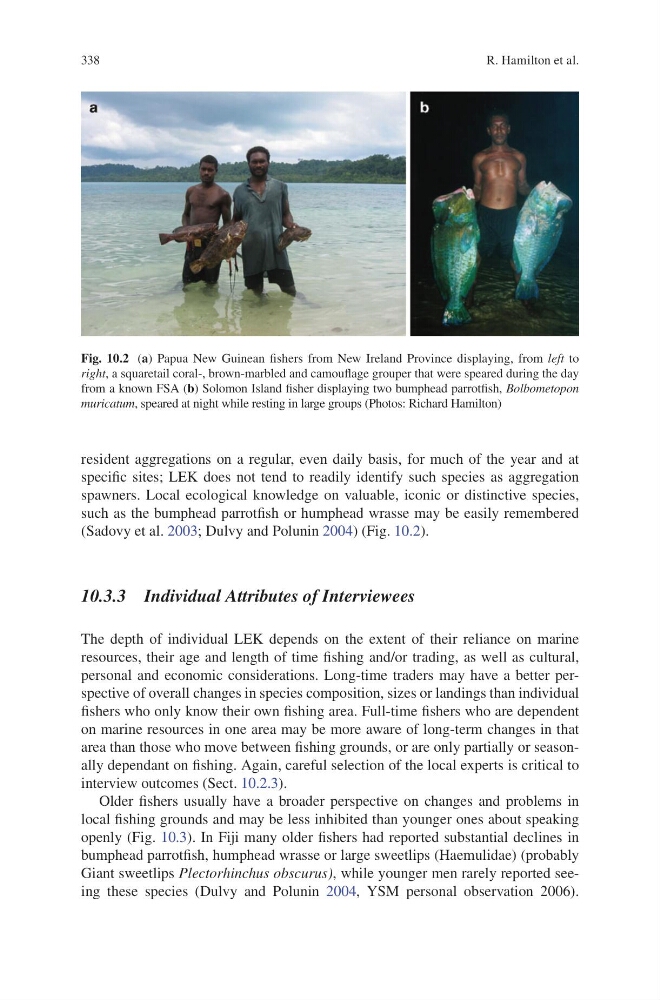
spawners. Local ecological knowledge on valuable, iconic or distinctive species,
such as the bumphead parrotfi sh or humphead wrasse may be easily remembered
(Sadovy et al. 2003 ; Dulvy and Polunin 2004 ) (Fig. 10.2 ).
10.3.3 Individual Attributes of Interviewees
The depth of individual LEK depends on the extent of their reliance on marine
resources, their age and length of time fi shing and/or trading, as well as cultural,
personal and economic considerations. Long-time traders may have a better perspective of overall changes in species composition, sizes or landings than individual
fi shers who only know their own fi shing area. Full-time fi shers who are dependent
on marine resources in one area may be more aware of long-term changes in that
area than those who move between fi shing grounds, or are only partially or seasonally dependant on fi shing. Again, careful selection of the local experts is critical to
interview outcomes (Sect. 10.2.3 ).
Older fi shers usually have a broader perspective on changes and problems in
local fi shing grounds and may be less inhibited than younger ones about speaking
openly (Fig. 10.3 ). In Fiji many older fi shers had reported substantial declines in
bumphead parrotfi sh, humphead wrasse or large sweetlips (Haemulidae) (probably
Giant sweetlips Plectorhinchus obscurus) , while younger men rarely reported seeing these species (Dulvy and Polunin 2004 , YSM personal observation 2006).
Fig. 10.2 ( a ) Papua New Guinean fi shers from New Ireland Province displaying, from left to
right , a squaretail coral-, brown-marbled and camoufl age grouper that were speared during the day
from a known FSA ( b ) Solomon Island fi sher displaying two bumphead parrotfi sh, Bolbometopon
muricatum , speared at night while resting in large groups (Photos: Richard Hamilton)
R. Hamilton et al.
resident aggregations on a regular, even daily basis, for much of the year and at
specifi c sites; LEK does not tend to readily identify such species as aggregation
spawners. Local ecological knowledge on valuable, iconic or distinctive species,
such as the bumphead parrotfi sh or humphead wrasse may be easily remembered
(Sadovy et al. 2003 ; Dulvy and Polunin 2004 ) (Fig. 10.2 ).
10.3.3 Individual Attributes of Interviewees
The depth of individual LEK depends on the extent of their reliance on marine
resources, their age and length of time fi shing and/or trading, as well as cultural,
personal and economic considerations. Long-time traders may have a better perspective of overall changes in species composition, sizes or landings than individual
fi shers who only know their own fi shing area. Full-time fi shers who are dependent
on marine resources in one area may be more aware of long-term changes in that
area than those who move between fi shing grounds, or are only partially or seasonally dependant on fi shing. Again, careful selection of the local experts is critical to
interview outcomes (Sect. 10.2.3 ).
Older fi shers usually have a broader perspective on changes and problems in
local fi shing grounds and may be less inhibited than younger ones about speaking
openly (Fig. 10.3 ). In Fiji many older fi shers had reported substantial declines in
bumphead parrotfi sh, humphead wrasse or large sweetlips (Haemulidae) (probably
Giant sweetlips Plectorhinchus obscurus) , while younger men rarely reported seeing these species (Dulvy and Polunin 2004 , YSM personal observation 2006).
Fig. 10.2 ( a ) Papua New Guinean fi shers from New Ireland Province displaying, from left to
right , a squaretail coral-, brown-marbled and camoufl age grouper that were speared during the day
from a known FSA ( b ) Solomon Island fi sher displaying two bumphead parrotfi sh, Bolbometopon
muricatum , speared at night while resting in large groups (Photos: Richard Hamilton)