

336
R. Hamilton et al.
from one or more community peers, or responses from a large sample of resource-users
to select experts are useful (Ferguson and Messier 1997 ; Olsson and Folke 2001 ) .
‘Snowballing’ is often used to identify additional experts whereby, at the end of an
interview; fi shers are asked to give the name(s) of other fi shers experienced and
knowledgeable in the area or species of interest (Neis et al. 1999b ) . Sadovy and
Cheung ( 2003 ) had to interview everybody they could fi nd with knowledge of the
giant yellow croaker, Bahaba taipingensis , as few fi shers of this species were still
surviving, whereas, when looking at historical changes in a fi shery, selection of
patriarch or locally respected, often older, fi shers is preferable (Johannes and
Yeeting 2001 ; Alves et al. 2005 ; Gass and Willison 2005 ; Fraser et al. 2006 ) . In
Brazil, interviews revealed just a small number of “goliath grouper experts”
( Epinephelus itajara ), in each community, with referrals for interviews rapidly
converging on just a few names (Gerhardinger et al. 2006 ) .
10.3 The Data Collection Process
In this section, we examine methods for conducting and assessing interviews and
other informal sources of information. Specifi cally, we examine how to select
interviewees, some of the challenges of data gathering and interpretation, and
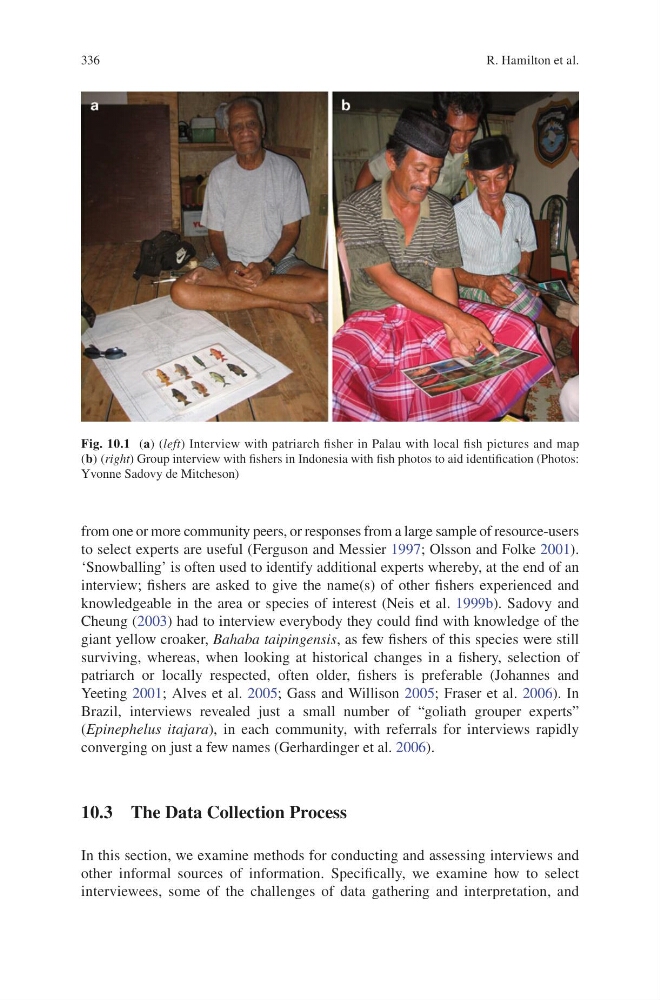
Fig. 10.1 ( a ) ( left ) Interview with patriarch fi sher in Palau with local fi sh pictures and map
( b ) ( right ) Group interview with fi shers in Indonesia with fi sh photos to aid identifi cation (Photos:
Yvonne Sadovy de Mitcheson)
R. Hamilton et al.
from one or more community peers, or responses from a large sample of resource-users
to select experts are useful (Ferguson and Messier 1997 ; Olsson and Folke 2001 ) .
‘Snowballing’ is often used to identify additional experts whereby, at the end of an
interview; fi shers are asked to give the name(s) of other fi shers experienced and
knowledgeable in the area or species of interest (Neis et al. 1999b ) . Sadovy and
Cheung ( 2003 ) had to interview everybody they could fi nd with knowledge of the
giant yellow croaker, Bahaba taipingensis , as few fi shers of this species were still
surviving, whereas, when looking at historical changes in a fi shery, selection of
patriarch or locally respected, often older, fi shers is preferable (Johannes and
Yeeting 2001 ; Alves et al. 2005 ; Gass and Willison 2005 ; Fraser et al. 2006 ) . In
Brazil, interviews revealed just a small number of “goliath grouper experts”
( Epinephelus itajara ), in each community, with referrals for interviews rapidly
converging on just a few names (Gerhardinger et al. 2006 ) .
10.3 The Data Collection Process
In this section, we examine methods for conducting and assessing interviews and
other informal sources of information. Specifi cally, we examine how to select
interviewees, some of the challenges of data gathering and interpretation, and
Fig. 10.1 ( a ) ( left ) Interview with patriarch fi sher in Palau with local fi sh pictures and map
( b ) ( right ) Group interview with fi shers in Indonesia with fi sh photos to aid identifi cation (Photos:
Yvonne Sadovy de Mitcheson)