

310
P.L. Colin
needed to cover all or the majority of an aggregation site and take into account
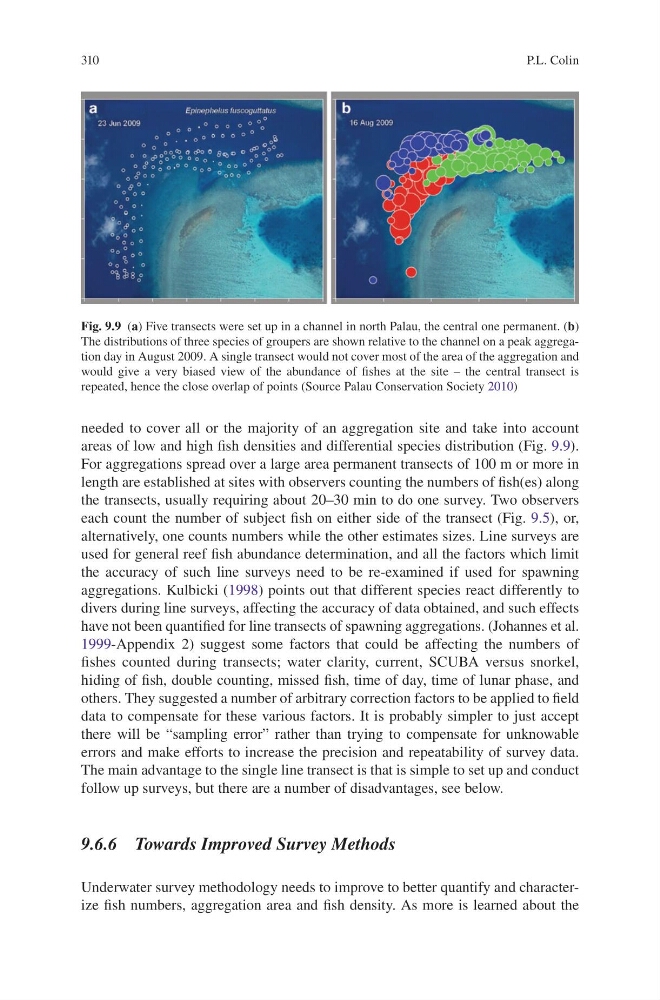
areas of low and high fi sh densities and differential species distribution (Fig. 9.9 ).
For aggregations spread over a large area permanent transects of 100 m or more in
length are established at sites with observers counting the numbers of fi sh(es) along
the transects, usually requiring about 20–30 min to do one survey. Two observers
each count the number of subject fi sh on either side of the transect (Fig. 9.5 ), or,
alternatively, one counts numbers while the other estimates sizes. Line surveys are
used for general reef fi sh abundance determination, and all the factors which limit
the accuracy of such line surveys need to be re-examined if used for spawning
aggregations. Kulbicki ( 1998 ) points out that different species react differently to
divers during line surveys, affecting the accuracy of data obtained, and such effects
have not been quantifi ed for line transects of spawning aggregations. (Johannes et al.
1999 -Appendix 2) suggest some factors that could be affecting the numbers of
fi shes counted during transects; water clarity, current, SCUBA versus snorkel,
hiding of fi sh, double counting, missed fi sh, time of day, time of lunar phase, and
others. They suggested a number of arbitrary correction factors to be applied to fi eld
data to compensate for these various factors. It is probably simpler to just accept
there will be “sampling error” rather than trying to compensate for unknowable
errors and make efforts to increase the precision and repeatability of survey data.
The main advantage to the single line transect is that is simple to set up and conduct
follow up surveys, but there are a number of disadvantages, see below.
9.6.6 Towards Improved Survey Methods
Underwater survey methodology needs to improve to better quantify and characterize fi sh numbers, aggregation area and fi sh density. As more is learned about the
Fig. 9.9 ( a ) Five transects were set up in a channel in north Palau, the central one permanent. ( b )
The distributions of three species of groupers are shown relative to the channel on a peak aggregation day in August 2009. A single transect would not cover most of the area of the aggregation and
would give a very biased view of the abundance of fi shes at the site – the central transect is
repeated, hence the close overlap of points (Source Palau Conservation Society 2010 )
P.L. Colin
needed to cover all or the majority of an aggregation site and take into account
areas of low and high fi sh densities and differential species distribution (Fig. 9.9 ).
For aggregations spread over a large area permanent transects of 100 m or more in
length are established at sites with observers counting the numbers of fi sh(es) along
the transects, usually requiring about 20–30 min to do one survey. Two observers
each count the number of subject fi sh on either side of the transect (Fig. 9.5 ), or,
alternatively, one counts numbers while the other estimates sizes. Line surveys are
used for general reef fi sh abundance determination, and all the factors which limit
the accuracy of such line surveys need to be re-examined if used for spawning
aggregations. Kulbicki ( 1998 ) points out that different species react differently to
divers during line surveys, affecting the accuracy of data obtained, and such effects
have not been quantifi ed for line transects of spawning aggregations. (Johannes et al.
1999 -Appendix 2) suggest some factors that could be affecting the numbers of
fi shes counted during transects; water clarity, current, SCUBA versus snorkel,
hiding of fi sh, double counting, missed fi sh, time of day, time of lunar phase, and
others. They suggested a number of arbitrary correction factors to be applied to fi eld
data to compensate for these various factors. It is probably simpler to just accept
there will be “sampling error” rather than trying to compensate for unknowable
errors and make efforts to increase the precision and repeatability of survey data.
The main advantage to the single line transect is that is simple to set up and conduct
follow up surveys, but there are a number of disadvantages, see below.
9.6.6 Towards Improved Survey Methods
Underwater survey methodology needs to improve to better quantify and characterize fi sh numbers, aggregation area and fi sh density. As more is learned about the
Fig. 9.9 ( a ) Five transects were set up in a channel in north Palau, the central one permanent. ( b )
The distributions of three species of groupers are shown relative to the channel on a peak aggregation day in August 2009. A single transect would not cover most of the area of the aggregation and
would give a very biased view of the abundance of fi shes at the site – the central transect is
repeated, hence the close overlap of points (Source Palau Conservation Society 2010 )