

294
P.L. Colin
need to catch and process fi sh. In the absence of direct spawning observations,
gonad condition, especially the presence of hydrated oocytes or post ovulatory
follicles (the latter needs to be determined using histology) can be considered direct
evidence of spawning (e.g. West 1990 ) . Often gonads are discarded as fi sh are
cleaned, but for some species they are a prized portion saved by fi shers, which can
make them costly or diffi cult to obtain. Sex can often be determined by externally,
and gently, squeezing the body cavity of the fi sh. Milt (sperm) will often be exuded
in ripe males, while if ready to spawn hydrated eggs may pour out of the genital
opening of females. However, there is a period very shortly before spawning when
eggs cannot easily be extruded due to tightening of the oviduct musculature at the
vent. Fish can also be cannulated, if it is important not to kill them (being tagged or
for conservation reasons) and sex and condition of the gonad determined. Samples
may be preserved for histology, often requiring subsampling of the gonad, and preserved in Davidson’s solution (or in its absence 10% formalin). Timing of spawning
can be estimated from fresh gonad samples taken hourly over a period of time
(Rhodes and Sadovy 2002a, b )
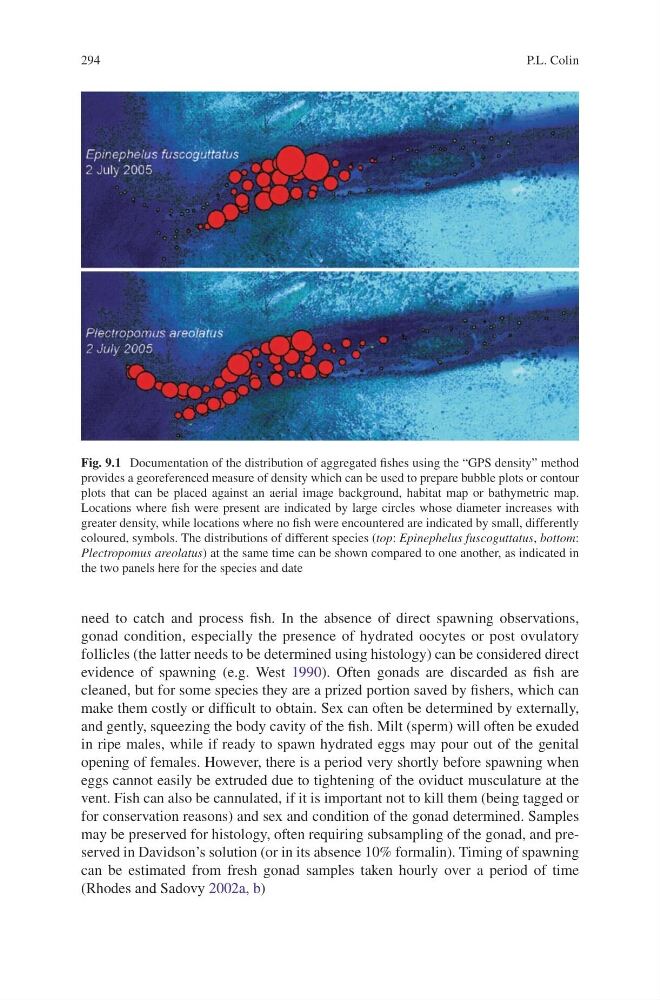
Fig. 9.1 Documentation of the distribution of aggregated fi shes using the “GPS density” method
provides a georeferenced measure of density which can be used to prepare bubble plots or contour
plots that can be placed against an aerial image background, habitat map or bathymetric map.
Locations where fi sh were present are indicated by large circles whose diameter increases with
greater density, while locations where no fi sh were encountered are indicated by small, differently
coloured, symbols. The distributions of different species ( top : Epinephelus fuscoguttatus , bottom :
Plectropomus areolatus ) at the same time can be shown compared to one another, as indicated in
the two panels here for the species and date
P.L. Colin
need to catch and process fi sh. In the absence of direct spawning observations,
gonad condition, especially the presence of hydrated oocytes or post ovulatory
follicles (the latter needs to be determined using histology) can be considered direct
evidence of spawning (e.g. West 1990 ) . Often gonads are discarded as fi sh are
cleaned, but for some species they are a prized portion saved by fi shers, which can
make them costly or diffi cult to obtain. Sex can often be determined by externally,
and gently, squeezing the body cavity of the fi sh. Milt (sperm) will often be exuded
in ripe males, while if ready to spawn hydrated eggs may pour out of the genital
opening of females. However, there is a period very shortly before spawning when
eggs cannot easily be extruded due to tightening of the oviduct musculature at the
vent. Fish can also be cannulated, if it is important not to kill them (being tagged or
for conservation reasons) and sex and condition of the gonad determined. Samples
may be preserved for histology, often requiring subsampling of the gonad, and preserved in Davidson’s solution (or in its absence 10% formalin). Timing of spawning
can be estimated from fresh gonad samples taken hourly over a period of time
(Rhodes and Sadovy 2002a, b )
Fig. 9.1 Documentation of the distribution of aggregated fi shes using the “GPS density” method
provides a georeferenced measure of density which can be used to prepare bubble plots or contour
plots that can be placed against an aerial image background, habitat map or bathymetric map.
Locations where fi sh were present are indicated by large circles whose diameter increases with
greater density, while locations where no fi sh were encountered are indicated by small, differently
coloured, symbols. The distributions of different species ( top : Epinephelus fuscoguttatus , bottom :
Plectropomus areolatus ) at the same time can be shown compared to one another, as indicated in
the two panels here for the species and date