

268
Y. Sadovy de Mitcheson and B. Erisman
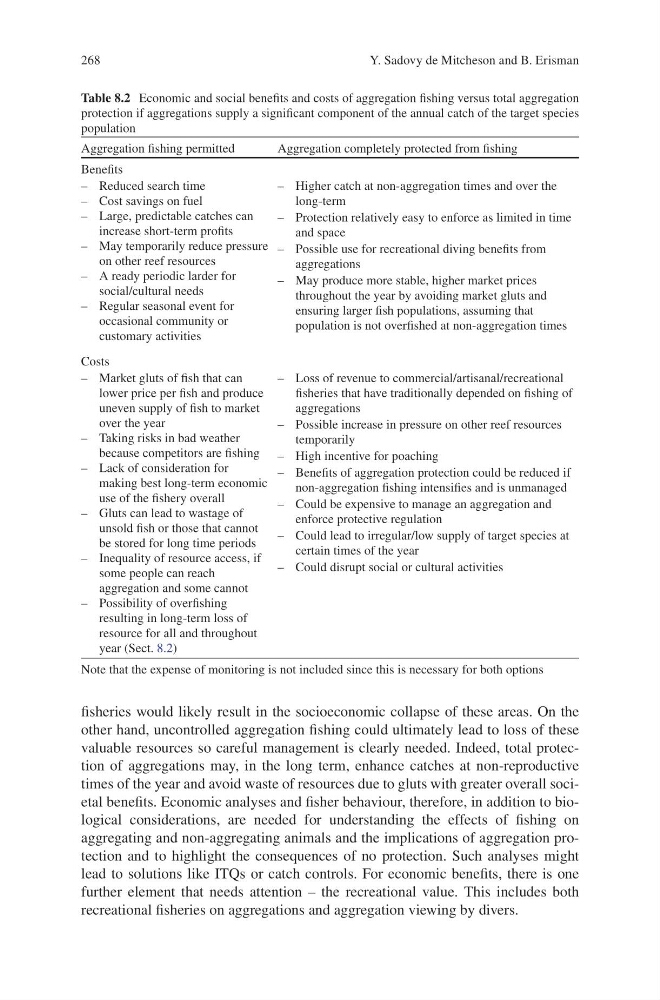
Table 8.2 Economic and social benefi ts and costs of aggregation fi shing versus total aggregation
protection if aggregations supply a signifi cant component of the annual catch of the target species
population
Aggregation fi shing permitted
Aggregation completely protected from fi shing
Benefi ts
– Reduced search time
– Cost savings on fuel
– Large, predictable catches can
increase short-term profi ts
– May temporarily reduce pressure
on other reef resources
– A ready periodic larder for
social/cultural needs
– Regular seasonal event for
occasional community or
customary activities
– Higher catch at non-aggregation times and over the
long-term
– Protection relatively easy to enforce as limited in time
and space
– Possible use for recreational diving benefi ts from
aggregations
– May produce more stable, higher market prices
throughout the year by avoiding market gluts and
ensuring larger fi sh populations, assuming that
population is not overfi shed at non-aggregation times
Costs
– Market gluts of fi sh that can
lower price per fi sh and produce
uneven supply of fi sh to market
over the year
– Taking risks in bad weather
because competitors are fi shing
– Lack of consideration for
making best long-term economic
use of the fi shery overall
– Gluts can lead to wastage of
unsold fi sh or those that cannot
be stored for long time periods
– Inequality of resource access, if
some people can reach
aggregation and some cannot
– Possibility of overfi shing
resulting in long-term loss of
resource for all and throughout
year (Sect. 8.2 )
– Loss of revenue to commercial/artisanal/recreational
fi sheries that have traditionally depended on fi shing of
aggregations
– Possible increase in pressure on other reef resources
temporarily
– High incentive for poaching
– Benefi ts of aggregation protection could be reduced if
non-aggregation fi shing intensifi es and is unmanaged
– Could be expensive to manage an aggregation and
enforce protective regulation
– Could lead to irregular/low supply of target species at
certain times of the year
– Could disrupt social or cultural activities
Note that the expense of monitoring is not included since this is necessary for both options
fi sheries would likely result in the socioeconomic collapse of these areas. On the
other hand, uncontrolled aggregation fi shing could ultimately lead to loss of these
valuable resources so careful management is clearly needed. Indeed, total protection of aggregations may, in the long term, enhance catches at non-reproductive
times of the year and avoid waste of resources due to gluts with greater overall societal benefi ts. Economic analyses and fi sher behaviour, therefore, in addition to biological considerations, are needed for understanding the effects of fi shing on
aggregating and non-aggregating animals and the implications of aggregation protection and to highlight the consequences of no protection. Such analyses might
lead to solutions like ITQs or catch controls. For economic benefi ts, there is one
further element that needs attention – the recreational value. This includes both
recreational fi sheries on aggregations and aggregation viewing by divers.
Y. Sadovy de Mitcheson and B. Erisman
Table 8.2 Economic and social benefi ts and costs of aggregation fi shing versus total aggregation
protection if aggregations supply a signifi cant component of the annual catch of the target species
population
Aggregation fi shing permitted
Aggregation completely protected from fi shing
Benefi ts
– Reduced search time
– Cost savings on fuel
– Large, predictable catches can
increase short-term profi ts
– May temporarily reduce pressure
on other reef resources
– A ready periodic larder for
social/cultural needs
– Regular seasonal event for
occasional community or
customary activities
– Higher catch at non-aggregation times and over the
long-term
– Protection relatively easy to enforce as limited in time
and space
– Possible use for recreational diving benefi ts from
aggregations
– May produce more stable, higher market prices
throughout the year by avoiding market gluts and
ensuring larger fi sh populations, assuming that
population is not overfi shed at non-aggregation times
Costs
– Market gluts of fi sh that can
lower price per fi sh and produce
uneven supply of fi sh to market
over the year
– Taking risks in bad weather
because competitors are fi shing
– Lack of consideration for
making best long-term economic
use of the fi shery overall
– Gluts can lead to wastage of
unsold fi sh or those that cannot
be stored for long time periods
– Inequality of resource access, if
some people can reach
aggregation and some cannot
– Possibility of overfi shing
resulting in long-term loss of
resource for all and throughout
year (Sect. 8.2 )
– Loss of revenue to commercial/artisanal/recreational
fi sheries that have traditionally depended on fi shing of
aggregations
– Possible increase in pressure on other reef resources
temporarily
– High incentive for poaching
– Benefi ts of aggregation protection could be reduced if
non-aggregation fi shing intensifi es and is unmanaged
– Could be expensive to manage an aggregation and
enforce protective regulation
– Could lead to irregular/low supply of target species at
certain times of the year
– Could disrupt social or cultural activities
Note that the expense of monitoring is not included since this is necessary for both options
fi sheries would likely result in the socioeconomic collapse of these areas. On the
other hand, uncontrolled aggregation fi shing could ultimately lead to loss of these
valuable resources so careful management is clearly needed. Indeed, total protection of aggregations may, in the long term, enhance catches at non-reproductive
times of the year and avoid waste of resources due to gluts with greater overall societal benefi ts. Economic analyses and fi sher behaviour, therefore, in addition to biological considerations, are needed for understanding the effects of fi shing on
aggregating and non-aggregating animals and the implications of aggregation protection and to highlight the consequences of no protection. Such analyses might
lead to solutions like ITQs or catch controls. For economic benefi ts, there is one
further element that needs attention – the recreational value. This includes both
recreational fi sheries on aggregations and aggregation viewing by divers.