

261
8 Fishery and Biological Implications of Fishing Spawning Aggregations…
Effects in commercial fi shery species, data at small population sizes are few and the
possibility cannot be ignored (Myers et al. 1995 ) .
If one of the adaptive values of congregating to spawn is to bring together males
and females within a complex mating system, or for mate selection, major deviations from the natural abundances, body sizes, or adult sex ratios within spawning
aggregations may be important. Extensive disruption of mating behaviour due to
fi shing is also possible. Such changes could potentially result in signifi cant declines
in reproductive output that translate into disproportionately lowered population
growth rates, i.e. an Allee Effect. For example, queen conch ( Strombus gigas ) normally aggregates to mate but spawning ceases below a threshold density of 48 individuals ha
−1 (Stoner and Ray-Culp 2000 ) . Densities are known to be important in
determining the prevalence of group- versus pair-spawning in an area, for example
in the bluehead wrasse (Chap. 12.14 ).
A decrease in the number of breeding males per female and reduction in sperm
concentration could result in lowered numbers of fertilizations and a reduced population size. Sperm limitation may be a signifi cant barrier to the recovery of overfi shed
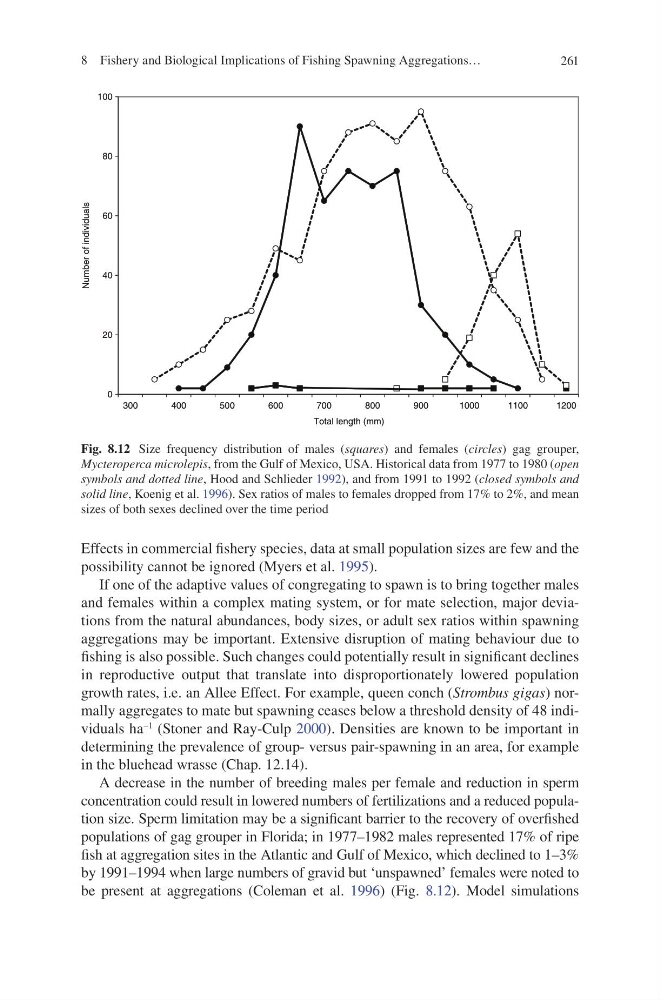
populations of gag grouper in Florida; in 1977–1982 males represented 17% of ripe
fi sh at aggregation sites in the Atlantic and Gulf of Mexico, which declined to 1–3%
by 1991–1994 when large numbers of gravid but ‘unspawned’ females were noted to
be present at aggregations (Coleman et al. 1996 ) (Fig. 8.12 ). Model simulations
0
20
40
60
80
100
300
400
500
600
700
800
900
1000
1100
1200
Number of individuals
Total length (mm)
Fig. 8.12 Size frequency distribution of males ( squares ) and females ( circles ) gag grouper,
Mycteroperca microlepis , from the Gulf of Mexico, USA. Historical data from 1977 to 1980 ( open
symbols and dotted line , Hood and Schlieder 1992 ) , and from 1991 to 1992 ( closed symbols and
solid line , Koenig et al. 1996 ) . Sex ratios of males to females dropped from 17% to 2%, and mean
sizes of both sexes declined over the time period
8 Fishery and Biological Implications of Fishing Spawning Aggregations…
Effects in commercial fi shery species, data at small population sizes are few and the
possibility cannot be ignored (Myers et al. 1995 ) .
If one of the adaptive values of congregating to spawn is to bring together males
and females within a complex mating system, or for mate selection, major deviations from the natural abundances, body sizes, or adult sex ratios within spawning
aggregations may be important. Extensive disruption of mating behaviour due to
fi shing is also possible. Such changes could potentially result in signifi cant declines
in reproductive output that translate into disproportionately lowered population
growth rates, i.e. an Allee Effect. For example, queen conch ( Strombus gigas ) normally aggregates to mate but spawning ceases below a threshold density of 48 individuals ha
−1 (Stoner and Ray-Culp 2000 ) . Densities are known to be important in
determining the prevalence of group- versus pair-spawning in an area, for example
in the bluehead wrasse (Chap. 12.14 ).
A decrease in the number of breeding males per female and reduction in sperm
concentration could result in lowered numbers of fertilizations and a reduced population size. Sperm limitation may be a signifi cant barrier to the recovery of overfi shed
populations of gag grouper in Florida; in 1977–1982 males represented 17% of ripe
fi sh at aggregation sites in the Atlantic and Gulf of Mexico, which declined to 1–3%
by 1991–1994 when large numbers of gravid but ‘unspawned’ females were noted to
be present at aggregations (Coleman et al. 1996 ) (Fig. 8.12 ). Model simulations
0
20
40
60
80
100
300
400
500
600
700
800
900
1000
1100
1200
Number of individuals
Total length (mm)
Fig. 8.12 Size frequency distribution of males ( squares ) and females ( circles ) gag grouper,
Mycteroperca microlepis , from the Gulf of Mexico, USA. Historical data from 1977 to 1980 ( open
symbols and dotted line , Hood and Schlieder 1992 ) , and from 1991 to 1992 ( closed symbols and
solid line , Koenig et al. 1996 ) . Sex ratios of males to females dropped from 17% to 2%, and mean
sizes of both sexes declined over the time period