

258
Y. Sadovy de Mitcheson and B. Erisman
within a single or a few spawning seasons (Johannes and Riepen 1995 ; Hamilton et al.
2005 ) . Serial depletions from fi shing are likely a major contributor to the complete
disappearance of a target species from larger regions (seventy-four Chale-Matsau et al.
2001 , orange roughy Clark 2001 , large yellow croaker Liu and Sadovy de Mitcheson
2008 , Epinephelus quinquefasciatus = itajara, Sala et al. 2004 , Nassau grouper Sadovy
and Eklund 1999 ; Sala et al. 2001 ; Aguilar-Perera 2007 ; Claro et al. 2009 ) .
Sex-specifi c differences in the temporal movement patterns of fi sh into, out from,
and around aggregation sites can interact with fi shing in ways that can alter adult sex
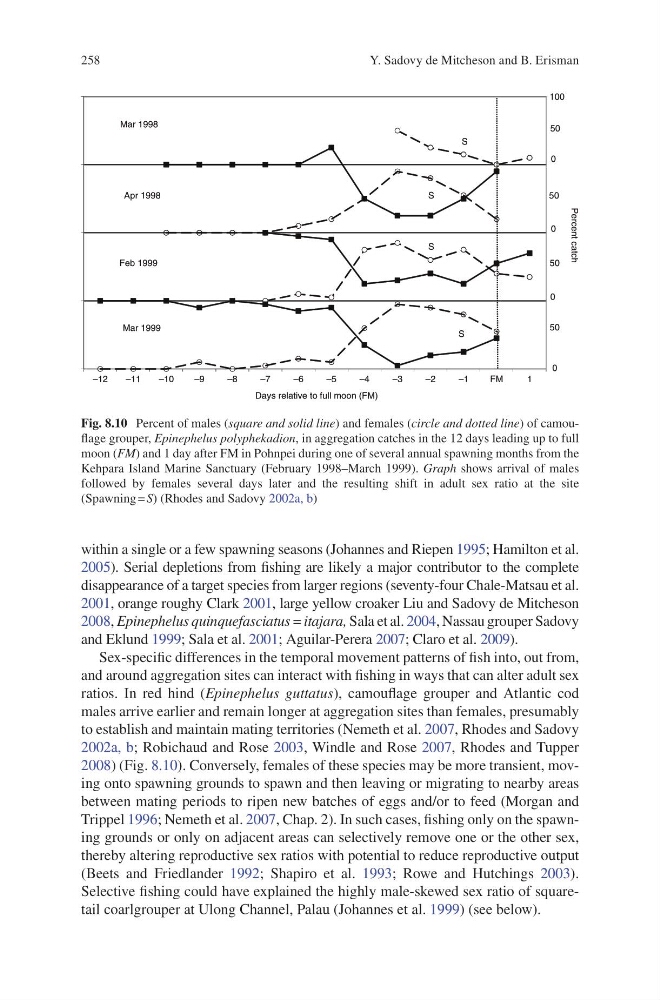
ratios. In red hind ( Epinephelus guttatus ), camoufl age grouper and Atlantic cod
males arrive earlier and remain longer at aggregation sites than females, presumably
to establish and maintain mating territories (Nemeth et al. 2007 , Rhodes and Sadovy
2002a, b ; Robichaud and Rose 2003 , Windle and Rose 2007 , Rhodes and Tupper
2008 ) (Fig. 8.10 ). Conversely, females of these species may be more transient, moving onto spawning grounds to spawn and then leaving or migrating to nearby areas
between mating periods to ripen new batches of eggs and/or to feed (Morgan and
Trippel 1996 ; Nemeth et al. 2007 , Chap. 2 ). In such cases, fi shing only on the spawning grounds or only on adjacent areas can selectively remove one or the other sex,
thereby altering reproductive sex ratios with potential to reduce reproductive output
(Beets and Friedlander 1992 ; Shapiro et al. 1993 ; Rowe and Hutchings 2003 ) .
Selective fi shing could have explained the highly male-skewed sex ratio of squaretail coarlgrouper at Ulong Channel, Palau (Johannes et al. 1999 ) (see below).
–12
–11
–10
–9
–8
–7
–6
–5
–4
–3
–2
–1
FM
1
Percent catch
Days relative to full moon (FM)
100
50
0
50
0
50
50
0
0
Mar 1998
Apr 1998
Feb 1999
Mar 1999
S
S
S
S
Fig. 8.10 Percent of males ( square and solid line ) and females ( circle and dotted line ) of camoufl age grouper, Epinephelus polyphekadion , in aggregation catches in the 12 days leading up to full
moon ( FM ) and 1 day after FM in Pohnpei during one of several annual spawning months from the
Kehpara Island Marine Sanctuary (February 1998–March 1999). Graph shows arrival of males
followed by females several days later and the resulting shift in adult sex ratio at the site
(Spawning = S ) (Rhodes and Sadovy 2002a, b )
Y. Sadovy de Mitcheson and B. Erisman
within a single or a few spawning seasons (Johannes and Riepen 1995 ; Hamilton et al.
2005 ) . Serial depletions from fi shing are likely a major contributor to the complete
disappearance of a target species from larger regions (seventy-four Chale-Matsau et al.
2001 , orange roughy Clark 2001 , large yellow croaker Liu and Sadovy de Mitcheson
2008 , Epinephelus quinquefasciatus = itajara, Sala et al. 2004 , Nassau grouper Sadovy
and Eklund 1999 ; Sala et al. 2001 ; Aguilar-Perera 2007 ; Claro et al. 2009 ) .
Sex-specifi c differences in the temporal movement patterns of fi sh into, out from,
and around aggregation sites can interact with fi shing in ways that can alter adult sex
ratios. In red hind ( Epinephelus guttatus ), camoufl age grouper and Atlantic cod
males arrive earlier and remain longer at aggregation sites than females, presumably
to establish and maintain mating territories (Nemeth et al. 2007 , Rhodes and Sadovy
2002a, b ; Robichaud and Rose 2003 , Windle and Rose 2007 , Rhodes and Tupper
2008 ) (Fig. 8.10 ). Conversely, females of these species may be more transient, moving onto spawning grounds to spawn and then leaving or migrating to nearby areas
between mating periods to ripen new batches of eggs and/or to feed (Morgan and
Trippel 1996 ; Nemeth et al. 2007 , Chap. 2 ). In such cases, fi shing only on the spawning grounds or only on adjacent areas can selectively remove one or the other sex,
thereby altering reproductive sex ratios with potential to reduce reproductive output
(Beets and Friedlander 1992 ; Shapiro et al. 1993 ; Rowe and Hutchings 2003 ) .
Selective fi shing could have explained the highly male-skewed sex ratio of squaretail coarlgrouper at Ulong Channel, Palau (Johannes et al. 1999 ) (see below).
–12
–11
–10
–9
–8
–7
–6
–5
–4
–3
–2
–1
FM
1
Percent catch
Days relative to full moon (FM)
100
50
0
50
0
50
50
0
0
Mar 1998
Apr 1998
Feb 1999
Mar 1999
S
S
S
S
Fig. 8.10 Percent of males ( square and solid line ) and females ( circle and dotted line ) of camoufl age grouper, Epinephelus polyphekadion , in aggregation catches in the 12 days leading up to full
moon ( FM ) and 1 day after FM in Pohnpei during one of several annual spawning months from the
Kehpara Island Marine Sanctuary (February 1998–March 1999). Graph shows arrival of males
followed by females several days later and the resulting shift in adult sex ratio at the site
(Spawning = S ) (Rhodes and Sadovy 2002a, b )