

248
Y. Sadovy de Mitcheson and B. Erisman
exploitation is uncontrolled. That is to say, those species that have evolved to spawn
in massive aggregations may have done so because it is a particularly successful
reproductive strategy, but however, the habit makes them very susceptible to
overfi shing.
To understand the impact of fi shing on spawning also aggregations, two factors
must be considered, the high catchability of fi sh while gathered for spawning, and
the possible direct and indirect effects of fi shing on aggregated and reproductively
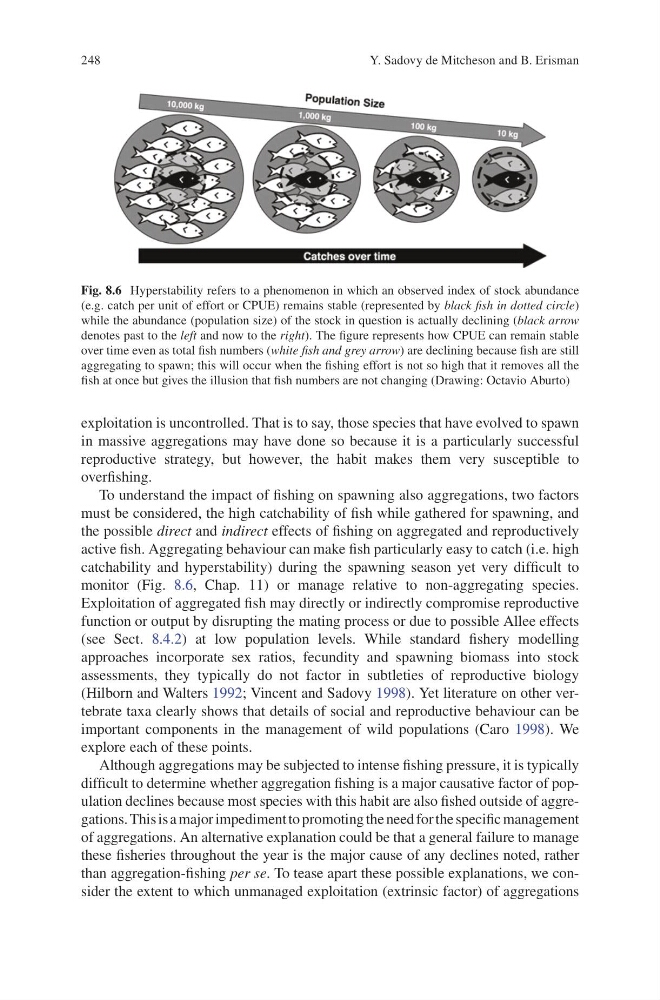
active fi sh. Aggregating behaviour can make fi sh particularly easy to catch (i.e. high
catchability and hyperstability) during the spawning season yet very diffi cult to
monitor (Fig. 8.6 , Chap. 11 ) or manage relative to non-aggregating species.
Exploitation of aggregated fi sh may directly or indirectly compromise reproductive
function or output by disrupting the mating process or due to possible Allee effects
(see Sect. 8.4.2 ) at low population levels. While standard fi shery modelling
approaches incorporate sex ratios, fecundity and spawning biomass into stock
assessments, they typically do not factor in subtleties of reproductive biology
(Hilborn and Walters 1992 ; Vincent and Sadovy 1998 ) . Yet literature on other vertebrate taxa clearly shows that details of social and reproductive behaviour can be
important components in the management of wild populations (Caro 1998 ) . We
explore each of these points.
Although aggregations may be subjected to intense fi shing pressure, it is typically
diffi cult to determine whether aggregation fi shing is a major causative factor of population declines because most species with this habit are also fi shed outside of aggregations. This is a major impediment to promoting the need for the specifi c management
of aggregations. An alternative explanation could be that a general failure to manage
these fi sheries throughout the year is the major cause of any declines noted, rather
than aggregation-fi shing per se . To tease apart these possible explanations, we consider the extent to which unmanaged exploitation (extrinsic factor) of aggregations
Fig. 8.6 Hyperstability refers to a phenomenon in which an observed index of stock abundance
(e.g. catch per unit of effort or CPUE) remains stable (represented by black fi sh in dotted circle )
while the abundance (population size) of the stock in question is actually declining ( black arrow
denotes past to the left and now to the right ). The fi gure represents how CPUE can remain stable
over time even as total fi sh numbers ( white fi sh and grey arrow ) are declining because fi sh are still
aggregating to spawn; this will occur when the fi shing effort is not so high that it removes all the
fi sh at once but gives the illusion that fi sh numbers are not changing (Drawing: Octavio Aburto)
Y. Sadovy de Mitcheson and B. Erisman
exploitation is uncontrolled. That is to say, those species that have evolved to spawn
in massive aggregations may have done so because it is a particularly successful
reproductive strategy, but however, the habit makes them very susceptible to
overfi shing.
To understand the impact of fi shing on spawning also aggregations, two factors
must be considered, the high catchability of fi sh while gathered for spawning, and
the possible direct and indirect effects of fi shing on aggregated and reproductively
active fi sh. Aggregating behaviour can make fi sh particularly easy to catch (i.e. high
catchability and hyperstability) during the spawning season yet very diffi cult to
monitor (Fig. 8.6 , Chap. 11 ) or manage relative to non-aggregating species.
Exploitation of aggregated fi sh may directly or indirectly compromise reproductive
function or output by disrupting the mating process or due to possible Allee effects
(see Sect. 8.4.2 ) at low population levels. While standard fi shery modelling
approaches incorporate sex ratios, fecundity and spawning biomass into stock
assessments, they typically do not factor in subtleties of reproductive biology
(Hilborn and Walters 1992 ; Vincent and Sadovy 1998 ) . Yet literature on other vertebrate taxa clearly shows that details of social and reproductive behaviour can be
important components in the management of wild populations (Caro 1998 ) . We
explore each of these points.
Although aggregations may be subjected to intense fi shing pressure, it is typically
diffi cult to determine whether aggregation fi shing is a major causative factor of population declines because most species with this habit are also fi shed outside of aggregations. This is a major impediment to promoting the need for the specifi c management
of aggregations. An alternative explanation could be that a general failure to manage
these fi sheries throughout the year is the major cause of any declines noted, rather
than aggregation-fi shing per se . To tease apart these possible explanations, we consider the extent to which unmanaged exploitation (extrinsic factor) of aggregations
Fig. 8.6 Hyperstability refers to a phenomenon in which an observed index of stock abundance
(e.g. catch per unit of effort or CPUE) remains stable (represented by black fi sh in dotted circle )
while the abundance (population size) of the stock in question is actually declining ( black arrow
denotes past to the left and now to the right ). The fi gure represents how CPUE can remain stable
over time even as total fi sh numbers ( white fi sh and grey arrow ) are declining because fi sh are still
aggregating to spawn; this will occur when the fi shing effort is not so high that it removes all the
fi sh at once but gives the illusion that fi sh numbers are not changing (Drawing: Octavio Aburto)