

244
Y. Sadovy de Mitcheson and B. Erisman
8.2.3 Commercial Fisheries
Spawning aggregations are increasingly the target of commercial fi sheries, using a
wide range of gears and for both local and international markets. Many such fi sheries
are lucrative, yet few are managed and many show evidence of declines probably
associated with aggregation-fi shing (Sadovy de Mitcheson et al. 2008 , Table 8.1 ).
Species range from those taken exclusively at aggregations, either live or dead, for
their fl esh to those taken for their roe or swimbladder. Inshore coastal migrations of
rabbitfi shes, tarpon and mullets have also long attracted seasonal fi shing operations,
because they are highly predictable and many have declined or no longer form. Some
species are mainly or exclusively taken in signifi cant numbers when they aggregate,
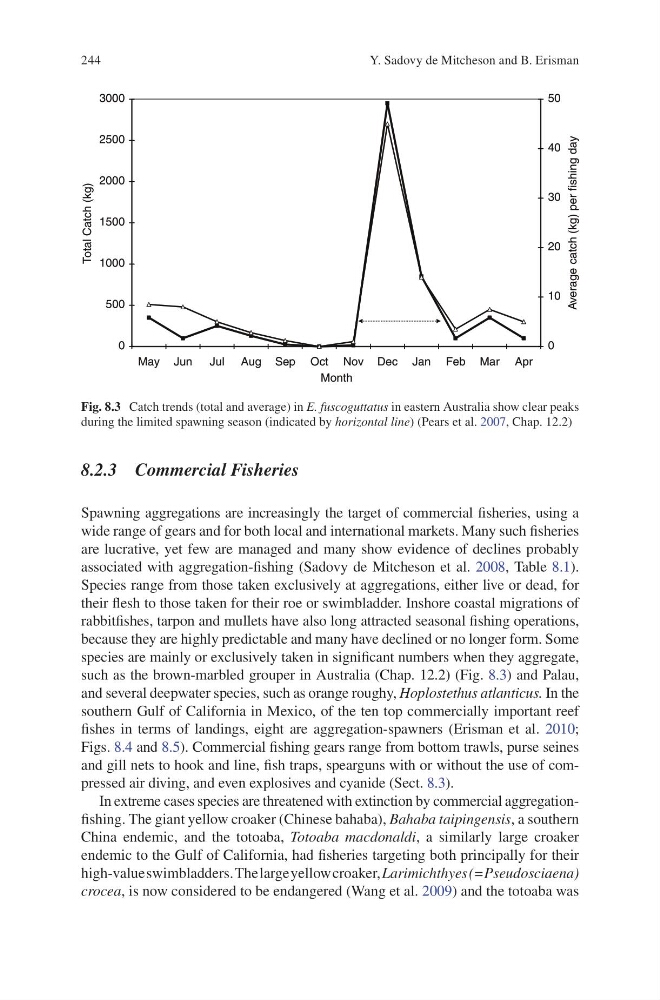
such as the brown-marbled grouper in Australia (Chap. 12.2 ) (Fig. 8.3 ) and Palau,
and several deepwater species, such as orange roughy, Hoplostethus atlanticus. In the
southern Gulf of California in Mexico, of the ten top commercially important reef
fi shes in terms of landings, eight are aggregation-spawners ( Erisman et al. 2010 ;
Figs. 8.4 and 8.5 ). Commercial fi shing gears range from bottom trawls, purse seines
and gill nets to hook and line, fi sh traps, spearguns with or without the use of compressed air diving, and even explosives and cyanide (Sect. 8.3 ).
In extreme cases species are threatened with extinction by commercial aggregationfi shing. The giant yellow croaker (Chinese bahaba), Bahaba taipingensis , a southern
China endemic, and the totoaba, Totoaba macdonaldi , a similarly large croaker
endemic to the Gulf of California, had fi sheries targeting both principally for their
high-value swimbladders. The large yellow croaker, Larimichthyes (=Pseudosciaena)
crocea , is now considered to be endangered (Wang et al. 2009 ) and the totoaba was
0
10
20
30
40
50
0
500
1000
1500
2000
2500
3000
May Jun
Jul Aug Sep Oct Nov Dec Jan Feb Mar Apr
Average catch (kg) per fishing day
Total Catch (kg)
Month
Fig. 8.3 Catch trends (total and average) in E. fuscoguttatus in eastern Australia show clear peaks
during the limited spawning season (indicated by horizontal line ) (Pears et al. 2007 , Chap. 12.2 )
Y. Sadovy de Mitcheson and B. Erisman
8.2.3 Commercial Fisheries
Spawning aggregations are increasingly the target of commercial fi sheries, using a
wide range of gears and for both local and international markets. Many such fi sheries
are lucrative, yet few are managed and many show evidence of declines probably
associated with aggregation-fi shing (Sadovy de Mitcheson et al. 2008 , Table 8.1 ).
Species range from those taken exclusively at aggregations, either live or dead, for
their fl esh to those taken for their roe or swimbladder. Inshore coastal migrations of
rabbitfi shes, tarpon and mullets have also long attracted seasonal fi shing operations,
because they are highly predictable and many have declined or no longer form. Some
species are mainly or exclusively taken in signifi cant numbers when they aggregate,
such as the brown-marbled grouper in Australia (Chap. 12.2 ) (Fig. 8.3 ) and Palau,
and several deepwater species, such as orange roughy, Hoplostethus atlanticus. In the
southern Gulf of California in Mexico, of the ten top commercially important reef
fi shes in terms of landings, eight are aggregation-spawners ( Erisman et al. 2010 ;
Figs. 8.4 and 8.5 ). Commercial fi shing gears range from bottom trawls, purse seines
and gill nets to hook and line, fi sh traps, spearguns with or without the use of compressed air diving, and even explosives and cyanide (Sect. 8.3 ).
In extreme cases species are threatened with extinction by commercial aggregationfi shing. The giant yellow croaker (Chinese bahaba), Bahaba taipingensis , a southern
China endemic, and the totoaba, Totoaba macdonaldi , a similarly large croaker
endemic to the Gulf of California, had fi sheries targeting both principally for their
high-value swimbladders. The large yellow croaker, Larimichthyes (=Pseudosciaena)
crocea , is now considered to be endangered (Wang et al. 2009 ) and the totoaba was
0
10
20
30
40
50
0
500
1000
1500
2000
2500
3000
May Jun
Jul Aug Sep Oct Nov Dec Jan Feb Mar Apr
Average catch (kg) per fishing day
Total Catch (kg)
Month
Fig. 8.3 Catch trends (total and average) in E. fuscoguttatus in eastern Australia show clear peaks
during the limited spawning season (indicated by horizontal line ) (Pears et al. 2007 , Chap. 12.2 )