

3
1 Revisiting Spawning Aggregations: Defi nitions and Challenges
Claydon ( 2004 ) argued that the Domeier and Colin ( 1997 ) defi nition was too
restrictive. He proposed a defi nition that does not require spawning individuals to
occur in greater numbers or higher density than normal: “spawning aggregations are
temporary aggregations formed by fi shes that have migrated for the specifi c purpose
of spawning.” The Claydon ( 2004 ) defi nition, therefore, simply requires the participants
to migrate to a specifi c spawning site while the Domeier and Colin ( 1997 ) defi nition
requires both a migration and an increase in density or numbers. Domeier and Colin
( 1997 ) recognized this type of spawning but they termed it Simple Migratory
Spawning: “migration and spawning of pairs or small groups of fi shes from a nonspawning area to a spawning area.” Furthermore, the Claydon defi nition is circular,
in that it uses the term “aggregation” to defi ne a spawning aggregation. This makes
interpretation of the defi nition quite subjective other than to effectively consider
groups of three or more fi sh that come together temporarily to spawn as spawning
aggregations, a defi nition that includes the majority of reef fi sh species and would
include streakers with pair-spawners.
The intent of the Domeier and Colin ( 1997 ) defi nition was to differentiate a
unique phenomenon of behavioural ecology where an entire sub-population of individuals halt their normal routine, migrate, gather and spawn. Not only is this a biologically signifi cant event, but it is also an economically important event with unique
management implications. For example, the increased numbers of fi sh predictably
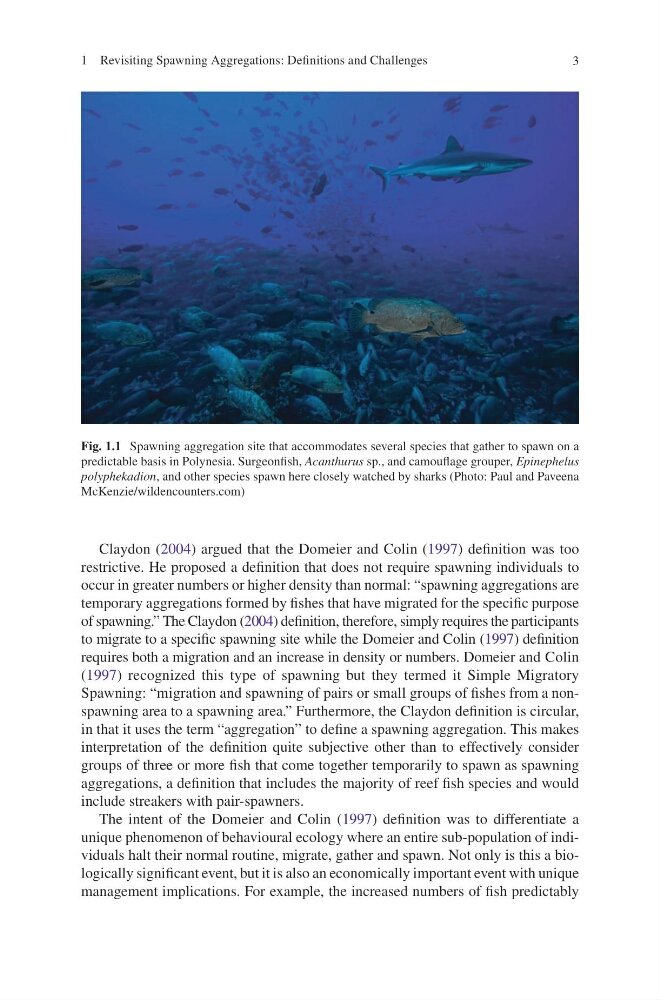
Fig. 1.1 Spawning aggregation site that accommodates several species that gather to spawn on a
predictable basis in Polynesia. Surgeonfi sh, Acanthurus sp., and camoufl age grouper, Epinephelus
polyphekadion , and other species spawn here closely watched by sharks (Photo: Paul and Paveena
McKenzie/wildencounters.com)
1 Revisiting Spawning Aggregations: Defi nitions and Challenges
Claydon ( 2004 ) argued that the Domeier and Colin ( 1997 ) defi nition was too
restrictive. He proposed a defi nition that does not require spawning individuals to
occur in greater numbers or higher density than normal: “spawning aggregations are
temporary aggregations formed by fi shes that have migrated for the specifi c purpose
of spawning.” The Claydon ( 2004 ) defi nition, therefore, simply requires the participants
to migrate to a specifi c spawning site while the Domeier and Colin ( 1997 ) defi nition
requires both a migration and an increase in density or numbers. Domeier and Colin
( 1997 ) recognized this type of spawning but they termed it Simple Migratory
Spawning: “migration and spawning of pairs or small groups of fi shes from a nonspawning area to a spawning area.” Furthermore, the Claydon defi nition is circular,
in that it uses the term “aggregation” to defi ne a spawning aggregation. This makes
interpretation of the defi nition quite subjective other than to effectively consider
groups of three or more fi sh that come together temporarily to spawn as spawning
aggregations, a defi nition that includes the majority of reef fi sh species and would
include streakers with pair-spawners.
The intent of the Domeier and Colin ( 1997 ) defi nition was to differentiate a
unique phenomenon of behavioural ecology where an entire sub-population of individuals halt their normal routine, migrate, gather and spawn. Not only is this a biologically signifi cant event, but it is also an economically important event with unique
management implications. For example, the increased numbers of fi sh predictably
Fig. 1.1 Spawning aggregation site that accommodates several species that gather to spawn on a
predictable basis in Polynesia. Surgeonfi sh, Acanthurus sp., and camoufl age grouper, Epinephelus
polyphekadion , and other species spawn here closely watched by sharks (Photo: Paul and Paveena
McKenzie/wildencounters.com)