

207
7 Aggregation Spawning: Biological Aspects of the Early Life History
extensive studies to be done using them that relate directly to the outcomes of
aggregations. However, there are a few reports of very large settlement pulses of
aggregating species (see Sect. 7.6.3 ). Some specialized sampling, such as channel
nets, can effectively capture some species (Colin et al. 1997 ; Keener et al. 1988).
Crest nets (established on tops of reef using waves and tidal currents to capture
fi shes) are an alternative method to sample incoming reef fi shes, but have not
been particularly effective at sampling aggregation spawned fi shes with the only
family contributing substantially to catches being the surgeonfi shes (Dufour and
Galzin 1993 , Hair et al. 2000 ) .
7.6.1 Settlement and Metamorphosis
The larvae of most species transition into the juvenile stage while still in mid-water
and may be able to position themselves in the vicinity of reefs during this stage as
many are strong swimmers in both speed and duration (Leis and McCormick 2002 ;
Leis and Carson-Ewart 1997 ) . Stobutzki and Bellwood ( 1997 ) found unfed settlement
stage individuals of three families (surgeonfi shes, snappers, emperors – Lethrinidae)
with spawning aggregations to have the highest swimming endurance (time capable
of maintaining 13.5 cm s
−1
) among nine families. If settlement stage fi sh are fed
while swimming, their endurance increases several-fold and some were capable of
continuous swimming at 13.5 cm s
−1
. The settlement stage fi shes of many aggregation
spawning families tend to be large and capable (Doherty et al. 1994 ) , putting them
among those species most likely to be able to move towards settlement habitat.
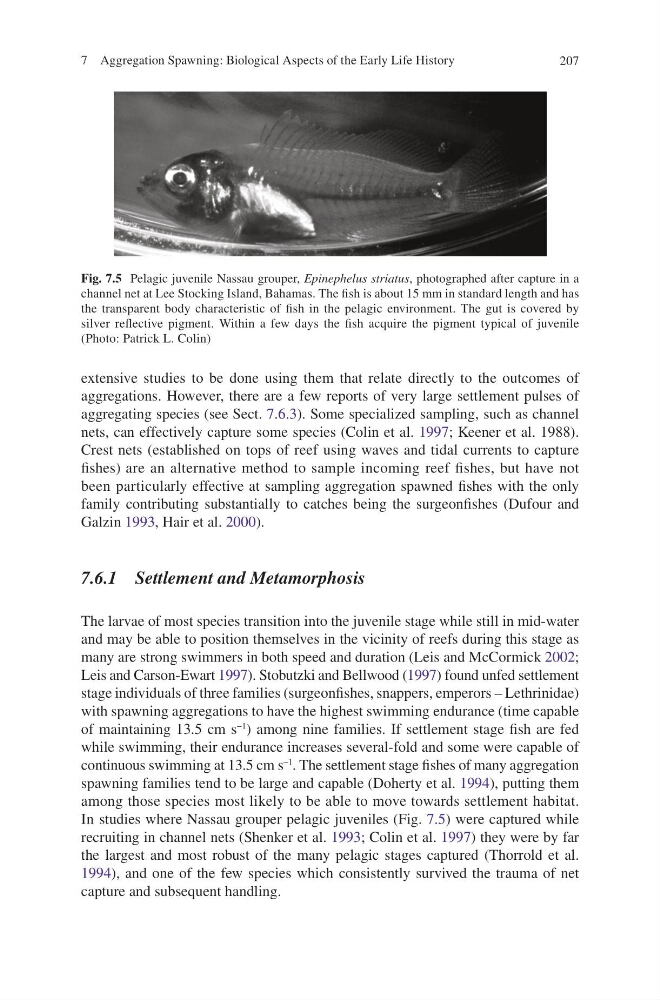
In studies where Nassau grouper pelagic juveniles (Fig. 7.5 ) were captured while
recruiting in channel nets (Shenker et al. 1993 ; Colin et al. 1997 ) they were by far
the largest and most robust of the many pelagic stages captured (Thorrold et al.
1994 ) , and one of the few species which consistently survived the trauma of net
capture and subsequent handling.
Fig. 7.5 Pelagic juvenile Nassau grouper, Epinephelus striatus , photographed after capture in a
channel net at Lee Stocking Island, Bahamas. The fi sh is about 15 mm in standard length and has
the transparent body characteristic of fi sh in the pelagic environment. The gut is covered by
silver refl ective pigment. Within a few days the fi sh acquire the pigment typical of juvenile
(Photo: Patrick L. Colin)
7 Aggregation Spawning: Biological Aspects of the Early Life History
extensive studies to be done using them that relate directly to the outcomes of
aggregations. However, there are a few reports of very large settlement pulses of
aggregating species (see Sect. 7.6.3 ). Some specialized sampling, such as channel
nets, can effectively capture some species (Colin et al. 1997 ; Keener et al. 1988).
Crest nets (established on tops of reef using waves and tidal currents to capture
fi shes) are an alternative method to sample incoming reef fi shes, but have not
been particularly effective at sampling aggregation spawned fi shes with the only
family contributing substantially to catches being the surgeonfi shes (Dufour and
Galzin 1993 , Hair et al. 2000 ) .
7.6.1 Settlement and Metamorphosis
The larvae of most species transition into the juvenile stage while still in mid-water
and may be able to position themselves in the vicinity of reefs during this stage as
many are strong swimmers in both speed and duration (Leis and McCormick 2002 ;
Leis and Carson-Ewart 1997 ) . Stobutzki and Bellwood ( 1997 ) found unfed settlement
stage individuals of three families (surgeonfi shes, snappers, emperors – Lethrinidae)
with spawning aggregations to have the highest swimming endurance (time capable
of maintaining 13.5 cm s
−1
) among nine families. If settlement stage fi sh are fed
while swimming, their endurance increases several-fold and some were capable of
continuous swimming at 13.5 cm s
−1
. The settlement stage fi shes of many aggregation
spawning families tend to be large and capable (Doherty et al. 1994 ) , putting them
among those species most likely to be able to move towards settlement habitat.
In studies where Nassau grouper pelagic juveniles (Fig. 7.5 ) were captured while
recruiting in channel nets (Shenker et al. 1993 ; Colin et al. 1997 ) they were by far
the largest and most robust of the many pelagic stages captured (Thorrold et al.
1994 ) , and one of the few species which consistently survived the trauma of net
capture and subsequent handling.
Fig. 7.5 Pelagic juvenile Nassau grouper, Epinephelus striatus , photographed after capture in a
channel net at Lee Stocking Island, Bahamas. The fi sh is about 15 mm in standard length and has
the transparent body characteristic of fi sh in the pelagic environment. The gut is covered by
silver refl ective pigment. Within a few days the fi sh acquire the pigment typical of juvenile
(Photo: Patrick L. Colin)