

203
7 Aggregation Spawning: Biological Aspects of the Early Life History
If water depths are shallow (only a few metres) and the expanse of an aggregation
large compared to the depth (many 10’s of metres across), multiple groups will
make short spawning ascents from over the entire aggregation area, producing a
fl urry of spawning which leaves a large area of water with a visible gamete cloud.
This is particularly seen in those IWP resident aggregators, typically surgeonfi shes
and parrotfi shes, spawning on lengthy shallow fore reefs just after high tide (Hamner
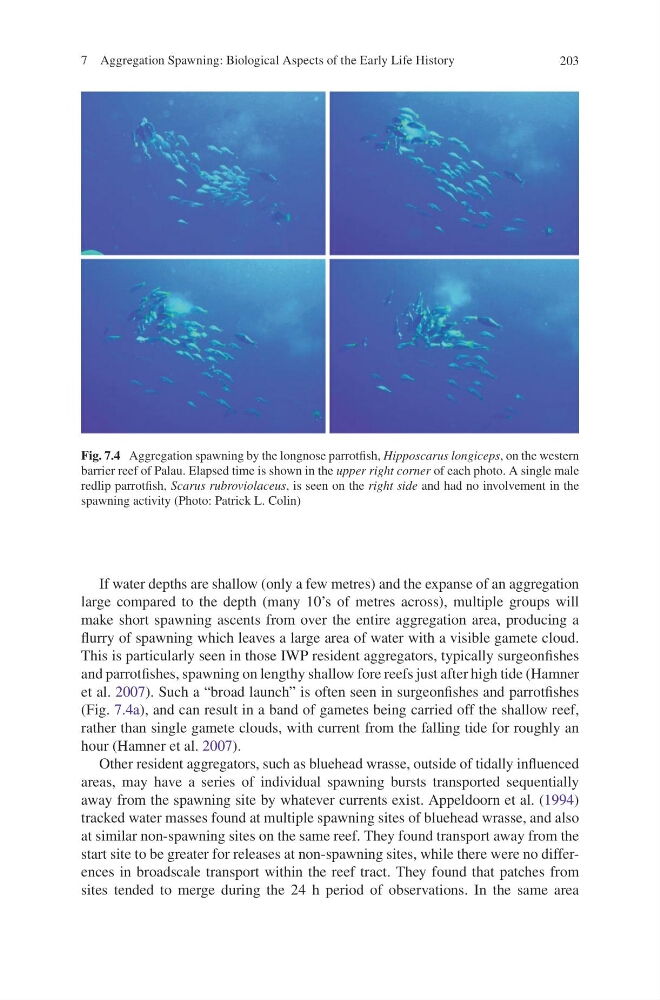
et al. 2007 ) . Such a “broad launch” is often seen in surgeonfi shes and parrotfi shes
(Fig. 7.4a ), and can result in a band of gametes being carried off the shallow reef,
rather than single gamete clouds, with current from the falling tide for roughly an
hour (Hamner et al. 2007 ) .
Other resident aggregators, such as bluehead wrasse, outside of tidally infl uenced
areas, may have a series of individual spawning bursts transported sequentially
away from the spawning site by whatever currents exist. Appeldoorn et al. ( 1994 )
tracked water masses found at multiple spawning sites of bluehead wrasse, and also
at similar non-spawning sites on the same reef. They found transport away from the
start site to be greater for releases at non-spawning sites, while there were no differences in broadscale transport within the reef tract. They found that patches from
sites tended to merge during the 24 h period of observations. In the same area
Fig. 7.4 Aggregation spawning by the longnose parrotfi sh, Hipposcarus longiceps , on the western
barrier reef of Palau. Elapsed time is shown in the upper right corner of each photo. A single male
redlip parrotfi sh, Scarus rubroviolaceus , is seen on the right side and had no involvement in the
spawning activity (Photo: Patrick L. Colin)
7 Aggregation Spawning: Biological Aspects of the Early Life History
If water depths are shallow (only a few metres) and the expanse of an aggregation
large compared to the depth (many 10’s of metres across), multiple groups will
make short spawning ascents from over the entire aggregation area, producing a
fl urry of spawning which leaves a large area of water with a visible gamete cloud.
This is particularly seen in those IWP resident aggregators, typically surgeonfi shes
and parrotfi shes, spawning on lengthy shallow fore reefs just after high tide (Hamner
et al. 2007 ) . Such a “broad launch” is often seen in surgeonfi shes and parrotfi shes
(Fig. 7.4a ), and can result in a band of gametes being carried off the shallow reef,
rather than single gamete clouds, with current from the falling tide for roughly an
hour (Hamner et al. 2007 ) .
Other resident aggregators, such as bluehead wrasse, outside of tidally infl uenced
areas, may have a series of individual spawning bursts transported sequentially
away from the spawning site by whatever currents exist. Appeldoorn et al. ( 1994 )
tracked water masses found at multiple spawning sites of bluehead wrasse, and also
at similar non-spawning sites on the same reef. They found transport away from the
start site to be greater for releases at non-spawning sites, while there were no differences in broadscale transport within the reef tract. They found that patches from
sites tended to merge during the 24 h period of observations. In the same area
Fig. 7.4 Aggregation spawning by the longnose parrotfi sh, Hipposcarus longiceps , on the western
barrier reef of Palau. Elapsed time is shown in the upper right corner of each photo. A single male
redlip parrotfi sh, Scarus rubroviolaceus , is seen on the right side and had no involvement in the
spawning activity (Photo: Patrick L. Colin)