

201
7 Aggregation Spawning: Biological Aspects of the Early Life History
The nature of gamete release is related to depth of water over the reef. Where the
depth is 5–10 m or more, the fi sh ascend to release eggs and sperm as a “burst”,
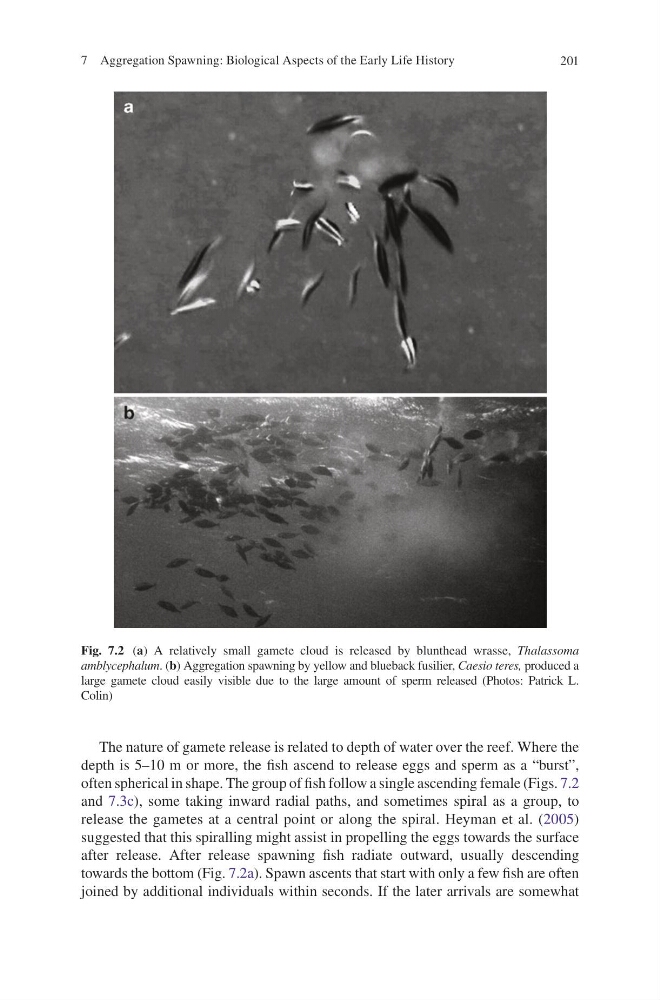
often spherical in shape. The group of fi sh follow a single ascending female (Figs. 7.2
and 7.3c ), some taking inward radial paths, and sometimes spiral as a group, to
release the gametes at a central point or along the spiral. Heyman et al. ( 2005 )
suggested that this spiralling might assist in propelling the eggs towards the surface
after release. After release spawning fi sh radiate outward, usually descending
towards the bottom (Fig. 7.2a ). Spawn ascents that start with only a few fi sh are often
joined by additional individuals within seconds. If the later arrivals are somewhat
Fig. 7.2 ( a ) A relatively small gamete cloud is released by blunthead wrasse, Thalassoma
amblycephalum . ( b ) Aggregation spawning by yellow and blueback fusilier, Caesio teres, produced a
large gamete cloud easily visible due to the large amount of sperm released (Photos: Patrick L.
Colin)
7 Aggregation Spawning: Biological Aspects of the Early Life History
The nature of gamete release is related to depth of water over the reef. Where the
depth is 5–10 m or more, the fi sh ascend to release eggs and sperm as a “burst”,
often spherical in shape. The group of fi sh follow a single ascending female (Figs. 7.2
and 7.3c ), some taking inward radial paths, and sometimes spiral as a group, to
release the gametes at a central point or along the spiral. Heyman et al. ( 2005 )
suggested that this spiralling might assist in propelling the eggs towards the surface
after release. After release spawning fi sh radiate outward, usually descending
towards the bottom (Fig. 7.2a ). Spawn ascents that start with only a few fi sh are often
joined by additional individuals within seconds. If the later arrivals are somewhat
Fig. 7.2 ( a ) A relatively small gamete cloud is released by blunthead wrasse, Thalassoma
amblycephalum . ( b ) Aggregation spawning by yellow and blueback fusilier, Caesio teres, produced a
large gamete cloud easily visible due to the large amount of sperm released (Photos: Patrick L.
Colin)