

193
7 Aggregation Spawning: Biological Aspects of the Early Life History
Aggregation propagules do not, apparently, form a cohesive group that would
remain so in the pelagic environment. So does aggregation spawning provide any
benefi t to early larvae? That question is still open, but may be examined by seeing
whether or not the conditions at times of aggregation spawning might promote
success of larvae through recruitment, particularly if other larval components are
present which might compete with fi sh larvae.
Reef fi sh eggs and larvae initially act as drifting plankton, and at a later stage
some become capable of behaving more as free-swimming nektonic organisms
(Leis 2006 ) . The exact stage of transition between the plankton-nekton, when larvae
go from being passive drifters to active swimmers, is variable. The extent to which
late stage larvae use sensory means to navigate or seek out settlement locations is an
area of considerable research, but also of much uncertainty. Larvae normally differ
greatly in morphology from juveniles/adults of the same species and have fewer
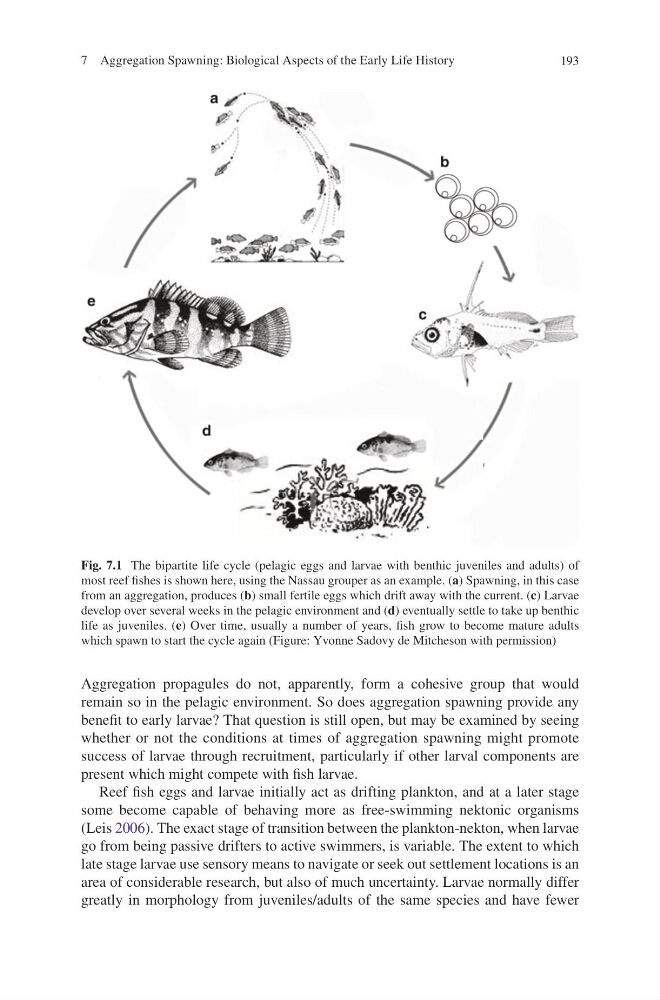
Fig. 7.1 The bipartite life cycle (pelagic eggs and larvae with benthic juveniles and adults) of
most reef fi shes is shown here, using the Nassau grouper as an example. ( a ) Spawning, in this case
from an aggregation, produces ( b ) small fertile eggs which drift away with the current. ( c ) Larvae
develop over several weeks in the pelagic environment and ( d ) eventually settle to take up benthic
life as juveniles. ( e ) Over time, usually a number of years, fi sh grow to become mature adults
which spawn to start the cycle again (Figure: Yvonne Sadovy de Mitcheson with permission)
7 Aggregation Spawning: Biological Aspects of the Early Life History
Aggregation propagules do not, apparently, form a cohesive group that would
remain so in the pelagic environment. So does aggregation spawning provide any
benefi t to early larvae? That question is still open, but may be examined by seeing
whether or not the conditions at times of aggregation spawning might promote
success of larvae through recruitment, particularly if other larval components are
present which might compete with fi sh larvae.
Reef fi sh eggs and larvae initially act as drifting plankton, and at a later stage
some become capable of behaving more as free-swimming nektonic organisms
(Leis 2006 ) . The exact stage of transition between the plankton-nekton, when larvae
go from being passive drifters to active swimmers, is variable. The extent to which
late stage larvae use sensory means to navigate or seek out settlement locations is an
area of considerable research, but also of much uncertainty. Larvae normally differ
greatly in morphology from juveniles/adults of the same species and have fewer
Fig. 7.1 The bipartite life cycle (pelagic eggs and larvae with benthic juveniles and adults) of
most reef fi shes is shown here, using the Nassau grouper as an example. ( a ) Spawning, in this case
from an aggregation, produces ( b ) small fertile eggs which drift away with the current. ( c ) Larvae
develop over several weeks in the pelagic environment and ( d ) eventually settle to take up benthic
life as juveniles. ( e ) Over time, usually a number of years, fi sh grow to become mature adults
which spawn to start the cycle again (Figure: Yvonne Sadovy de Mitcheson with permission)