

186
W.M. Hamner and J.L. Largier
6.6 Summary
Aggregation-spawning reef fi shes produce eggs, yolk-sac and pre-fl exion larvae that are
planktonic but which are not necessarily advected away into the open sea. Diffusion
dynamics of spawning clouds, tidally limited advection by coastal boundary currents,
entrainment within tidal eddies, and lateral trapping by reef topography reduce offshore
dispersion. Particularly instructive have been investigations in which drifters were
released at spawning sites to evaluate long-shore advection and eddy entrainment.
The role of aggregation-spawning for gamete cloud dispersal has been largely
ignored. Do aggregations produce large cohorts that recruit at the same time, or do
aggregations confer direct benefi ts on eggs and early stage larvae? The types of
gamete clouds produced by small, herbivorous resident-fi sh aggregations and by
large, carnivorous transient fi sh aggregations are different, but we cannot yet compare their relative costs and benefi ts. Comparison between reef length and advection
velocity gives an estimate of how long the spawning cloud diffuses in the vicinity
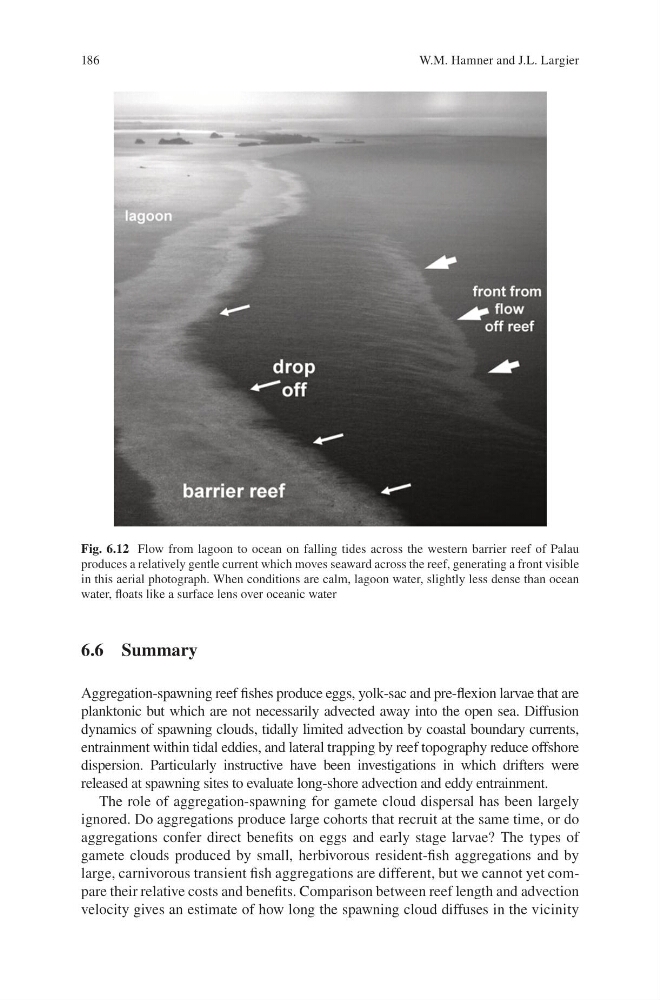
Fig. 6.12 Flow from lagoon to ocean on falling tides across the western barrier reef of Palau
produces a relatively gentle current which moves seaward across the reef, generating a front visible
in this aerial photograph. When conditions are calm, lagoon water, slightly less dense than ocean
water, fl oats like a surface lens over oceanic water
W.M. Hamner and J.L. Largier
6.6 Summary
Aggregation-spawning reef fi shes produce eggs, yolk-sac and pre-fl exion larvae that are
planktonic but which are not necessarily advected away into the open sea. Diffusion
dynamics of spawning clouds, tidally limited advection by coastal boundary currents,
entrainment within tidal eddies, and lateral trapping by reef topography reduce offshore
dispersion. Particularly instructive have been investigations in which drifters were
released at spawning sites to evaluate long-shore advection and eddy entrainment.
The role of aggregation-spawning for gamete cloud dispersal has been largely
ignored. Do aggregations produce large cohorts that recruit at the same time, or do
aggregations confer direct benefi ts on eggs and early stage larvae? The types of
gamete clouds produced by small, herbivorous resident-fi sh aggregations and by
large, carnivorous transient fi sh aggregations are different, but we cannot yet compare their relative costs and benefi ts. Comparison between reef length and advection
velocity gives an estimate of how long the spawning cloud diffuses in the vicinity
Fig. 6.12 Flow from lagoon to ocean on falling tides across the western barrier reef of Palau
produces a relatively gentle current which moves seaward across the reef, generating a front visible
in this aerial photograph. When conditions are calm, lagoon water, slightly less dense than ocean
water, fl oats like a surface lens over oceanic water