

184
W.M. Hamner and J.L. Largier
due to differential mortality of the larvae related to the availability of food for the
fi rst-feeding larvae. Laboratory rearing studies with California anchovy larvae
(Lasker et al. 1970 ; Lasker 1975 ) indicated the density of larval food must be higher
than that usually found at sea to obtain even moderate larval growth and survival.
Off southern California anchovy larvae were able to feed extensively on water from
the chlorophyll maximum layer, which contained phytoplankton, but they did not
survive if fed phytoplankton defi cient surface waters. Recently, there has been a
resurgence of interest in the horizontal phytoplankton layers concentrated at the
thermocline (or halocline), called “thin layers.” Sullivan et al. ( 2010 ) reported that
fi ne-scale, dense patches of organisms are “ubiquitous features” in the ocean and
the term “thin layer” (vertical extents from centimetres to a few meters) describes
horizontally concentrated patches of organisms, or particles that can extend horizontally for many kilometres and persist for weeks.
Reef fi sh larvae, including those of aggregation spawners, are believed to feed on
small zooplankters that graze on phytoplankton, hence concentrations of phytoplankton in the tropics could have some correlation with the occurrence of aggregation
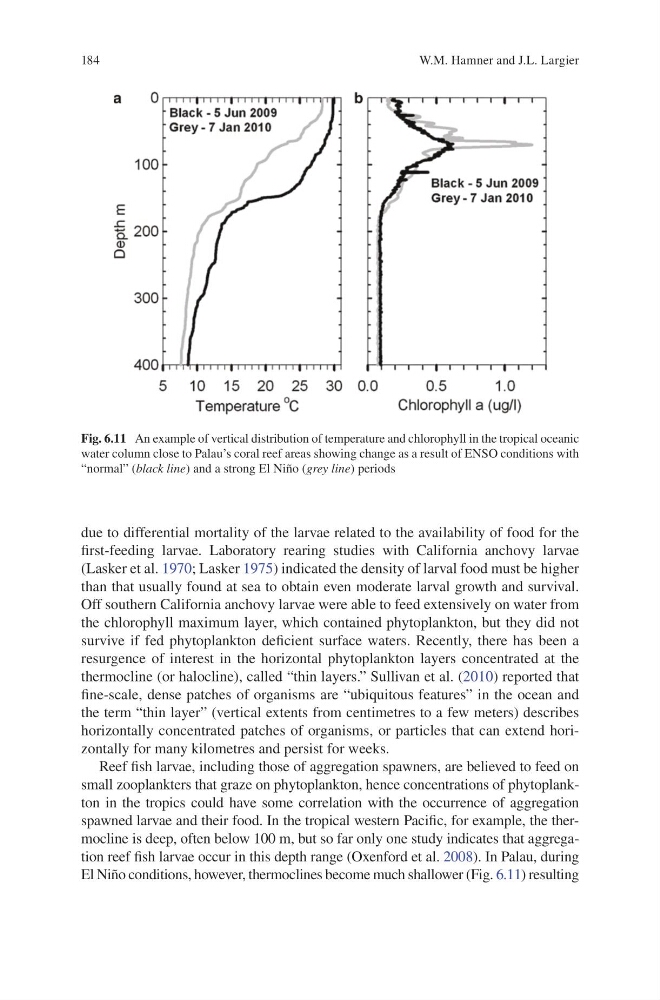
spawned larvae and their food. In the tropical western Pacifi c, for example, the thermocline is deep, often below 100 m, but so far only one study indicates that aggregation reef fi sh larvae occur in this depth range (Oxenford et al. 2008 ) . In Palau, during
El Niño conditions, however, thermoclines become much shallower (Fig. 6.11 ) resulting
Fig. 6.11 An example of vertical distribution of temperature and chlorophyll in the tropical oceanic
water column close to Palau’s coral reef areas showing change as a result of ENSO conditions with
“normal” ( black line ) and a strong El Niño ( grey line ) periods
W.M. Hamner and J.L. Largier
due to differential mortality of the larvae related to the availability of food for the
fi rst-feeding larvae. Laboratory rearing studies with California anchovy larvae
(Lasker et al. 1970 ; Lasker 1975 ) indicated the density of larval food must be higher
than that usually found at sea to obtain even moderate larval growth and survival.
Off southern California anchovy larvae were able to feed extensively on water from
the chlorophyll maximum layer, which contained phytoplankton, but they did not
survive if fed phytoplankton defi cient surface waters. Recently, there has been a
resurgence of interest in the horizontal phytoplankton layers concentrated at the
thermocline (or halocline), called “thin layers.” Sullivan et al. ( 2010 ) reported that
fi ne-scale, dense patches of organisms are “ubiquitous features” in the ocean and
the term “thin layer” (vertical extents from centimetres to a few meters) describes
horizontally concentrated patches of organisms, or particles that can extend horizontally for many kilometres and persist for weeks.
Reef fi sh larvae, including those of aggregation spawners, are believed to feed on
small zooplankters that graze on phytoplankton, hence concentrations of phytoplankton in the tropics could have some correlation with the occurrence of aggregation
spawned larvae and their food. In the tropical western Pacifi c, for example, the thermocline is deep, often below 100 m, but so far only one study indicates that aggregation reef fi sh larvae occur in this depth range (Oxenford et al. 2008 ) . In Palau, during
El Niño conditions, however, thermoclines become much shallower (Fig. 6.11 ) resulting
Fig. 6.11 An example of vertical distribution of temperature and chlorophyll in the tropical oceanic
water column close to Palau’s coral reef areas showing change as a result of ENSO conditions with
“normal” ( black line ) and a strong El Niño ( grey line ) periods