

182
W.M. Hamner and J.L. Largier
circulation such that bottom water fl ows radially toward the eddy centre with upwelling
and downwelling (Wolanski et al. 1984 ; Tomczak 1988 ; Wolanski and Hamner 1988 ;
Wolanski 2001 ; Suthers et al. 2004 ; White and Wolanski 2007 ) , giving shallowwater wakes 3-dimensional structure. It is now clear that 3-D wakes behind
shallow-water continental reefs are all qualitatively different from the mostly 2-D
wakes that occur downstream of oceanic reefs and islands (Tomczak 1988 ) , although
there is also gentle upwelling and downwelling in large mesoscale oceanic gyres.
All oceanic islands and atolls also produce wakes, but in deep oceanic waters there is
no bottom friction to generate rapid recurrent 3 dimensional fl ow. However, from a
satellite 2-D and 3-D wakes look much the same (Teinturier et al. 2010 ) , with smooth
fl ow around the reefs when ambient far-fi eld currents are gentle, paired stable eddies
as fl ow increases, and downstream vortex streets when currents are strong. Dong
et al. ( 2009 ) recently modelled wakes for islands surrounded by deep water, including
the relationships between island size, wake instability, coherent vortex formation,
and mesoscale and sub-mesoscale eddy activity. The presence of sloping island
sides, as opposed to vertical sides, introduces an additional set of variables affecting
the structure of the downstream wake. Wakes of deep water islands and reefs cannot
entrain and retain densely concentrated zooplankton or larval fi shes as rapidly as
shallow fl ows around islands and reefs on continental and island shelves.
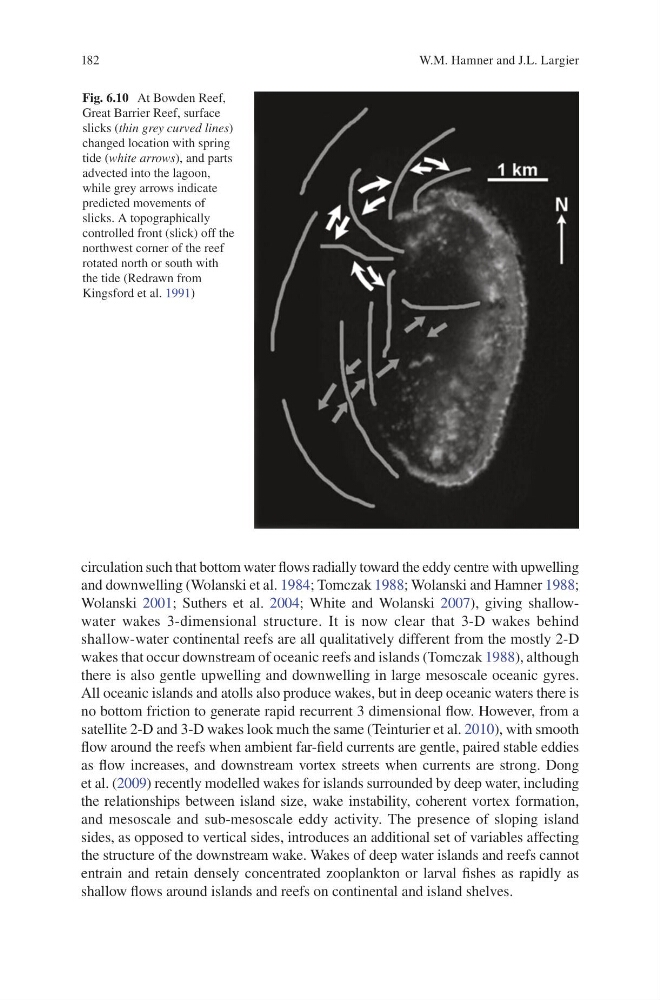
Fig. 6.10 At Bowden Reef,
Great Barrier Reef, surface
slicks ( thin grey curved lines )
changed location with spring
tide ( white arrows ), and parts
advected into the lagoon,
while grey arrows indicate
predicted movements of
slicks. A topographically
controlled front (slick) off the
northwest corner of the reef
rotated north or south with
the tide (Redrawn from
Kingsford et al. 1991 )
W.M. Hamner and J.L. Largier
circulation such that bottom water fl ows radially toward the eddy centre with upwelling
and downwelling (Wolanski et al. 1984 ; Tomczak 1988 ; Wolanski and Hamner 1988 ;
Wolanski 2001 ; Suthers et al. 2004 ; White and Wolanski 2007 ) , giving shallowwater wakes 3-dimensional structure. It is now clear that 3-D wakes behind
shallow-water continental reefs are all qualitatively different from the mostly 2-D
wakes that occur downstream of oceanic reefs and islands (Tomczak 1988 ) , although
there is also gentle upwelling and downwelling in large mesoscale oceanic gyres.
All oceanic islands and atolls also produce wakes, but in deep oceanic waters there is
no bottom friction to generate rapid recurrent 3 dimensional fl ow. However, from a
satellite 2-D and 3-D wakes look much the same (Teinturier et al. 2010 ) , with smooth
fl ow around the reefs when ambient far-fi eld currents are gentle, paired stable eddies
as fl ow increases, and downstream vortex streets when currents are strong. Dong
et al. ( 2009 ) recently modelled wakes for islands surrounded by deep water, including
the relationships between island size, wake instability, coherent vortex formation,
and mesoscale and sub-mesoscale eddy activity. The presence of sloping island
sides, as opposed to vertical sides, introduces an additional set of variables affecting
the structure of the downstream wake. Wakes of deep water islands and reefs cannot
entrain and retain densely concentrated zooplankton or larval fi shes as rapidly as
shallow fl ows around islands and reefs on continental and island shelves.
Fig. 6.10 At Bowden Reef,
Great Barrier Reef, surface
slicks ( thin grey curved lines )
changed location with spring
tide ( white arrows ), and parts
advected into the lagoon,
while grey arrows indicate
predicted movements of
slicks. A topographically
controlled front (slick) off the
northwest corner of the reef
rotated north or south with
the tide (Redrawn from
Kingsford et al. 1991 )