

171
6 Oceanography of the Planktonic Stages of Aggregation Spawning Reef Fishes
coral outcroppings that are both close to their normal home ranges and adjacent to
the nearest deep water on the seaward edge of the barrier reef. Hamner et al. ( 2007 )
investigated the export of eggs from these aggregations into the gentle alongshore
fl ow that forms a coastal boundary current along the face of the barrier reef. Resident
fi shes aggregated and spawned after high tide, releasing fertilized eggs into tidal
currents that fl owed across the reef from the lagoon to the offshore edge of the reef,
thus placing spawn in the coastal boundary layer fl ow along the outer reef face
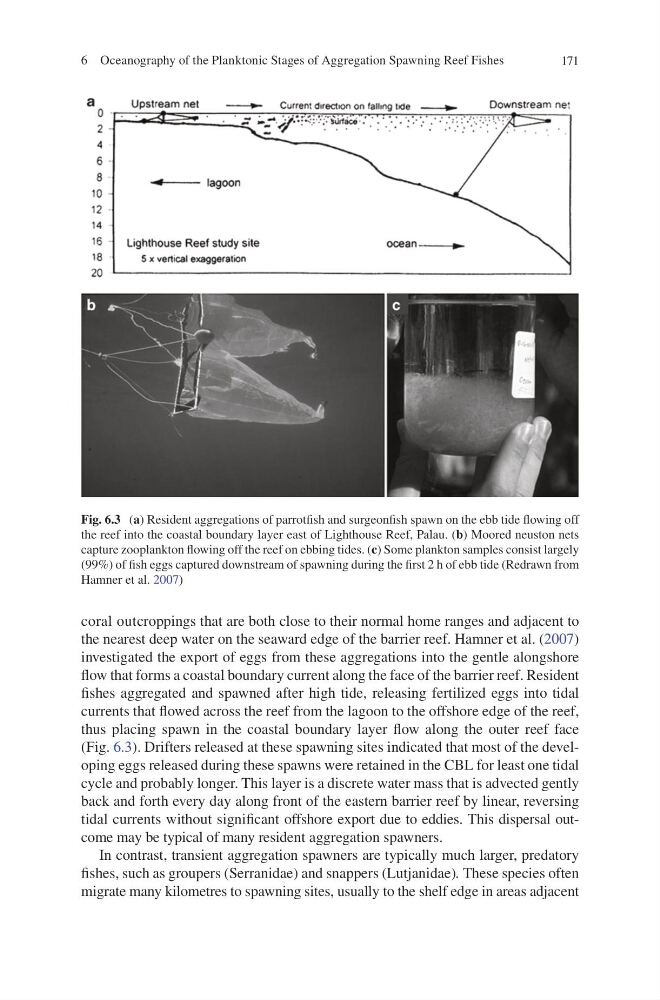
(Fig. 6.3 ). Drifters released at these spawning sites indicated that most of the developing eggs released during these spawns were retained in the CBL for least one tidal
cycle and probably longer. This layer is a discrete water mass that is advected gently
back and forth every day along front of the eastern barrier reef by linear, reversing
tidal currents without signifi cant offshore export due to eddies. This dispersal outcome may be typical of many resident aggregation spawners.
In contrast, transient aggregation spawners are typically much larger, predatory
fi shes, such as groupers (Serranidae) and snappers (Lutjanidae) . These species often
migrate many kilometres to spawning sites, usually to the shelf edge in areas adjacent
Fig. 6.3 ( a ) Resident aggregations of parrotfi sh and surgeonfi sh spawn on the ebb tide fl owing off
the reef into the coastal boundary layer east of Lighthouse Reef, Palau. ( b ) Moored neuston nets
capture zooplankton fl owing off the reef on ebbing tides. ( c ) Some plankton samples consist largely
(99%) of fi sh eggs captured downstream of spawning during the fi rst 2 h of ebb tide (Redrawn from
Hamner et al. 2007 )
6 Oceanography of the Planktonic Stages of Aggregation Spawning Reef Fishes
coral outcroppings that are both close to their normal home ranges and adjacent to
the nearest deep water on the seaward edge of the barrier reef. Hamner et al. ( 2007 )
investigated the export of eggs from these aggregations into the gentle alongshore
fl ow that forms a coastal boundary current along the face of the barrier reef. Resident
fi shes aggregated and spawned after high tide, releasing fertilized eggs into tidal
currents that fl owed across the reef from the lagoon to the offshore edge of the reef,
thus placing spawn in the coastal boundary layer fl ow along the outer reef face
(Fig. 6.3 ). Drifters released at these spawning sites indicated that most of the developing eggs released during these spawns were retained in the CBL for least one tidal
cycle and probably longer. This layer is a discrete water mass that is advected gently
back and forth every day along front of the eastern barrier reef by linear, reversing
tidal currents without signifi cant offshore export due to eddies. This dispersal outcome may be typical of many resident aggregation spawners.
In contrast, transient aggregation spawners are typically much larger, predatory
fi shes, such as groupers (Serranidae) and snappers (Lutjanidae) . These species often
migrate many kilometres to spawning sites, usually to the shelf edge in areas adjacent
Fig. 6.3 ( a ) Resident aggregations of parrotfi sh and surgeonfi sh spawn on the ebb tide fl owing off
the reef into the coastal boundary layer east of Lighthouse Reef, Palau. ( b ) Moored neuston nets
capture zooplankton fl owing off the reef on ebbing tides. ( c ) Some plankton samples consist largely
(99%) of fi sh eggs captured downstream of spawning during the fi rst 2 h of ebb tide (Redrawn from
Hamner et al. 2007 )