

150
P.L. Colin
numbers are extremely large and overall it is believed that egg predators may only
take a small percent of the egg output (Hamner et al. 2007 ) .
Egg predators are typically benthic-based zooplanktivores that normally select
particulate items in mid-water above reefs functioning as “cloud predators”, that
attack aggressively masses of just-released gametes (Colin and Bell 1991 ) spawned
by aggregating and non-aggregating fi shes. The predators are not specialized for
feeding solely on fi sh eggs, but most are aware when fi sh are preparing to spawn and
rush in within seconds after gamete release to feed. While most pick individual eggs
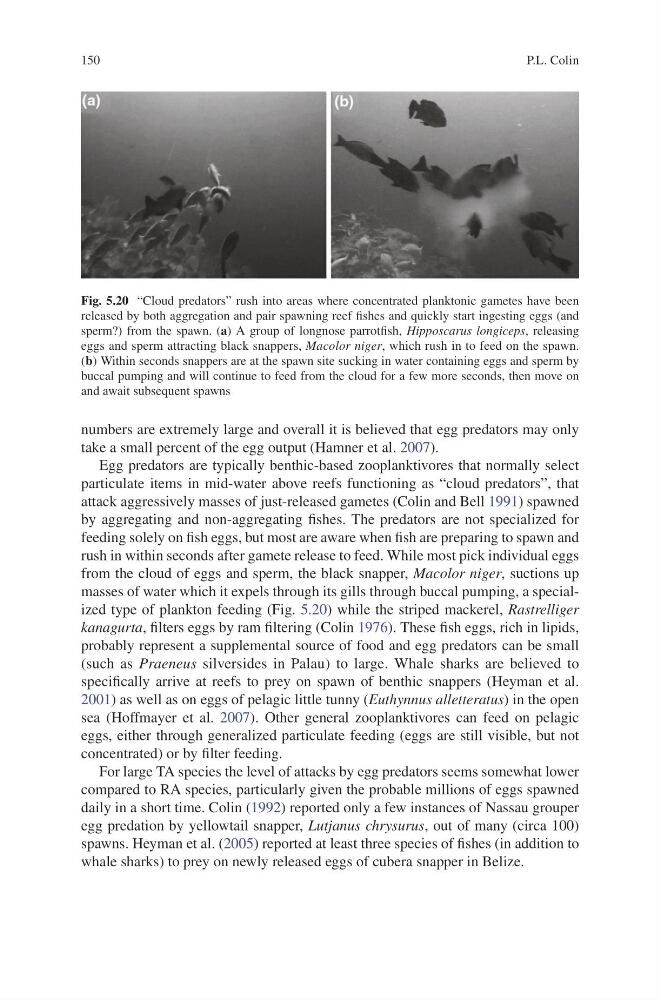
from the cloud of eggs and sperm, the black snapper, Macolor niger , suctions up
masses of water which it expels through its gills through buccal pumping, a specialized type of plankton feeding (Fig. 5.20 ) while the striped mackerel, Rastrelliger
kanagurta , fi lters eggs by ram fi ltering (Colin 1976 ) . These fi sh eggs, rich in lipids,
probably represent a supplemental source of food and egg predators can be small
(such as Praeneus silversides in Palau) to large. Whale sharks are believed to
specifi cally arrive at reefs to prey on spawn of benthic snappers (Heyman et al.
2001 ) as well as on eggs of pelagic little tunny ( Euthynnus alletteratus ) in the open
sea (Hoffmayer et al. 2007 ) . Other general zooplanktivores can feed on pelagic
eggs, either through generalized particulate feeding (eggs are still visible, but not
concentrated) or by fi lter feeding.
For large TA species the level of attacks by egg predators seems somewhat lower
compared to RA species, particularly given the probable millions of eggs spawned
daily in a short time. Colin ( 1992 ) reported only a few instances of Nassau grouper
egg predation by yellowtail snapper, Lutjanus chrysurus , out of many (circa 100)
spawns. Heyman et al. ( 2005 ) reported at least three species of fi shes (in addition to
whale sharks) to prey on newly released eggs of cubera snapper in Belize.
Fig. 5.20 “Cloud predators” rush into areas where concentrated planktonic gametes have been
released by both aggregation and pair spawning reef fi shes and quickly start ingesting eggs (and
sperm?) from the spawn. ( a ) A group of longnose parrotfi sh, Hipposcarus longiceps , releasing
eggs and sperm attracting black snappers, Macolor niger , which rush in to feed on the spawn.
( b ) Within seconds snappers are at the spawn site sucking in water containing eggs and sperm by
buccal pumping and will continue to feed from the cloud for a few more seconds, then move on
and await subsequent spawns
P.L. Colin
numbers are extremely large and overall it is believed that egg predators may only
take a small percent of the egg output (Hamner et al. 2007 ) .
Egg predators are typically benthic-based zooplanktivores that normally select
particulate items in mid-water above reefs functioning as “cloud predators”, that
attack aggressively masses of just-released gametes (Colin and Bell 1991 ) spawned
by aggregating and non-aggregating fi shes. The predators are not specialized for
feeding solely on fi sh eggs, but most are aware when fi sh are preparing to spawn and
rush in within seconds after gamete release to feed. While most pick individual eggs
from the cloud of eggs and sperm, the black snapper, Macolor niger , suctions up
masses of water which it expels through its gills through buccal pumping, a specialized type of plankton feeding (Fig. 5.20 ) while the striped mackerel, Rastrelliger
kanagurta , fi lters eggs by ram fi ltering (Colin 1976 ) . These fi sh eggs, rich in lipids,
probably represent a supplemental source of food and egg predators can be small
(such as Praeneus silversides in Palau) to large. Whale sharks are believed to
specifi cally arrive at reefs to prey on spawn of benthic snappers (Heyman et al.
2001 ) as well as on eggs of pelagic little tunny ( Euthynnus alletteratus ) in the open
sea (Hoffmayer et al. 2007 ) . Other general zooplanktivores can feed on pelagic
eggs, either through generalized particulate feeding (eggs are still visible, but not
concentrated) or by fi lter feeding.
For large TA species the level of attacks by egg predators seems somewhat lower
compared to RA species, particularly given the probable millions of eggs spawned
daily in a short time. Colin ( 1992 ) reported only a few instances of Nassau grouper
egg predation by yellowtail snapper, Lutjanus chrysurus , out of many (circa 100)
spawns. Heyman et al. ( 2005 ) reported at least three species of fi shes (in addition to
whale sharks) to prey on newly released eggs of cubera snapper in Belize.
Fig. 5.20 “Cloud predators” rush into areas where concentrated planktonic gametes have been
released by both aggregation and pair spawning reef fi shes and quickly start ingesting eggs (and
sperm?) from the spawn. ( a ) A group of longnose parrotfi sh, Hipposcarus longiceps , releasing
eggs and sperm attracting black snappers, Macolor niger , which rush in to feed on the spawn.
( b ) Within seconds snappers are at the spawn site sucking in water containing eggs and sperm by
buccal pumping and will continue to feed from the cloud for a few more seconds, then move on
and await subsequent spawns