

145
5 Timing and Location of Aggregation and Spawning in Reef Fishes
shorter or longer pelagic life history stage, a new moon spawning could also result
in recruitment on the new moon one or more months after spawning. Samoilys
( 1997 ) found leopard coralgrouper to spawn most often during the new moon while
Doherty et al. ( 1994 ) found coral trout recruiting on the new moon, based on numbers
of daily otolith increments, at an age of 25 days after spawning. Further studies of
larval life length, based on otolith ages, are needed for large TA species to see
whether spawning times typically produces recruitment around the new moon.
5.8.3 Seasonal Periodicity
Major astronomical markers each year include the solstices and the equinoxes.
In the northern hemisphere the winter solstice is December 21 or 22 and the summer
solstice June 21 or 22. They are reversed in the southern hemisphere. The equinoxes
occur on March 20 or 21 (vernal in north hemisphere) and September 22 or 23
(autumnal in same). On these dates day and night length are equal everywhere.
Spawning aggregations are usually associated with specifi c seasonal periods
and lunar phases. In the TWA nearly all known TA species have their spawning in
the winter or spring (Domeier and Colin 1997 , Chap. 2 ), however in Bermuda
some groupers aggregate in June and July (Bardach et al. 1958 ; Luckhurst 1998 )
possibly due to overall lower water temperatures there. The goliath grouper,
Epinephelus itajara , may be an exception, with probable (but not confi rmed)
spawning aggregations occurring during the summer (Bullock et al. 1992 ; Colin
1994 , Chap. 12.4 ). Within the Caribbean portion of the TWA, individual species
that aggregate seem to have the same seasonal timing across the region. Cubera
snapper have the same spawning seasonality throughout the Caribbean (US Virgin
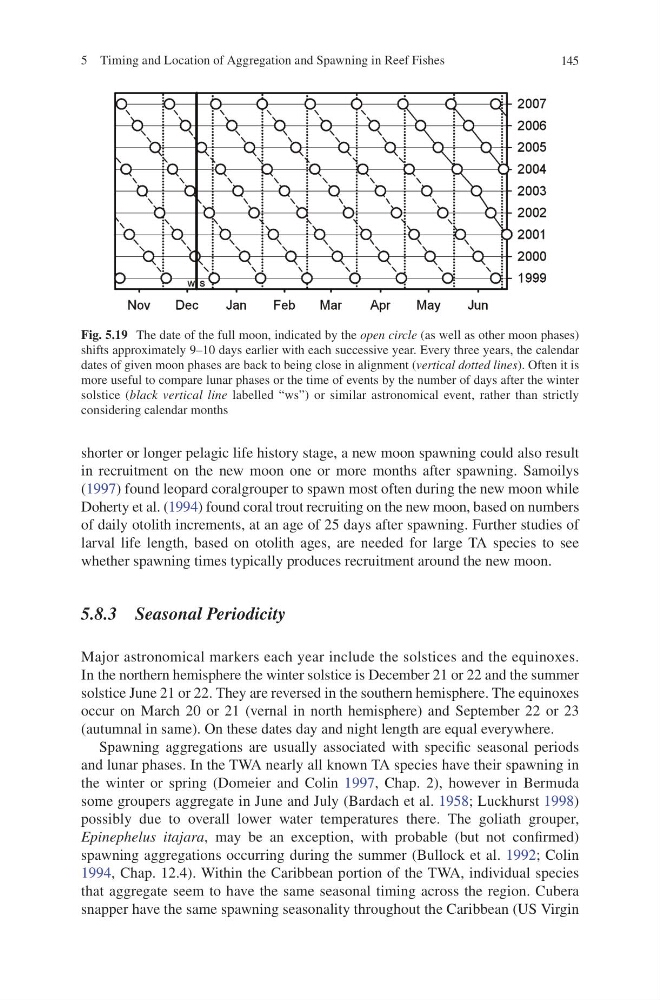
Fig. 5.19 The date of the full moon, indicated by the open circle (as well as other moon phases)
shifts approximately 9–10 days earlier with each successive year. Every three years, the calendar
dates of given moon phases are back to being close in alignment ( vertical dotted lines ). Often it is
more useful to compare lunar phases or the time of events by the number of days after the winter
solstice ( black vertical line labelled “ws”) or similar astronomical event, rather than strictly
considering calendar months
5 Timing and Location of Aggregation and Spawning in Reef Fishes
shorter or longer pelagic life history stage, a new moon spawning could also result
in recruitment on the new moon one or more months after spawning. Samoilys
( 1997 ) found leopard coralgrouper to spawn most often during the new moon while
Doherty et al. ( 1994 ) found coral trout recruiting on the new moon, based on numbers
of daily otolith increments, at an age of 25 days after spawning. Further studies of
larval life length, based on otolith ages, are needed for large TA species to see
whether spawning times typically produces recruitment around the new moon.
5.8.3 Seasonal Periodicity
Major astronomical markers each year include the solstices and the equinoxes.
In the northern hemisphere the winter solstice is December 21 or 22 and the summer
solstice June 21 or 22. They are reversed in the southern hemisphere. The equinoxes
occur on March 20 or 21 (vernal in north hemisphere) and September 22 or 23
(autumnal in same). On these dates day and night length are equal everywhere.
Spawning aggregations are usually associated with specifi c seasonal periods
and lunar phases. In the TWA nearly all known TA species have their spawning in
the winter or spring (Domeier and Colin 1997 , Chap. 2 ), however in Bermuda
some groupers aggregate in June and July (Bardach et al. 1958 ; Luckhurst 1998 )
possibly due to overall lower water temperatures there. The goliath grouper,
Epinephelus itajara , may be an exception, with probable (but not confi rmed)
spawning aggregations occurring during the summer (Bullock et al. 1992 ; Colin
1994 , Chap. 12.4 ). Within the Caribbean portion of the TWA, individual species
that aggregate seem to have the same seasonal timing across the region. Cubera
snapper have the same spawning seasonality throughout the Caribbean (US Virgin
Fig. 5.19 The date of the full moon, indicated by the open circle (as well as other moon phases)
shifts approximately 9–10 days earlier with each successive year. Every three years, the calendar
dates of given moon phases are back to being close in alignment ( vertical dotted lines ). Often it is
more useful to compare lunar phases or the time of events by the number of days after the winter
solstice ( black vertical line labelled “ws”) or similar astronomical event, rather than strictly
considering calendar months