

140
P.L. Colin
For the Nassau grouper temperature may be a critical factor in early larval
success. They are known to spawn within a relatively narrow temperature range
(about 25.5–26.5°C) with timing varying geographically with water temperatures
(Carter 1986 ; Colin 1992 ; Sadovy and Eklund 1999 ; Whaylen et al. 2004, 2006 ;
Starr et al. 2007 ). For the central Bahamas the annual temperature range is about
5°C, with lowest temperatures (24.0–24.5°C) in late February and early March, with
25.5–26.5°C occurring during the known spawning season of December–January
(Colin 1992 ) . Watanabe et al. ( 1995 ) , in hatchery studies on Bahamian Nassau
grouper, found that the incubation time for eggs and fi rst day survival post hatching
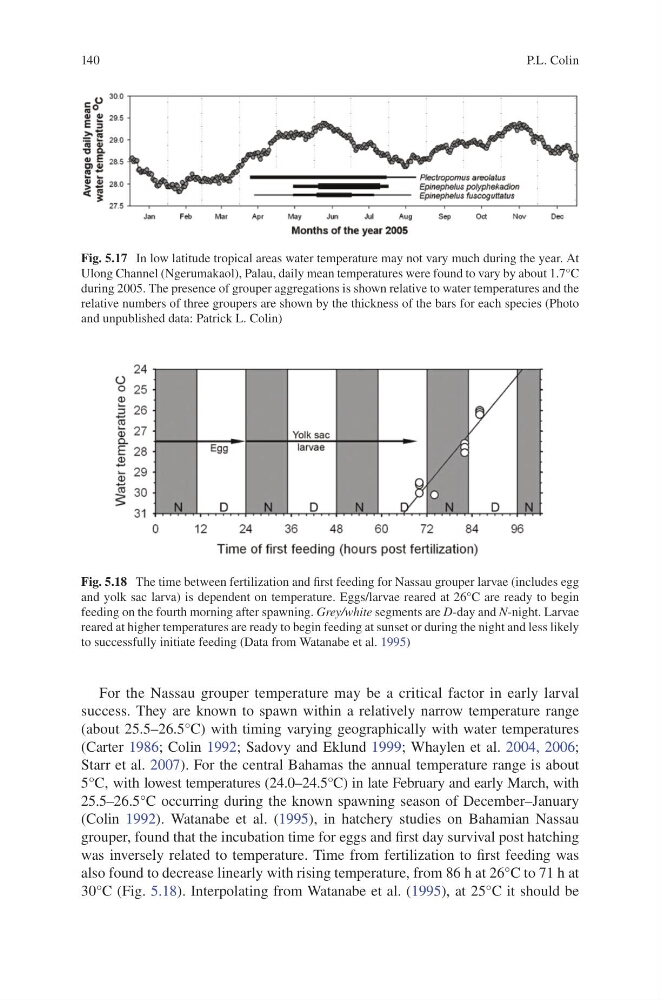
was inversely related to temperature. Time from fertilization to fi rst feeding was
also found to decrease linearly with rising temperature, from 86 h at 26°C to 71 h at
30°C (Fig. 5.18 ). Interpolating from Watanabe et al. ( 1995 ) , at 25°C it should be
Fig. 5.17 In low latitude tropical areas water temperature may not vary much during the year. At
Ulong Channel (Ngerumakaol), Palau, daily mean temperatures were found to vary by about 1.7°C
during 2005. The presence of grouper aggregations is shown relative to water temperatures and the
relative numbers of three groupers are shown by the thickness of the bars for each species (Photo
and unpublished data: Patrick L. Colin)
Fig. 5.18 The time between fertilization and fi rst feeding for Nassau grouper larvae (includes egg
and yolk sac larva) is dependent on temperature. Eggs/larvae reared at 26°C are ready to begin
feeding on the fourth morning after spawning. Grey/white segments are D -day and N -night. Larvae
reared at higher temperatures are ready to begin feeding at sunset or during the night and less likely
to successfully initiate feeding (Data from Watanabe et al. 1995 )
P.L. Colin
For the Nassau grouper temperature may be a critical factor in early larval
success. They are known to spawn within a relatively narrow temperature range
(about 25.5–26.5°C) with timing varying geographically with water temperatures
(Carter 1986 ; Colin 1992 ; Sadovy and Eklund 1999 ; Whaylen et al. 2004, 2006 ;
Starr et al. 2007 ). For the central Bahamas the annual temperature range is about
5°C, with lowest temperatures (24.0–24.5°C) in late February and early March, with
25.5–26.5°C occurring during the known spawning season of December–January
(Colin 1992 ) . Watanabe et al. ( 1995 ) , in hatchery studies on Bahamian Nassau
grouper, found that the incubation time for eggs and fi rst day survival post hatching
was inversely related to temperature. Time from fertilization to fi rst feeding was
also found to decrease linearly with rising temperature, from 86 h at 26°C to 71 h at
30°C (Fig. 5.18 ). Interpolating from Watanabe et al. ( 1995 ) , at 25°C it should be
Fig. 5.17 In low latitude tropical areas water temperature may not vary much during the year. At
Ulong Channel (Ngerumakaol), Palau, daily mean temperatures were found to vary by about 1.7°C
during 2005. The presence of grouper aggregations is shown relative to water temperatures and the
relative numbers of three groupers are shown by the thickness of the bars for each species (Photo
and unpublished data: Patrick L. Colin)
Fig. 5.18 The time between fertilization and fi rst feeding for Nassau grouper larvae (includes egg
and yolk sac larva) is dependent on temperature. Eggs/larvae reared at 26°C are ready to begin
feeding on the fourth morning after spawning. Grey/white segments are D -day and N -night. Larvae
reared at higher temperatures are ready to begin feeding at sunset or during the night and less likely
to successfully initiate feeding (Data from Watanabe et al. 1995 )