

131
5 Timing and Location of Aggregation and Spawning in Reef Fishes
resembles that of a bank reef. Lang Bank, at the eastern end of the St. Croix insular
shelf (Fig. 5.11c ), is an aggregation area for red hinds and other fi shes ( Nemeth
et al. 2007 ). A broad shelf deeper than the bank aggregation area separates it from
the island 20 km away, so the bank is openly exposed to general oceanic currents
and not generating island effects itself.
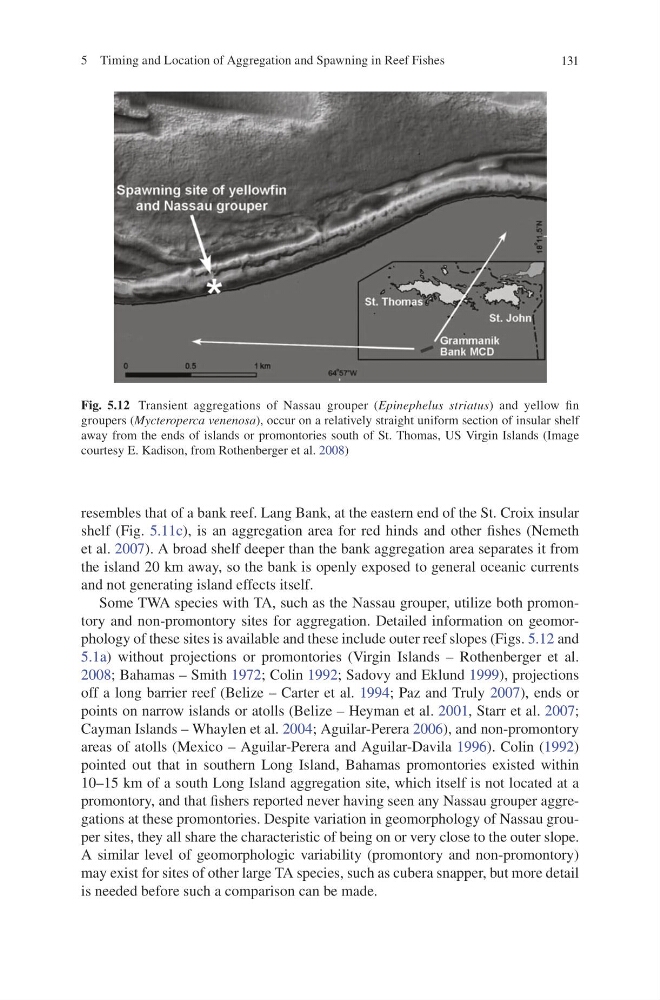
Some TWA species with TA, such as the Nassau grouper, utilize both promontory and non-promontory sites for aggregation. Detailed information on geomorphology of these sites is available and these include outer reef slopes (Figs. 5.12 and
5.1a ) without projections or promontories (Virgin Islands – Rothenberger et al.
2008 ; Bahamas – Smith 1972 ; Colin 1992 ; Sadovy and Eklund 1999 ) , projections
off a long barrier reef (Belize – Carter et al. 1994 ; Paz and Truly 2007 ) , ends or
points on narrow islands or atolls (Belize – Heyman et al. 2001 , Starr et al. 2007 ;
Cayman Islands – Whaylen et al. 2004 ; Aguilar-Perera 2006 ) , and non-promontory
areas of atolls (Mexico – Aguilar-Perera and Aguilar-Davila 1996 ) . Colin ( 1992 )
pointed out that in southern Long Island, Bahamas promontories existed within
10–15 km of a south Long Island aggregation site, which itself is not located at a
promontory, and that fi shers reported never having seen any Nassau grouper aggregations at these promontories. Despite variation in geomorphology of Nassau grouper sites, they all share the characteristic of being on or very close to the outer slope.
A similar level of geomorphologic variability (promontory and non-promontory)
may exist for sites of other large TA species, such as cubera snapper, but more detail
is needed before such a comparison can be made.
Fig. 5.12 Transient aggregations of Nassau grouper ( Epinephelus striatus ) and yellow fi n
groupers ( Mycteroperca venenosa ), occur on a relatively straight uniform section of insular shelf
away from the ends of islands or promontories south of St. Thomas, US Virgin Islands (Image
courtesy E. Kadison, from Rothenberger et al. 2008 )
5 Timing and Location of Aggregation and Spawning in Reef Fishes
resembles that of a bank reef. Lang Bank, at the eastern end of the St. Croix insular
shelf (Fig. 5.11c ), is an aggregation area for red hinds and other fi shes ( Nemeth
et al. 2007 ). A broad shelf deeper than the bank aggregation area separates it from
the island 20 km away, so the bank is openly exposed to general oceanic currents
and not generating island effects itself.
Some TWA species with TA, such as the Nassau grouper, utilize both promontory and non-promontory sites for aggregation. Detailed information on geomorphology of these sites is available and these include outer reef slopes (Figs. 5.12 and
5.1a ) without projections or promontories (Virgin Islands – Rothenberger et al.
2008 ; Bahamas – Smith 1972 ; Colin 1992 ; Sadovy and Eklund 1999 ) , projections
off a long barrier reef (Belize – Carter et al. 1994 ; Paz and Truly 2007 ) , ends or
points on narrow islands or atolls (Belize – Heyman et al. 2001 , Starr et al. 2007 ;
Cayman Islands – Whaylen et al. 2004 ; Aguilar-Perera 2006 ) , and non-promontory
areas of atolls (Mexico – Aguilar-Perera and Aguilar-Davila 1996 ) . Colin ( 1992 )
pointed out that in southern Long Island, Bahamas promontories existed within
10–15 km of a south Long Island aggregation site, which itself is not located at a
promontory, and that fi shers reported never having seen any Nassau grouper aggregations at these promontories. Despite variation in geomorphology of Nassau grouper sites, they all share the characteristic of being on or very close to the outer slope.
A similar level of geomorphologic variability (promontory and non-promontory)
may exist for sites of other large TA species, such as cubera snapper, but more detail
is needed before such a comparison can be made.
Fig. 5.12 Transient aggregations of Nassau grouper ( Epinephelus striatus ) and yellow fi n
groupers ( Mycteroperca venenosa ), occur on a relatively straight uniform section of insular shelf
away from the ends of islands or promontories south of St. Thomas, US Virgin Islands (Image
courtesy E. Kadison, from Rothenberger et al. 2008 )