

122
P.L. Colin
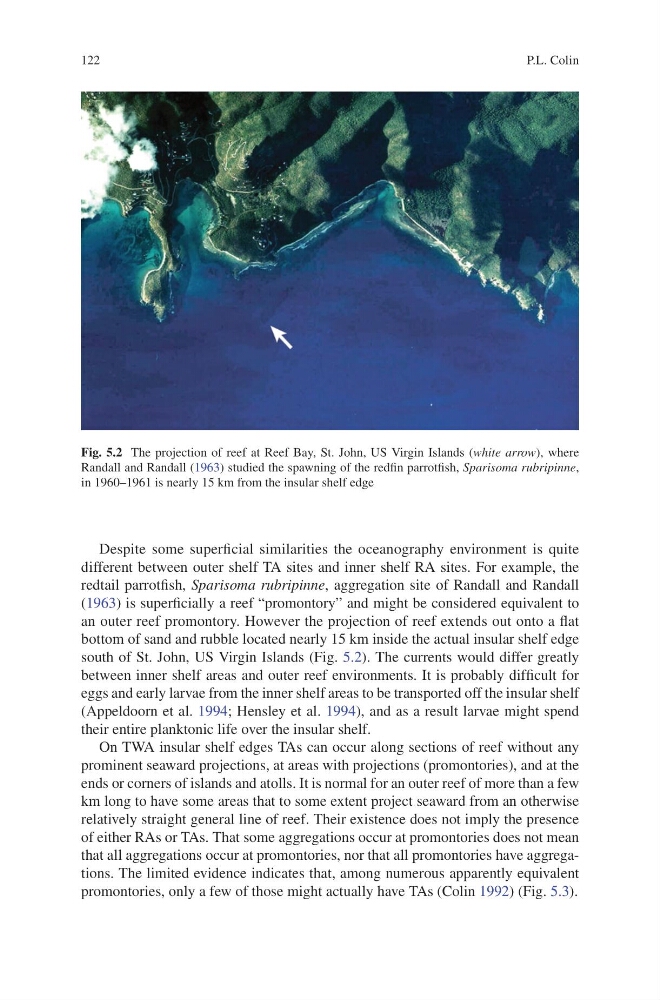
Despite some superfi cial similarities the oceanography environment is quite
different between outer shelf TA sites and inner shelf RA sites. For example, the
redtail parrotfi sh, Sparisoma rubripinne , aggregation site of Randall and Randall
( 1963 ) is superfi cially a reef “promontory” and might be considered equivalent to
an outer reef promontory. However the projection of reef extends out onto a fl at
bottom of sand and rubble located nearly 15 km inside the actual insular shelf edge
south of St. John, US Virgin Islands (Fig. 5.2 ). The currents would differ greatly
between inner shelf areas and outer reef environments. It is probably diffi cult for
eggs and early larvae from the inner shelf areas to be transported off the insular shelf
(Appeldoorn et al. 1994 ; Hensley et al. 1994 ) , and as a result larvae might spend
their entire planktonic life over the insular shelf.
On TWA insular shelf edges TAs can occur along sections of reef without any
prominent seaward projections, at areas with projections (promontories), and at the
ends or corners of islands and atolls. It is normal for an outer reef of more than a few
km long to have some areas that to some extent project seaward from an otherwise
relatively straight general line of reef. Their existence does not imply the presence
of either RAs or TAs. That some aggregations occur at promontories does not mean
that all aggregations occur at promontories, nor that all promontories have aggregations. The limited evidence indicates that, among numerous apparently equivalent
promontories, only a few of those might actually have TAs (Colin 1992 ) (Fig. 5.3 ).
Fig. 5.2 The projection of reef at Reef Bay, St. John, US Virgin Islands ( white arrow ), where
Randall and Randall ( 1963 ) studied the spawning of the redfi n parrotfi sh, Sparisoma rubripinne ,
in 1960–1961 is nearly 15 km from the insular shelf edge
P.L. Colin
Despite some superfi cial similarities the oceanography environment is quite
different between outer shelf TA sites and inner shelf RA sites. For example, the
redtail parrotfi sh, Sparisoma rubripinne , aggregation site of Randall and Randall
( 1963 ) is superfi cially a reef “promontory” and might be considered equivalent to
an outer reef promontory. However the projection of reef extends out onto a fl at
bottom of sand and rubble located nearly 15 km inside the actual insular shelf edge
south of St. John, US Virgin Islands (Fig. 5.2 ). The currents would differ greatly
between inner shelf areas and outer reef environments. It is probably diffi cult for
eggs and early larvae from the inner shelf areas to be transported off the insular shelf
(Appeldoorn et al. 1994 ; Hensley et al. 1994 ) , and as a result larvae might spend
their entire planktonic life over the insular shelf.
On TWA insular shelf edges TAs can occur along sections of reef without any
prominent seaward projections, at areas with projections (promontories), and at the
ends or corners of islands and atolls. It is normal for an outer reef of more than a few
km long to have some areas that to some extent project seaward from an otherwise
relatively straight general line of reef. Their existence does not imply the presence
of either RAs or TAs. That some aggregations occur at promontories does not mean
that all aggregations occur at promontories, nor that all promontories have aggregations. The limited evidence indicates that, among numerous apparently equivalent
promontories, only a few of those might actually have TAs (Colin 1992 ) (Fig. 5.3 ).
Fig. 5.2 The projection of reef at Reef Bay, St. John, US Virgin Islands ( white arrow ), where
Randall and Randall ( 1963 ) studied the spawning of the redfi n parrotfi sh, Sparisoma rubripinne ,
in 1960–1961 is nearly 15 km from the insular shelf edge