

108
J.H. Choat
netic element in that large wrasses exceed the size threshold but appear to be
resident spawners. However both body form (most large wrasses have a high degree
of lateral compression) and nutritional ecology appear to preclude the development
of a large ovarian mass. In this context, large wrasses, i.e. labrids such as the hogfi sh, Lachnolaimus maximus , are predicted to be confi rmed as resident spawners.
Transient spawning is predicted to be more prevalent in the tropical Atlantic than
the western Pacifi c for two reasons. Firstly, reef extent and structure differ between
these regions such that suitable spawning sites are restricted in the Atlantic thereby
requiring fi sh to travel greater distances to aggregate (Tables 4.4 – 4.7 ). Secondly, the
mean size of the dominant transient spawning groups, snapper and groupers is
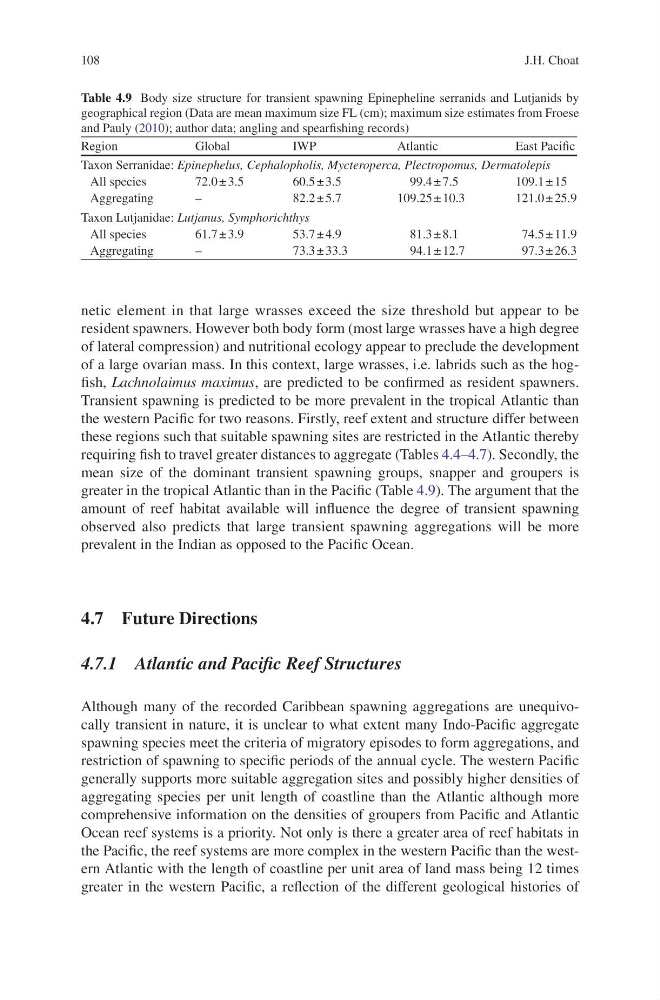
greater in the tropical Atlantic than in the Pacifi c (Table 4.9 ). The argument that the
amount of reef habitat available will infl uence the degree of transient spawning
observed also predicts that large transient spawning aggregations will be more
prevalent in the Indian as opposed to the Pacifi c Ocean.
4.7 Future Directions
4.7.1 Atlantic and Pacifi c Reef Structures
Although many of the recorded Caribbean spawning aggregations are unequivocally transient in nature, it is unclear to what extent many Indo-Pacifi c aggregate
spawning species meet the criteria of migratory episodes to form aggregations, and
restriction of spawning to specifi c periods of the annual cycle. The western Pacifi c
generally supports more suitable aggregation sites and possibly higher densities of
aggregating species per unit length of coastline than the Atlantic although more
comprehensive information on the densities of groupers from Pacifi c and Atlantic
Ocean reef systems is a priority. Not only is there a greater area of reef habitats in
the Pacifi c, the reef systems are more complex in the western Pacifi c than the western Atlantic with the length of coastline per unit area of land mass being 12 times
greater in the western Pacifi c, a refl ection of the different geological histories of
Table 4.9 Body size structure for transient spawning Epinepheline serranids and Lutjanids by
geographical region (Data are mean maximum size FL (cm); maximum size estimates from Froese
and Pauly ( 2010 ) ; author data; angling and spearfi shing records)
Region
Global
IWP
Atlantic
East Pacifi c
Taxon Serranidae: Epinephelus, Cephalopholis, Mycteroperca, Plectropomus, Dermatolepis
All species
72.0 ± 3.5
60.5 ± 3.5
99.4 ± 7.5
109.1 ± 15
Aggregating
–
82.2 ± 5.7
109.25 ± 10.3
121.0 ± 25.9
Taxon Lutjanidae: Lutjanus, Symphorichthys
All species
61.7 ± 3.9
53.7 ± 4.9
81.3 ± 8.1
74.5 ± 11.9
Aggregating
–
73.3 ± 33.3
94.1 ± 12.7
97.3 ± 26.3
J.H. Choat
netic element in that large wrasses exceed the size threshold but appear to be
resident spawners. However both body form (most large wrasses have a high degree
of lateral compression) and nutritional ecology appear to preclude the development
of a large ovarian mass. In this context, large wrasses, i.e. labrids such as the hogfi sh, Lachnolaimus maximus , are predicted to be confi rmed as resident spawners.
Transient spawning is predicted to be more prevalent in the tropical Atlantic than
the western Pacifi c for two reasons. Firstly, reef extent and structure differ between
these regions such that suitable spawning sites are restricted in the Atlantic thereby
requiring fi sh to travel greater distances to aggregate (Tables 4.4 – 4.7 ). Secondly, the
mean size of the dominant transient spawning groups, snapper and groupers is
greater in the tropical Atlantic than in the Pacifi c (Table 4.9 ). The argument that the
amount of reef habitat available will infl uence the degree of transient spawning
observed also predicts that large transient spawning aggregations will be more
prevalent in the Indian as opposed to the Pacifi c Ocean.
4.7 Future Directions
4.7.1 Atlantic and Pacifi c Reef Structures
Although many of the recorded Caribbean spawning aggregations are unequivocally transient in nature, it is unclear to what extent many Indo-Pacifi c aggregate
spawning species meet the criteria of migratory episodes to form aggregations, and
restriction of spawning to specifi c periods of the annual cycle. The western Pacifi c
generally supports more suitable aggregation sites and possibly higher densities of
aggregating species per unit length of coastline than the Atlantic although more
comprehensive information on the densities of groupers from Pacifi c and Atlantic
Ocean reef systems is a priority. Not only is there a greater area of reef habitats in
the Pacifi c, the reef systems are more complex in the western Pacifi c than the western Atlantic with the length of coastline per unit area of land mass being 12 times
greater in the western Pacifi c, a refl ection of the different geological histories of
Table 4.9 Body size structure for transient spawning Epinepheline serranids and Lutjanids by
geographical region (Data are mean maximum size FL (cm); maximum size estimates from Froese
and Pauly ( 2010 ) ; author data; angling and spearfi shing records)
Region
Global
IWP
Atlantic
East Pacifi c
Taxon Serranidae: Epinephelus, Cephalopholis, Mycteroperca, Plectropomus, Dermatolepis
All species
72.0 ± 3.5
60.5 ± 3.5
99.4 ± 7.5
109.1 ± 15
Aggregating
–
82.2 ± 5.7
109.25 ± 10.3
121.0 ± 25.9
Taxon Lutjanidae: Lutjanus, Symphorichthys
All species
61.7 ± 3.9
53.7 ± 4.9
81.3 ± 8.1
74.5 ± 11.9
Aggregating
–
73.3 ± 33.3
94.1 ± 12.7
97.3 ± 26.3