

98
J.H. Choat
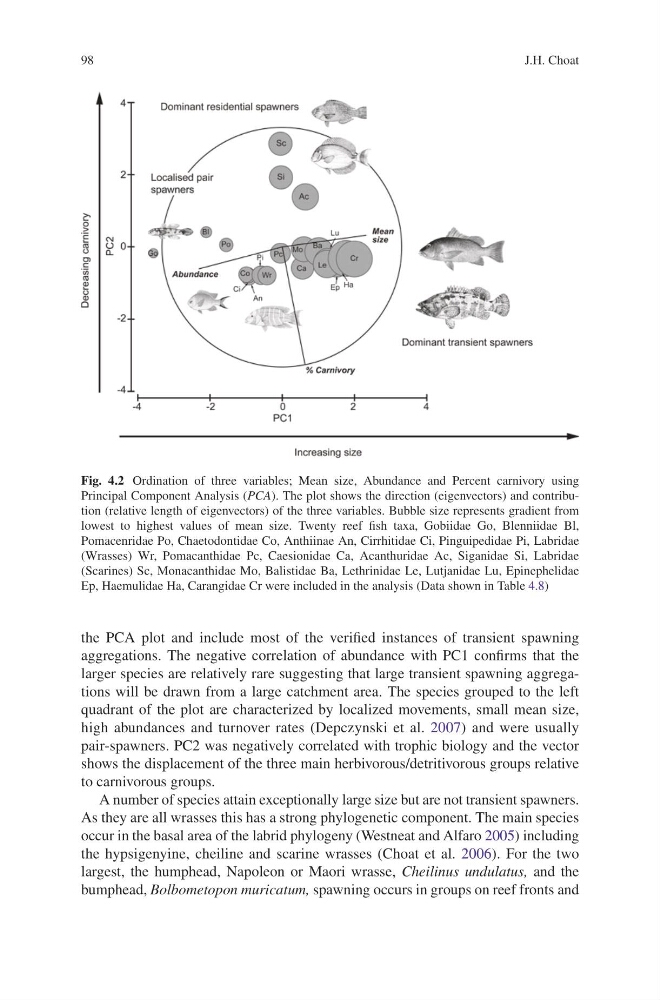
the PCA plot and include most of the verifi ed instances of transient spawning
aggregations. The negative correlation of abundance with PC1 confi rms that the
larger species are relatively rare suggesting that large transient spawning aggregations will be drawn from a large catchment area. The species grouped to the left
quadrant of the plot are characterized by localized movements, small mean size,
high abundances and turnover rates (Depczynski et al. 2007 ) and were usually
pair-spawners. PC2 was negatively correlated with trophic biology and the vector
shows the displacement of the three main herbivorous/detritivorous groups relative
to carnivorous groups.
A number of species attain exceptionally large size but are not transient spawners.
As they are all wrasses this has a strong phylogenetic component. The main species
occur in the basal area of the labrid phylogeny (Westneat and Alfaro 2005 ) including
the hypsigenyine, cheiline and scarine wrasses (Choat et al. 2006 ) . For the two
largest, the humphead, Napoleon or Maori wrasse, Cheilinus undulatus, and the
bumphead, Bolbometopon muricatum, spawning occurs in groups on reef fronts and
Fig. 4.2 Ordination of three variables; Mean size, Abundance and Percent carnivory using
Principal Component Analysis ( PCA ). The plot shows the direction (eigenvectors) and contribution (relative length of eigenvectors) of the three variables. Bubble size represents gradient from
lowest to highest values of mean size. Twenty reef fi sh taxa, Gobiidae Go, Blenniidae Bl,
Pomacenridae Po, Chaetodontidae Co, Anthiinae An, Cirrhitidae Ci, Pinguipedidae Pi, Labridae
(Wrasses) Wr, Pomacanthidae Pc, Caesionidae Ca, Acanthuridae Ac, Siganidae Si, Labridae
(Scarines) Sc, Monacanthidae Mo, Balistidae Ba, Lethrinidae Le, Lutjanidae Lu, Epinephelidae
Ep, Haemulidae Ha, Carangidae Cr were included in the analysis (Data shown in Table 4.8 )
J.H. Choat
the PCA plot and include most of the verifi ed instances of transient spawning
aggregations. The negative correlation of abundance with PC1 confi rms that the
larger species are relatively rare suggesting that large transient spawning aggregations will be drawn from a large catchment area. The species grouped to the left
quadrant of the plot are characterized by localized movements, small mean size,
high abundances and turnover rates (Depczynski et al. 2007 ) and were usually
pair-spawners. PC2 was negatively correlated with trophic biology and the vector
shows the displacement of the three main herbivorous/detritivorous groups relative
to carnivorous groups.
A number of species attain exceptionally large size but are not transient spawners.
As they are all wrasses this has a strong phylogenetic component. The main species
occur in the basal area of the labrid phylogeny (Westneat and Alfaro 2005 ) including
the hypsigenyine, cheiline and scarine wrasses (Choat et al. 2006 ) . For the two
largest, the humphead, Napoleon or Maori wrasse, Cheilinus undulatus, and the
bumphead, Bolbometopon muricatum, spawning occurs in groups on reef fronts and
Fig. 4.2 Ordination of three variables; Mean size, Abundance and Percent carnivory using
Principal Component Analysis ( PCA ). The plot shows the direction (eigenvectors) and contribution (relative length of eigenvectors) of the three variables. Bubble size represents gradient from
lowest to highest values of mean size. Twenty reef fi sh taxa, Gobiidae Go, Blenniidae Bl,
Pomacenridae Po, Chaetodontidae Co, Anthiinae An, Cirrhitidae Ci, Pinguipedidae Pi, Labridae
(Wrasses) Wr, Pomacanthidae Pc, Caesionidae Ca, Acanthuridae Ac, Siganidae Si, Labridae
(Scarines) Sc, Monacanthidae Mo, Balistidae Ba, Lethrinidae Le, Lutjanidae Lu, Epinephelidae
Ep, Haemulidae Ha, Carangidae Cr were included in the analysis (Data shown in Table 4.8 )