

91
4 Spawning Aggregations in Reef Fishes; Ecological and Evolutionary Processes
Pacifi c with only fractional reef development with a total of <100 km
2 (Spalding
and Grenfell 1997 ; Spalding et al. 2001 ) . Given the major differences in reef habitat
metrics among ocean basins it is possible that the dynamics of spawning aggregations
will also vary on a biogeographic scale, by the number and size of aggregations
present in different oceans. A greater cover of coral reef habitat and their greater
structural complexity, for example, as opposed to simply hard bottom habitats would
be associated with larger numbers of relatively small aggregations.
4.3 Spawning Modes and Reproductive Behaviour
in Reef Fishes
Spawning aggregations in reef fi shes can be classifi ed as either resident or transient
(Domeier and Colin 1997 , Chap. 1 ). These are nested within a broader classifi cation
of reef fi sh reproductive biology. A basic reproductive trait is mode of egg development.
This can be demersal, where fertilized eggs develop in nests or attached to the substratum, or pelagic, where eggs are fertilized and develop in open water following
broadcast spawning (Chap. 7 ). Demersal egg development followed by pelagic larval
development occurs mainly in small species (Thresher 1984 ; Munday and Jones
1998 ) the majority of which are not aggregate spawners. Reproduction is usually
accomplished by pair- spawning, occurs within localized areas in the normal foraging habitat and may involve parental care. There are exceptions to the condition of
small size and non-migratory spawning behaviour in species with demersal egg
development. Two groups, triggerfi shes (Balistidae), and the rabbitfi shes (Siganidae),
contain relatively large and mobile species that produce demersal eggs yet undergo
aggregative spawning (Table 4.8 ).
Triggerfi shes (mean length of 42 cm, range of 15–100 fork length cm), are predominantly pair-spawning (Kawase 1998 ) with varying degrees of parental care. Residential
spawning aggregations have been recorded in Pseudobalistes (55–60 cm) and
Balistoides (75 mm) spp. These include the yellowmargin triggerfi sh, Pseudobalistes
fl avimarginatus , in which spawning occurs in a lek-like system (Gladstone 1994 ) .
Aggregation has also been observed in the titan trigger fi sh, Balistoides viridescens ,
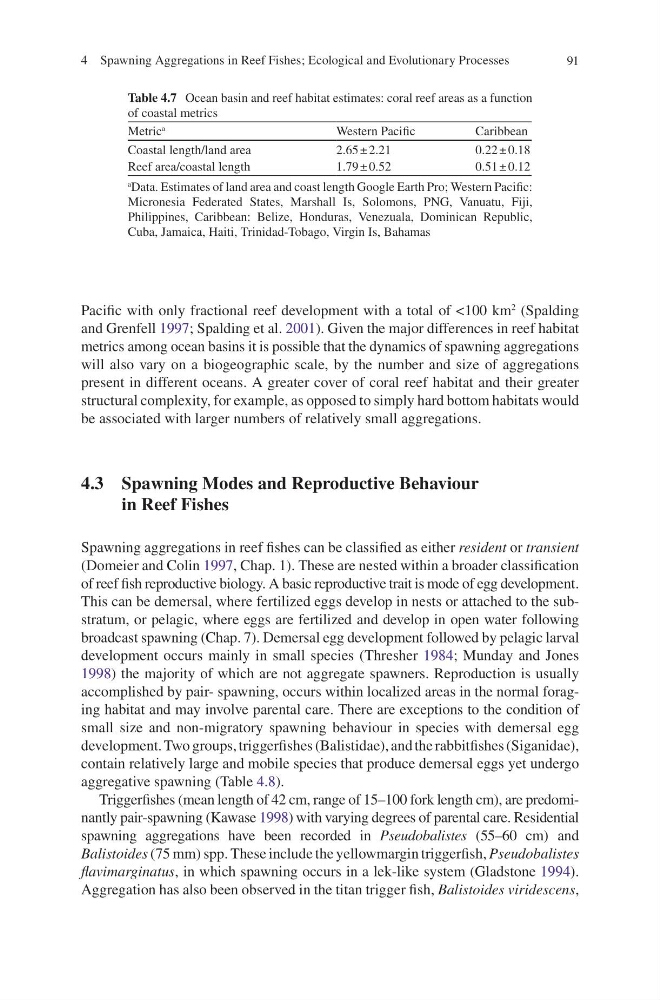
Table 4.7 Ocean basin and reef habitat estimates: coral reef areas as a function
of coastal metrics
Metric
a
Western Pacifi c
Caribbean
Coastal length/land area
2.65 ± 2.21
0.22 ± 0.18
Reef area/coastal length
1.79 ± 0.52
0.51 ± 0.12
a
Data. Estimates of land area and coast length Google Earth Pro; Western Pacifi c:
Micronesia Federated States, Marshall Is, Solomons, PNG, Vanuatu, Fiji,
Philippines, Caribbean: Belize, Honduras, Venezuala, Dominican Republic,
Cuba, Jamaica, Haiti, Trinidad-Tobago, Virgin Is, Bahamas
4 Spawning Aggregations in Reef Fishes; Ecological and Evolutionary Processes
Pacifi c with only fractional reef development with a total of <100 km
2 (Spalding
and Grenfell 1997 ; Spalding et al. 2001 ) . Given the major differences in reef habitat
metrics among ocean basins it is possible that the dynamics of spawning aggregations
will also vary on a biogeographic scale, by the number and size of aggregations
present in different oceans. A greater cover of coral reef habitat and their greater
structural complexity, for example, as opposed to simply hard bottom habitats would
be associated with larger numbers of relatively small aggregations.
4.3 Spawning Modes and Reproductive Behaviour
in Reef Fishes
Spawning aggregations in reef fi shes can be classifi ed as either resident or transient
(Domeier and Colin 1997 , Chap. 1 ). These are nested within a broader classifi cation
of reef fi sh reproductive biology. A basic reproductive trait is mode of egg development.
This can be demersal, where fertilized eggs develop in nests or attached to the substratum, or pelagic, where eggs are fertilized and develop in open water following
broadcast spawning (Chap. 7 ). Demersal egg development followed by pelagic larval
development occurs mainly in small species (Thresher 1984 ; Munday and Jones
1998 ) the majority of which are not aggregate spawners. Reproduction is usually
accomplished by pair- spawning, occurs within localized areas in the normal foraging habitat and may involve parental care. There are exceptions to the condition of
small size and non-migratory spawning behaviour in species with demersal egg
development. Two groups, triggerfi shes (Balistidae), and the rabbitfi shes (Siganidae),
contain relatively large and mobile species that produce demersal eggs yet undergo
aggregative spawning (Table 4.8 ).
Triggerfi shes (mean length of 42 cm, range of 15–100 fork length cm), are predominantly pair-spawning (Kawase 1998 ) with varying degrees of parental care. Residential
spawning aggregations have been recorded in Pseudobalistes (55–60 cm) and
Balistoides (75 mm) spp. These include the yellowmargin triggerfi sh, Pseudobalistes
fl avimarginatus , in which spawning occurs in a lek-like system (Gladstone 1994 ) .
Aggregation has also been observed in the titan trigger fi sh, Balistoides viridescens ,
Table 4.7 Ocean basin and reef habitat estimates: coral reef areas as a function
of coastal metrics
Metric
a
Western Pacifi c
Caribbean
Coastal length/land area
2.65 ± 2.21
0.22 ± 0.18
Reef area/coastal length
1.79 ± 0.52
0.51 ± 0.12
a
Data. Estimates of land area and coast length Google Earth Pro; Western Pacifi c:
Micronesia Federated States, Marshall Is, Solomons, PNG, Vanuatu, Fiji,
Philippines, Caribbean: Belize, Honduras, Venezuala, Dominican Republic,
Cuba, Jamaica, Haiti, Trinidad-Tobago, Virgin Is, Bahamas