

471
average of 0.35 ± 0.11 % day at 12 °C. The embryo is conspicuous at day 22 at 12 °C
(Uriarte et al. 2009), when reaching stage IX (according to Naef 1928). At the end
of the embryonic period, paralarvae ML is 4.4 ± 0.1 mm, with an arm length (AL)/
ML ratio of 0.61 ± 0.01 (Uriarte et al. 2010).
25.2.3 Paralarvae Culture
When the paralarvae of R� fontaniana hatch, they have a total length of 3.4–6.0 mm
(González et al. 2008; Uriarte et al. 2010; Ortiz and Ré 2011). According to Ortiz
and Ré (2011), the chromatophore pattern, in terms of shape and distribution of
paralarvae of this species, allows its easy distinction from other octopods from the
Patagonian Atlantic and the Patagonian Pacific. Carrasco et al. (2012) differentiated
paralarvae of both E� megalocyathus and R� fontaniana in oceanographic zooplankton samples collected in the Chilean Fjord region (41–43°S).
Uriarte et al. (2010) demonstrated that the total length of the paralarvae of R�
fontaniana increases exponentially from hatching to benthic settlement. The AL and
eye diameter increase proportionally to the total length of the paralarvae, while the
mantle increases logarithmically. According to these authors, this demonstrates an
important increase of the paralarvae predatory abilities throughout their ontogenetic
development. Fasting affects the morphometry of the paralarvae, noting that starved
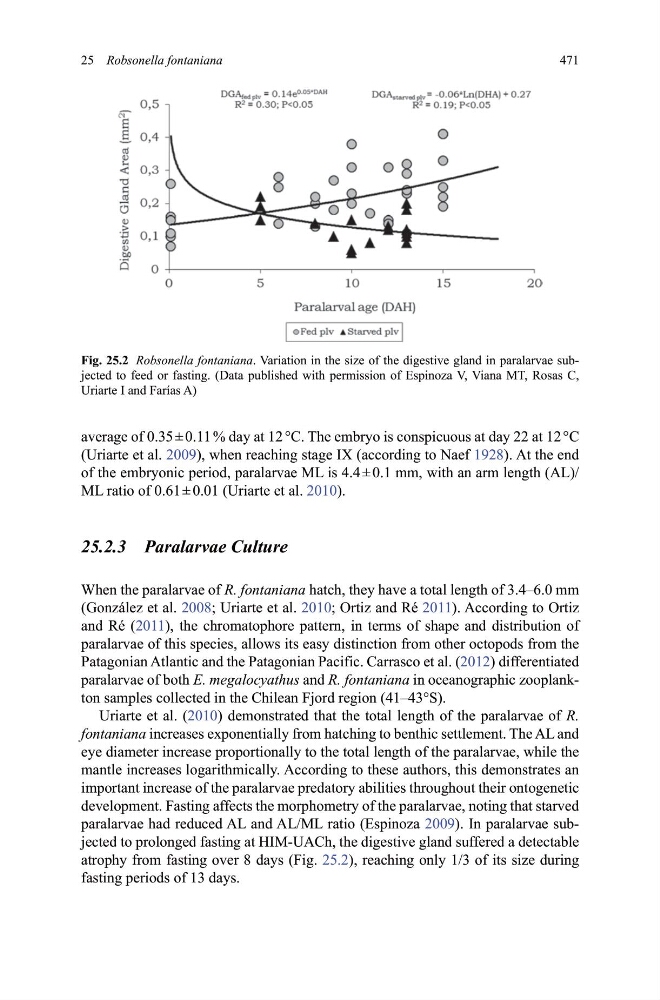
paralarvae had reduced AL and AL/ML ratio (Espinoza 2009). In paralarvae subjected to prolonged fasting at HIM-UACh, the digestive gland suffered a detectable
atrophy from fasting over 8 days (Fig. 25.2), reaching only 1/3 of its size during
fasting periods of 13 days.
Fig. 25.2 Robsonella fontaniana. Variation in the size of the digestive gland in paralarvae subjected to feed or fasting. (Data published with permission of Espinoza V, Viana MT, Rosas C,
Uriarte I and Farías A)
25 Robsonella fontaniana
average of 0.35 ± 0.11 % day at 12 °C. The embryo is conspicuous at day 22 at 12 °C
(Uriarte et al. 2009), when reaching stage IX (according to Naef 1928). At the end
of the embryonic period, paralarvae ML is 4.4 ± 0.1 mm, with an arm length (AL)/
ML ratio of 0.61 ± 0.01 (Uriarte et al. 2010).
25.2.3 Paralarvae Culture
When the paralarvae of R� fontaniana hatch, they have a total length of 3.4–6.0 mm
(González et al. 2008; Uriarte et al. 2010; Ortiz and Ré 2011). According to Ortiz
and Ré (2011), the chromatophore pattern, in terms of shape and distribution of
paralarvae of this species, allows its easy distinction from other octopods from the
Patagonian Atlantic and the Patagonian Pacific. Carrasco et al. (2012) differentiated
paralarvae of both E� megalocyathus and R� fontaniana in oceanographic zooplankton samples collected in the Chilean Fjord region (41–43°S).
Uriarte et al. (2010) demonstrated that the total length of the paralarvae of R�
fontaniana increases exponentially from hatching to benthic settlement. The AL and
eye diameter increase proportionally to the total length of the paralarvae, while the
mantle increases logarithmically. According to these authors, this demonstrates an
important increase of the paralarvae predatory abilities throughout their ontogenetic
development. Fasting affects the morphometry of the paralarvae, noting that starved
paralarvae had reduced AL and AL/ML ratio (Espinoza 2009). In paralarvae subjected to prolonged fasting at HIM-UACh, the digestive gland suffered a detectable
atrophy from fasting over 8 days (Fig. 25.2), reaching only 1/3 of its size during
fasting periods of 13 days.
Fig. 25.2 Robsonella fontaniana. Variation in the size of the digestive gland in paralarvae subjected to feed or fasting. (Data published with permission of Espinoza V, Viana MT, Rosas C,
Uriarte I and Farías A)
25 Robsonella fontaniana