

454
F. J. Sánchez et al.
However, results obtained by Gómez et al. (2005) point to a decrease of the ammonia excretion rate above 1.2 mg total ammonia nitrogen (TAN) L
−1
at 19 °C,
suggesting that higher values may be toxic.
24.3 Culture Parameters
24.3.1 Oxygen Consumption and Water Flow
The water flowing through a culture system (e.g. a tank) must ensure that the oxygen supply is sufficient to cover the metabolic needs of the animals in question,
but also maintains optimal levels of oxygen, which must never be a limiting factor
for production. The water also must ensure the removal of nitrogen compounds,
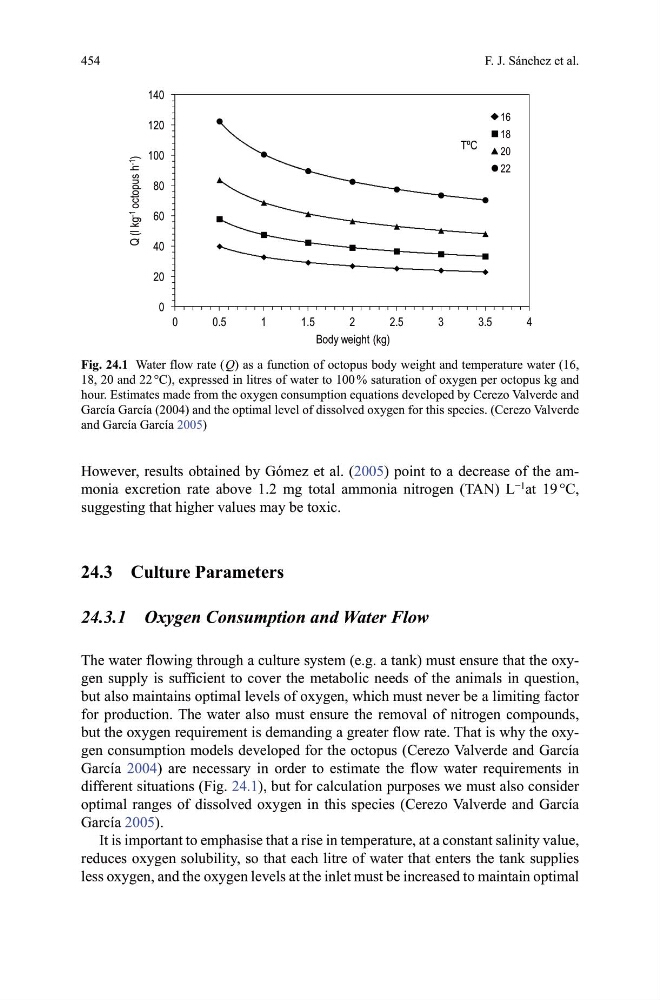
but the oxygen requirement is demanding a greater flow rate. That is why the oxygen consumption models developed for the octopus (Cerezo Valverde and García
García 2004) are necessary in order to estimate the flow water requirements in
different situations (Fig. 24.1), but for calculation purposes we must also consider
optimal ranges of dissolved oxygen in this species (Cerezo Valverde and García
García 2005).
It is important to emphasise that a rise in temperature, at a constant salinity value,
reduces oxygen solubility, so that each litre of water that enters the tank supplies
less oxygen, and the oxygen levels at the inlet must be increased to maintain optimal
0
20
40
60
80
100
120
140
0
0 .5
1
1 .5
2
2 .5
3
3 .5
4
Body weight (kg)
16
18
20
22
TºC
Q (l kg -1
octopus h -1
)
Fig. 24.1 Water flow rate ( Q) as a function of octopus body weight and temperature water (16,
18, 20 and 22 °C), expressed in litres of water to 100 % saturation of oxygen per octopus kg and
hour. Estimates made from the oxygen consumption equations developed by Cerezo Valverde and
García García (2004) and the optimal level of dissolved oxygen for this species. (Cerezo Valverde
and García García 2005)
F. J. Sánchez et al.
However, results obtained by Gómez et al. (2005) point to a decrease of the ammonia excretion rate above 1.2 mg total ammonia nitrogen (TAN) L
−1
at 19 °C,
suggesting that higher values may be toxic.
24.3 Culture Parameters
24.3.1 Oxygen Consumption and Water Flow
The water flowing through a culture system (e.g. a tank) must ensure that the oxygen supply is sufficient to cover the metabolic needs of the animals in question,
but also maintains optimal levels of oxygen, which must never be a limiting factor
for production. The water also must ensure the removal of nitrogen compounds,
but the oxygen requirement is demanding a greater flow rate. That is why the oxygen consumption models developed for the octopus (Cerezo Valverde and García
García 2004) are necessary in order to estimate the flow water requirements in
different situations (Fig. 24.1), but for calculation purposes we must also consider
optimal ranges of dissolved oxygen in this species (Cerezo Valverde and García
García 2005).
It is important to emphasise that a rise in temperature, at a constant salinity value,
reduces oxygen solubility, so that each litre of water that enters the tank supplies
less oxygen, and the oxygen levels at the inlet must be increased to maintain optimal
0
20
40
60
80
100
120
140
0
0 .5
1
1 .5
2
2 .5
3
3 .5
4
Body weight (kg)
16
18
20
22
TºC
Q (l kg -1
octopus h -1
)
Fig. 24.1 Water flow rate ( Q) as a function of octopus body weight and temperature water (16,
18, 20 and 22 °C), expressed in litres of water to 100 % saturation of oxygen per octopus kg and
hour. Estimates made from the oxygen consumption equations developed by Cerezo Valverde and
García García (2004) and the optimal level of dissolved oxygen for this species. (Cerezo Valverde
and García García 2005)