

443
23 Octopus vulgaris. Paralarval Culture
brachydactyla) zoeae as live prey, and obtaining a paralarvae dry weight of
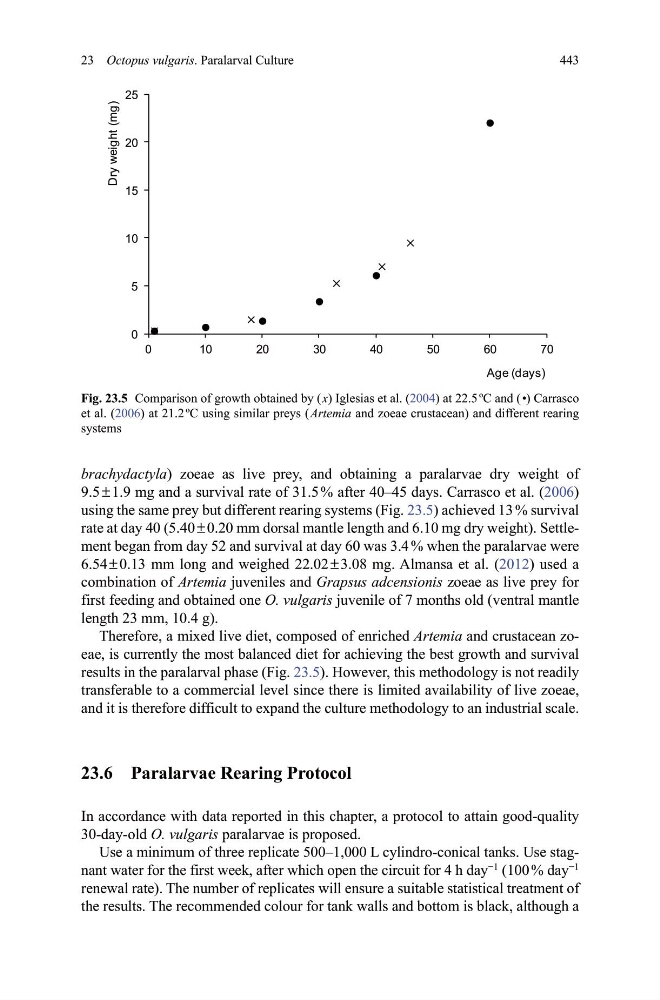
9.5 ± 1.9 mg and a survival rate of 31.5 % after 40–45 days. Carrasco et al. (2006)
using the same prey but different rearing systems (Fig. 23.5) achieved 13 % survival
rate at day 40 (5.40 ± 0.20 mm dorsal mantle length and 6.10 mg dry weight). Settlement began from day 52 and survival at day 60 was 3.4 % when the paralarvae were
6.54 ± 0.13 mm long and weighed 22.02 ± 3.08 mg. Almansa et al. (2012) used a
combination of Artemia juveniles and Grapsus adcensionis zoeae as live prey for
first feeding and obtained one O� vulgaris juvenile of 7 months old (ventral mantle
length 23 mm, 10.4 g).
Therefore, a mixed live diet, composed of enriched Artemia and crustacean zoeae, is currently the most balanced diet for achieving the best growth and survival
results in the paralarval phase (Fig. 23.5). However, this methodology is not readily
transferable to a commercial level since there is limited availability of live zoeae,
and it is therefore difficult to expand the culture methodology to an industrial scale.
23.6 Paralarvae Rearing Protocol
In accordance with data reported in this chapter, a protocol to attain good-quality
30-day-old O� vulgaris paralarvae is proposed.
Use a minimum of three replicate 500–1,000 L cylindro-conical tanks. Use stagnant water for the first week, after which open the circuit for 4 h day
−1
(100 % day
−1
renewal rate). The number of replicates will ensure a suitable statistical treatment of
the results. The recommended colour for tank walls and bottom is black, although a
0
5
10
15
20
25
0
1 0
2 0
3 0
4 0
5 0
6 0
7 0
Dry weight (mg)
Age (days)
Fig. 23.5 Comparison of growth obtained by ( x) Iglesias et al. (2004) at 22.5 ºC and ( •) Carrasco
et al. (2006) at 21.2 ºC using similar preys ( Artemia and zoeae crustacean) and different rearing
systems
23 Octopus vulgaris. Paralarval Culture
brachydactyla) zoeae as live prey, and obtaining a paralarvae dry weight of
9.5 ± 1.9 mg and a survival rate of 31.5 % after 40–45 days. Carrasco et al. (2006)
using the same prey but different rearing systems (Fig. 23.5) achieved 13 % survival
rate at day 40 (5.40 ± 0.20 mm dorsal mantle length and 6.10 mg dry weight). Settlement began from day 52 and survival at day 60 was 3.4 % when the paralarvae were
6.54 ± 0.13 mm long and weighed 22.02 ± 3.08 mg. Almansa et al. (2012) used a
combination of Artemia juveniles and Grapsus adcensionis zoeae as live prey for
first feeding and obtained one O� vulgaris juvenile of 7 months old (ventral mantle
length 23 mm, 10.4 g).
Therefore, a mixed live diet, composed of enriched Artemia and crustacean zoeae, is currently the most balanced diet for achieving the best growth and survival
results in the paralarval phase (Fig. 23.5). However, this methodology is not readily
transferable to a commercial level since there is limited availability of live zoeae,
and it is therefore difficult to expand the culture methodology to an industrial scale.
23.6 Paralarvae Rearing Protocol
In accordance with data reported in this chapter, a protocol to attain good-quality
30-day-old O� vulgaris paralarvae is proposed.
Use a minimum of three replicate 500–1,000 L cylindro-conical tanks. Use stagnant water for the first week, after which open the circuit for 4 h day
−1
(100 % day
−1
renewal rate). The number of replicates will ensure a suitable statistical treatment of
the results. The recommended colour for tank walls and bottom is black, although a
0
5
10
15
20
25
0
1 0
2 0
3 0
4 0
5 0
6 0
7 0
Dry weight (mg)
Age (days)
Fig. 23.5 Comparison of growth obtained by ( x) Iglesias et al. (2004) at 22.5 ºC and ( •) Carrasco
et al. (2006) at 21.2 ºC using similar preys ( Artemia and zoeae crustacean) and different rearing
systems