

441
23 Octopus vulgaris. Paralarval Culture
23.5.3 Artemia Enrichment
Even though Artemia is easily available and well accepted by O� vulgaris paralarvae, Navarro and Villanueva (2003) have reported that Artemia per se has an inadequate lipid composition, the docosahexaenoic acid (DHA) and eicosapentaenoic
acid (EPA) content being especially low.
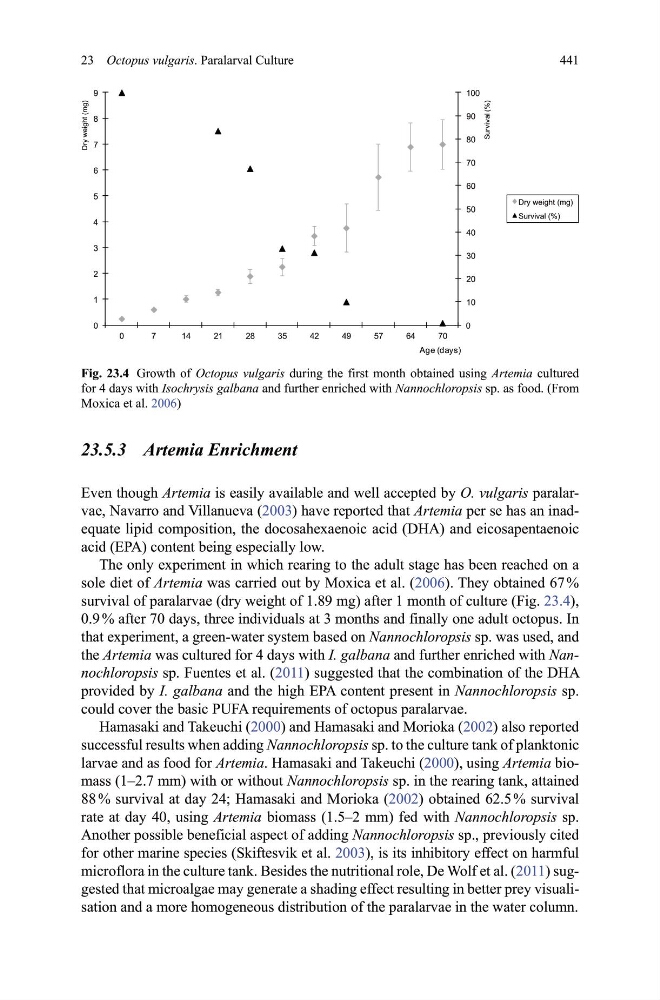
The only experiment in which rearing to the adult stage has been reached on a
sole diet of Artemia was carried out by Moxica et al. (2006). They obtained 67 %
survival of paralarvae (dry weight of 1.89 mg) after 1 month of culture (Fig. 23.4),
0.9 % after 70 days, three individuals at 3 months and finally one adult octopus. In
that experiment, a green-water system based on Nannochloropsis sp. was used, and
the Artemia was cultured for 4 days with I� galbana and further enriched with Nannochloropsis sp. Fuentes et al. (2011) suggested that the combination of the DHA
provided by I� galbana and the high EPA content present in Nannochloropsis sp.
could cover the basic PUFA requirements of octopus paralarvae.
Hamasaki and Takeuchi (2000) and Hamasaki and Morioka (2002) also reported
successful results when adding Nannochloropsis sp. to the culture tank of planktonic
larvae and as food for Artemia. Hamasaki and Takeuchi (2000), using Artemia biomass (1–2.7 mm) with or without Nannochloropsis sp. in the rearing tank, attained
88 % survival at day 24; Hamasaki and Morioka (2002) obtained 62.5 % survival
rate at day 40, using Artemia biomass (1.5–2 mm) fed with Nannochloropsis sp.
Another possible beneficial aspect of adding Nannochloropsis sp., previously cited
for other marine species (Skiftesvik et al. 2003), is its inhibitory effect on harmful
microflora in the culture tank. Besides the nutritional role, De Wolf et al. (2011) suggested that microalgae may generate a shading effect resulting in better prey visualisation and a more homogeneous distribution of the paralarvae in the water column.
0
10
20
30
40
50
60
70
80
90
100
0
1
2
3
4
5
6
7
8
9
0
7
14
21
28
35
42
49
57
64
70
Survival (%)
Dry weight (mg)
Age (days)
Dry weight (mg)
Survival (%)
Fig. 23.4 Growth of Octopus vulgaris during the first month obtained using Artemia cultured
for 4 days with Isochrysis galbana and further enriched with Nannochloropsis sp. as food. (From
Moxica et al. 2006)
23 Octopus vulgaris. Paralarval Culture
23.5.3 Artemia Enrichment
Even though Artemia is easily available and well accepted by O� vulgaris paralarvae, Navarro and Villanueva (2003) have reported that Artemia per se has an inadequate lipid composition, the docosahexaenoic acid (DHA) and eicosapentaenoic
acid (EPA) content being especially low.
The only experiment in which rearing to the adult stage has been reached on a
sole diet of Artemia was carried out by Moxica et al. (2006). They obtained 67 %
survival of paralarvae (dry weight of 1.89 mg) after 1 month of culture (Fig. 23.4),
0.9 % after 70 days, three individuals at 3 months and finally one adult octopus. In
that experiment, a green-water system based on Nannochloropsis sp. was used, and
the Artemia was cultured for 4 days with I� galbana and further enriched with Nannochloropsis sp. Fuentes et al. (2011) suggested that the combination of the DHA
provided by I� galbana and the high EPA content present in Nannochloropsis sp.
could cover the basic PUFA requirements of octopus paralarvae.
Hamasaki and Takeuchi (2000) and Hamasaki and Morioka (2002) also reported
successful results when adding Nannochloropsis sp. to the culture tank of planktonic
larvae and as food for Artemia. Hamasaki and Takeuchi (2000), using Artemia biomass (1–2.7 mm) with or without Nannochloropsis sp. in the rearing tank, attained
88 % survival at day 24; Hamasaki and Morioka (2002) obtained 62.5 % survival
rate at day 40, using Artemia biomass (1.5–2 mm) fed with Nannochloropsis sp.
Another possible beneficial aspect of adding Nannochloropsis sp., previously cited
for other marine species (Skiftesvik et al. 2003), is its inhibitory effect on harmful
microflora in the culture tank. Besides the nutritional role, De Wolf et al. (2011) suggested that microalgae may generate a shading effect resulting in better prey visualisation and a more homogeneous distribution of the paralarvae in the water column.
0
10
20
30
40
50
60
70
80
90
100
0
1
2
3
4
5
6
7
8
9
0
7
14
21
28
35
42
49
57
64
70
Survival (%)
Dry weight (mg)
Age (days)
Dry weight (mg)
Survival (%)
Fig. 23.4 Growth of Octopus vulgaris during the first month obtained using Artemia cultured
for 4 days with Isochrysis galbana and further enriched with Nannochloropsis sp. as food. (From
Moxica et al. 2006)