

32
benthic lifestyle immediately, but also grow rapidly, feeding on crustaceans and
other small prey (Forsythe 1984).
2.6 Conclusions
This chapter reveals how complex and poorly understood are the behaviours of
cephalopods. Yet, despite this, knowledge of this natural behaviour can serve as a
foundation for successful culture of different cephalopod species. Even this partial account gives details of limitations, suggestions for how to assure that animals
thrive in captivity, and, perhaps most importantly, an indication of which behaviours to monitor to assure oneself that the animals are doing well or warning signs
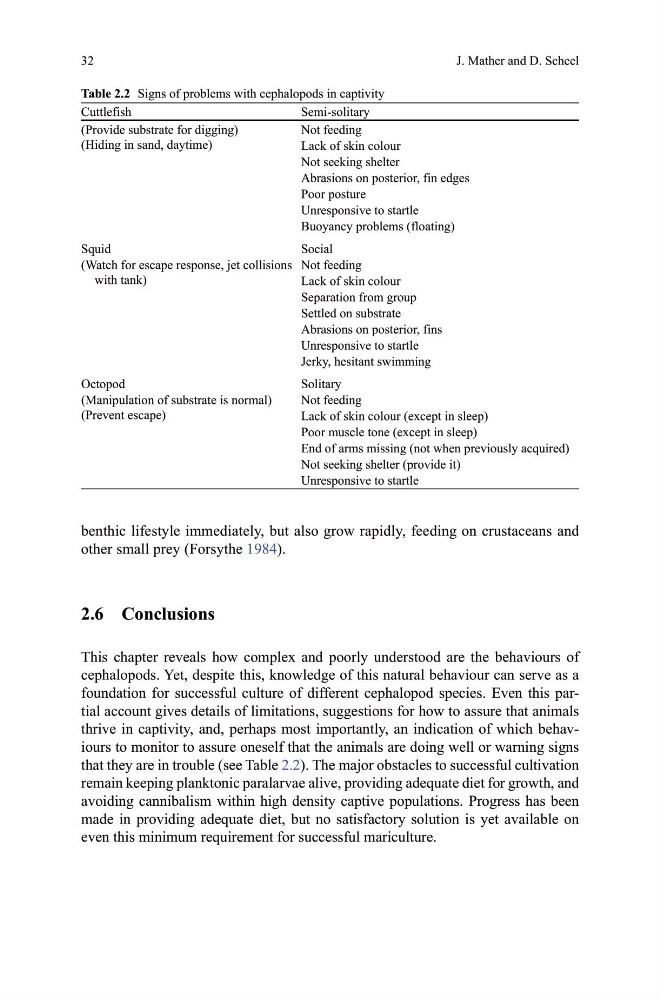
that they are in trouble (see Table 2.2). The major obstacles to successful cultivation
remain keeping planktonic paralarvae alive, providing adequate diet for growth, and
avoiding cannibalism within high density captive populations. Progress has been
made in providing adequate diet, but no satisfactory solution is yet available on
even this minimum requirement for successful mariculture.
Table 2.2 Signs of problems with cephalopods in captivity
Cuttlefish
Semi-solitary
(Provide substrate for digging)
(Hiding in sand, daytime)
Not feeding
Lack of skin colour
Not seeking shelter
Abrasions on posterior, fin edges
Poor posture
Unresponsive to startle
Buoyancy problems (floating)
Squid
Social
(Watch for escape response, jet collisions
with tank)
Not feeding
Lack of skin colour
Separation from group
Settled on substrate
Abrasions on posterior, fins
Unresponsive to startle
Jerky, hesitant swimming
Octopod
Solitary
(Manipulation of substrate is normal)
(Prevent escape)
Not feeding
Lack of skin colour (except in sleep)
Poor muscle tone (except in sleep)
End of arms missing (not when previously acquired)
Not seeking shelter (provide it)
Unresponsive to startle
J. Mather and D. Scheel
benthic lifestyle immediately, but also grow rapidly, feeding on crustaceans and
other small prey (Forsythe 1984).
2.6 Conclusions
This chapter reveals how complex and poorly understood are the behaviours of
cephalopods. Yet, despite this, knowledge of this natural behaviour can serve as a
foundation for successful culture of different cephalopod species. Even this partial account gives details of limitations, suggestions for how to assure that animals
thrive in captivity, and, perhaps most importantly, an indication of which behaviours to monitor to assure oneself that the animals are doing well or warning signs
that they are in trouble (see Table 2.2). The major obstacles to successful cultivation
remain keeping planktonic paralarvae alive, providing adequate diet for growth, and
avoiding cannibalism within high density captive populations. Progress has been
made in providing adequate diet, but no satisfactory solution is yet available on
even this minimum requirement for successful mariculture.
Table 2.2 Signs of problems with cephalopods in captivity
Cuttlefish
Semi-solitary
(Provide substrate for digging)
(Hiding in sand, daytime)
Not feeding
Lack of skin colour
Not seeking shelter
Abrasions on posterior, fin edges
Poor posture
Unresponsive to startle
Buoyancy problems (floating)
Squid
Social
(Watch for escape response, jet collisions
with tank)
Not feeding
Lack of skin colour
Separation from group
Settled on substrate
Abrasions on posterior, fins
Unresponsive to startle
Jerky, hesitant swimming
Octopod
Solitary
(Manipulation of substrate is normal)
(Prevent escape)
Not feeding
Lack of skin colour (except in sleep)
Poor muscle tone (except in sleep)
End of arms missing (not when previously acquired)
Not seeking shelter (provide it)
Unresponsive to startle
J. Mather and D. Scheel