

394
C. Rosas et al.
20.6 Conclusions
Presently, O� maya culture is closed; broodstock animals are grown from hatchlings cultured in outdoor ponds. However, studies on other cephalopod species have demonstrated that cephalopod culture in captivity reduces animal sizes after several generations.
Therefore, the broodstock and the O� maya genetic bank in culture conditions needs to
be refreshed every year, when the fisheries season is opened (August–December). So,
every year broodstock is complemented with animals obtained in culture conditions.
A system that includes broodstock area, incubation system, pre-fattening ponds
and fattening outdoor ponds works as a demonstrative unit just to show the technological process of O� maya culture. At this moment, the system has been transferred
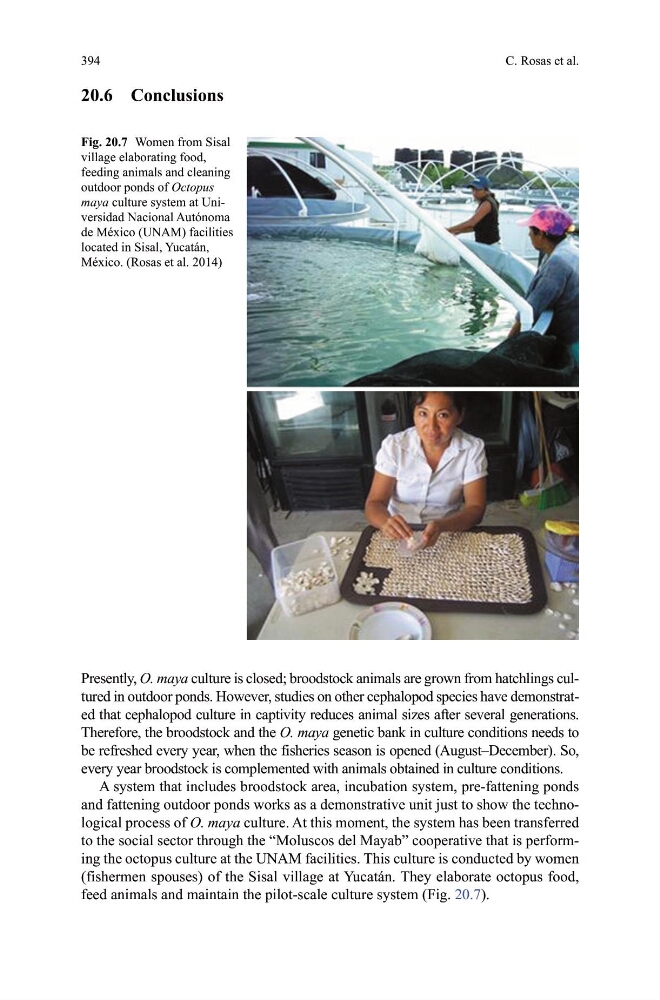
to the social sector through the “Moluscos del Mayab” cooperative that is performing the octopus culture at the UNAM facilities. This culture is conducted by women
(fishermen spouses) of the Sisal village at Yucatán. They elaborate octopus food,
feed animals and maintain the pilot-scale culture system (Fig. 20.7).
Fig. 20.7 Women from Sisal
village elaborating food,
feeding animals and cleaning
outdoor ponds of Octopus
maya culture system at Universidad Nacional Autónoma
de México (UNAM) facilities
located in Sisal, Yucatán,
México. (Rosas et al. 2014)
C. Rosas et al.
20.6 Conclusions
Presently, O� maya culture is closed; broodstock animals are grown from hatchlings cultured in outdoor ponds. However, studies on other cephalopod species have demonstrated that cephalopod culture in captivity reduces animal sizes after several generations.
Therefore, the broodstock and the O� maya genetic bank in culture conditions needs to
be refreshed every year, when the fisheries season is opened (August–December). So,
every year broodstock is complemented with animals obtained in culture conditions.
A system that includes broodstock area, incubation system, pre-fattening ponds
and fattening outdoor ponds works as a demonstrative unit just to show the technological process of O� maya culture. At this moment, the system has been transferred
to the social sector through the “Moluscos del Mayab” cooperative that is performing the octopus culture at the UNAM facilities. This culture is conducted by women
(fishermen spouses) of the Sisal village at Yucatán. They elaborate octopus food,
feed animals and maintain the pilot-scale culture system (Fig. 20.7).
Fig. 20.7 Women from Sisal
village elaborating food,
feeding animals and cleaning
outdoor ponds of Octopus
maya culture system at Universidad Nacional Autónoma
de México (UNAM) facilities
located in Sisal, Yucatán,
México. (Rosas et al. 2014)