

377
19 Enteroctopus megalocyathus
At HIM-UACh, the egg incubation period ends when the paralarvae start to
hatch at regular intervals during 5–10 days. Artemia nauplii is supplied for feeding
in the incubation tanks, so they can feed after hatching. Early paralarvae are transferred to rectangular ponds of 28 L, at a density of 10 paralarvae L
−1
(Table 19.3).
The density of Artemia nauplii is maintained at 2 nauplii paralarvae
−1
day
−1
.
Paralarvae cultivation is carried out with a recirculated sea-water system, sterilized
with UV, with temperature control, water replacement of 70 % of the tank day
−1
and O 2 concentration above 85 % saturation. The unconsumed and dead Artemia
nauplii waste is removed daily throughout the culture in order to maintain water
quality at appropriate levels of oxygen and ammonia. The paralarval development
period takes 4–5 months before reaching settlement. Presettlement reflexes of E�
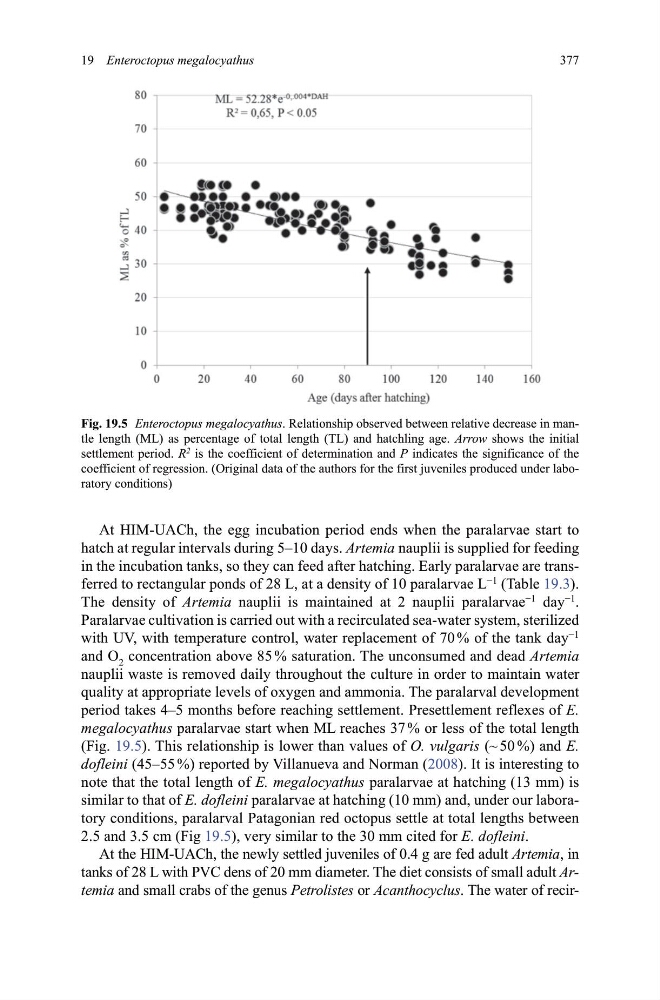
megalocyathus paralarvae start when ML reaches 37 % or less of the total length
(Fig. 19.5). This relationship is lower than values of O� vulgaris (~ 50 %) and E�
dofleini (45–55 %) reported by Villanueva and Norman (2008). It is interesting to
note that the total length of E� megalocyathus paralarvae at hatching (13 mm) is
similar to that of E� dofleini paralarvae at hatching (10 mm) and, under our laboratory conditions, paralarval Patagonian red octopus settle at total lengths between
2.5 and 3.5 cm (Fig 19.5), very similar to the 30 mm cited for E� dofleini.
At the HIM-UACh, the newly settled juveniles of 0.4 g are fed adult Artemia, in
tanks of 28 L with PVC dens of 20 mm diameter. The diet consists of small adult Artemia and small crabs of the genus Petrolistes or Acanthocyclus. The water of recirFig. 19.5 Enteroctopus megalocyathus. Relationship observed between relative decrease in mantle length (ML) as percentage of total length (TL) and hatchling age. Arrow shows the initial
settlement period. R
2
is the coefficient of determination and P indicates the significance of the
coefficient of regression. (Original data of the authors for the first juveniles produced under laboratory conditions)
19 Enteroctopus megalocyathus
At HIM-UACh, the egg incubation period ends when the paralarvae start to
hatch at regular intervals during 5–10 days. Artemia nauplii is supplied for feeding
in the incubation tanks, so they can feed after hatching. Early paralarvae are transferred to rectangular ponds of 28 L, at a density of 10 paralarvae L
−1
(Table 19.3).
The density of Artemia nauplii is maintained at 2 nauplii paralarvae
−1
day
−1
.
Paralarvae cultivation is carried out with a recirculated sea-water system, sterilized
with UV, with temperature control, water replacement of 70 % of the tank day
−1
and O 2 concentration above 85 % saturation. The unconsumed and dead Artemia
nauplii waste is removed daily throughout the culture in order to maintain water
quality at appropriate levels of oxygen and ammonia. The paralarval development
period takes 4–5 months before reaching settlement. Presettlement reflexes of E�
megalocyathus paralarvae start when ML reaches 37 % or less of the total length
(Fig. 19.5). This relationship is lower than values of O� vulgaris (~ 50 %) and E�
dofleini (45–55 %) reported by Villanueva and Norman (2008). It is interesting to
note that the total length of E� megalocyathus paralarvae at hatching (13 mm) is
similar to that of E� dofleini paralarvae at hatching (10 mm) and, under our laboratory conditions, paralarval Patagonian red octopus settle at total lengths between
2.5 and 3.5 cm (Fig 19.5), very similar to the 30 mm cited for E� dofleini.
At the HIM-UACh, the newly settled juveniles of 0.4 g are fed adult Artemia, in
tanks of 28 L with PVC dens of 20 mm diameter. The diet consists of small adult Artemia and small crabs of the genus Petrolistes or Acanthocyclus. The water of recirFig. 19.5 Enteroctopus megalocyathus. Relationship observed between relative decrease in mantle length (ML) as percentage of total length (TL) and hatchling age. Arrow shows the initial
settlement period. R
2
is the coefficient of determination and P indicates the significance of the
coefficient of regression. (Original data of the authors for the first juveniles produced under laboratory conditions)