

372
reach up to 20,000 eggs per female, while Ortiz et al. (2011) reported an expected
fecundity of 3,729 ± 1,443 oocytes; these authors found significant correlations between expected fecundity of males and females and body weight. Under laboratory
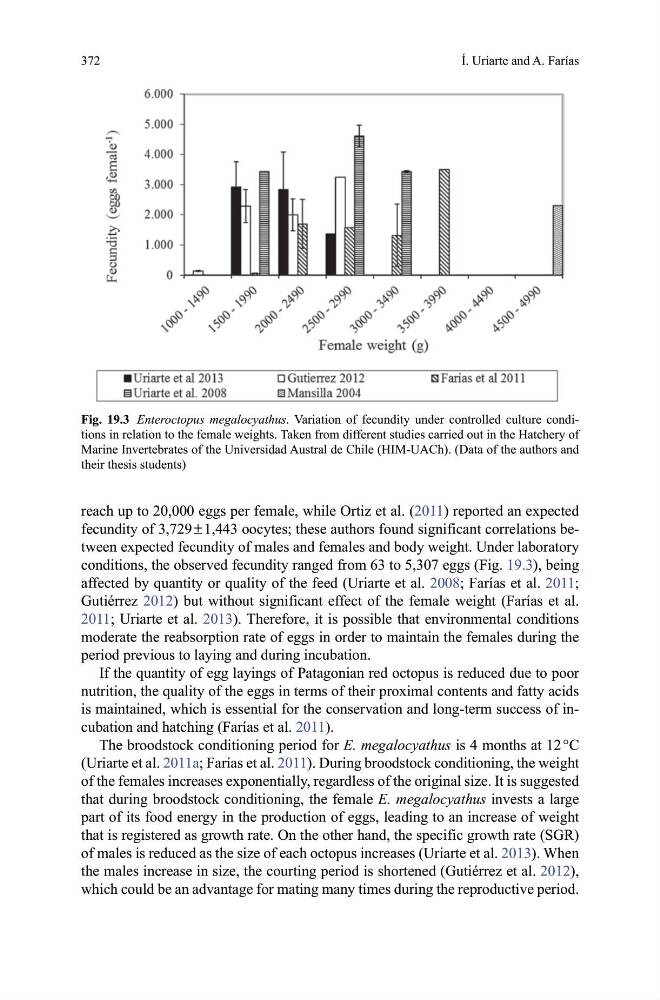
conditions, the observed fecundity ranged from 63 to 5,307 eggs (Fig. 19.3), being
affected by quantity or quality of the feed (Uriarte et al. 2008; Farías et al. 2011;
Gutiérrez 2012) but without significant effect of the female weight (Farías et al.
2011; Uriarte et al. 2013). Therefore, it is possible that environmental conditions
moderate the reabsorption rate of eggs in order to maintain the females during the
period previous to laying and during incubation.
If the quantity of egg layings of Patagonian red octopus is reduced due to poor
nutrition, the quality of the eggs in terms of their proximal contents and fatty acids
is maintained, which is essential for the conservation and long-term success of incubation and hatching (Farías et al. 2011).
The broodstock conditioning period for E� megalocyathus is 4 months at 12 °C
(Uriarte et al. 2011a; Farías et al. 2011). During broodstock conditioning, the weight
of the females increases exponentially, regardless of the original size. It is suggested
that during broodstock conditioning, the female E� megalocyathus invests a large
part of its food energy in the production of eggs, leading to an increase of weight
that is registered as growth rate. On the other hand, the specific growth rate (SGR)
of males is reduced as the size of each octopus increases (Uriarte et al. 2013). When
the males increase in size, the courting period is shortened (Gutiérrez et al. 2012),
which could be an advantage for mating many times during the reproductive period.
Fig. 19.3 Enteroctopus megalocyathus. Variation of fecundity under controlled culture conditions in relation to the female weights. Taken from different studies carried out in the Hatchery of
Marine Invertebrates of the Universidad Austral de Chile (HIM-UACh). (Data of the authors and
their thesis students)
Í. Uriarte and A. Farías
reach up to 20,000 eggs per female, while Ortiz et al. (2011) reported an expected
fecundity of 3,729 ± 1,443 oocytes; these authors found significant correlations between expected fecundity of males and females and body weight. Under laboratory
conditions, the observed fecundity ranged from 63 to 5,307 eggs (Fig. 19.3), being
affected by quantity or quality of the feed (Uriarte et al. 2008; Farías et al. 2011;
Gutiérrez 2012) but without significant effect of the female weight (Farías et al.
2011; Uriarte et al. 2013). Therefore, it is possible that environmental conditions
moderate the reabsorption rate of eggs in order to maintain the females during the
period previous to laying and during incubation.
If the quantity of egg layings of Patagonian red octopus is reduced due to poor
nutrition, the quality of the eggs in terms of their proximal contents and fatty acids
is maintained, which is essential for the conservation and long-term success of incubation and hatching (Farías et al. 2011).
The broodstock conditioning period for E� megalocyathus is 4 months at 12 °C
(Uriarte et al. 2011a; Farías et al. 2011). During broodstock conditioning, the weight
of the females increases exponentially, regardless of the original size. It is suggested
that during broodstock conditioning, the female E� megalocyathus invests a large
part of its food energy in the production of eggs, leading to an increase of weight
that is registered as growth rate. On the other hand, the specific growth rate (SGR)
of males is reduced as the size of each octopus increases (Uriarte et al. 2013). When
the males increase in size, the courting period is shortened (Gutiérrez et al. 2012),
which could be an advantage for mating many times during the reproductive period.
Fig. 19.3 Enteroctopus megalocyathus. Variation of fecundity under controlled culture conditions in relation to the female weights. Taken from different studies carried out in the Hatchery of
Marine Invertebrates of the Universidad Austral de Chile (HIM-UACh). (Data of the authors and
their thesis students)
Í. Uriarte and A. Farías