

368
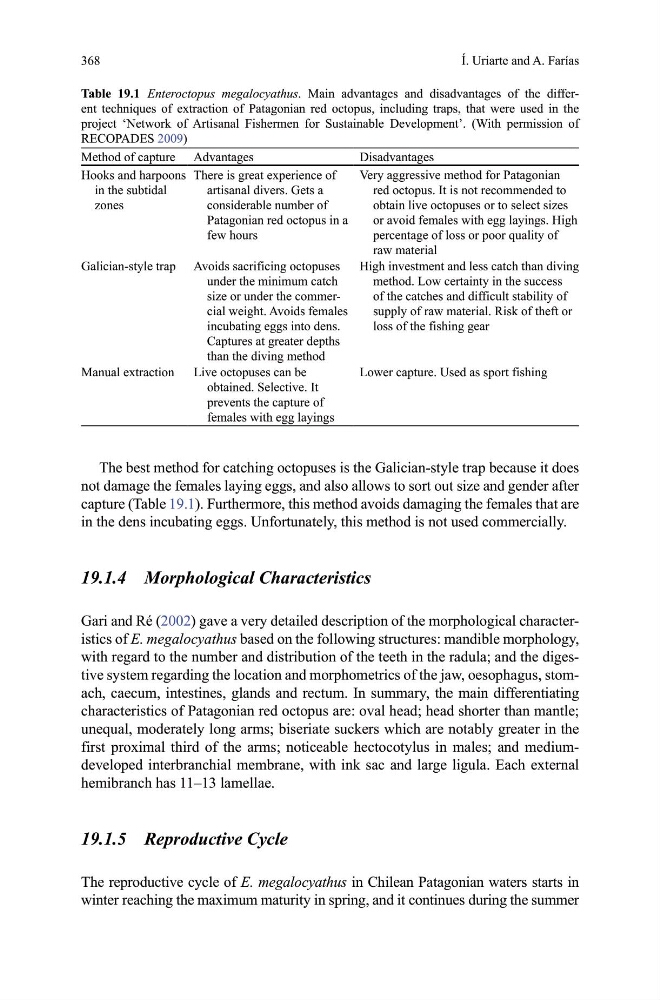
The best method for catching octopuses is the Galician-style trap because it does
not damage the females laying eggs, and also allows to sort out size and gender after
capture (Table 19.1). Furthermore, this method avoids damaging the females that are
in the dens incubating eggs. Unfortunately, this method is not used commercially.
19.1.4 Morphological Characteristics
Gari and Ré (2002) gave a very detailed description of the morphological characteristics of E� megalocyathus based on the following structures: mandible morphology,
with regard to the number and distribution of the teeth in the radula; and the digestive system regarding the location and morphometrics of the jaw, oesophagus, stomach, caecum, intestines, glands and rectum. In summary, the main differentiating
characteristics of Patagonian red octopus are: oval head; head shorter than mantle;
unequal, moderately long arms; biseriate suckers which are notably greater in the
first proximal third of the arms; noticeable hectocotylus in males; and mediumdeveloped interbranchial membrane, with ink sac and large ligula. Each external
hemibranch has 11–13 lamellae.
19.1.5 Reproductive Cycle
The reproductive cycle of E� megalocyathus in Chilean Patagonian waters starts in
winter reaching the maximum maturity in spring, and it continues during the summer
Table 19.1 Enteroctopus megalocyathus. Main advantages and disadvantages of the different techniques of extraction of Patagonian red octopus, including traps, that were used in the
project ‘Network of Artisanal Fishermen for Sustainable Development’. (With permission of
RECOPADES 2009)
Method of capture Advantages
Disadvantages
Hooks and harpoons
in the subtidal
zones
There is great experience of
artisanal divers. Gets a
considerable number of
Patagonian red octopus in a
few hours
Very aggressive method for Patagonian
red octopus. It is not recommended to
obtain live octopuses or to select sizes
or avoid females with egg layings. High
percentage of loss or poor quality of
raw material
Galician-style trap Avoids sacrificing octopuses
under the minimum catch
size or under the commercial weight. Avoids females
incubating eggs into dens.
Captures at greater depths
than the diving method
High investment and less catch than diving
method. Low certainty in the success
of the catches and difficult stability of
supply of raw material. Risk of theft or
loss of the fishing gear
Manual extraction
Live octopuses can be
obtained. Selective. It
prevents the capture of
females with egg layings
Lower capture. Used as sport fishing
Í. Uriarte and A. Farías
The best method for catching octopuses is the Galician-style trap because it does
not damage the females laying eggs, and also allows to sort out size and gender after
capture (Table 19.1). Furthermore, this method avoids damaging the females that are
in the dens incubating eggs. Unfortunately, this method is not used commercially.
19.1.4 Morphological Characteristics
Gari and Ré (2002) gave a very detailed description of the morphological characteristics of E� megalocyathus based on the following structures: mandible morphology,
with regard to the number and distribution of the teeth in the radula; and the digestive system regarding the location and morphometrics of the jaw, oesophagus, stomach, caecum, intestines, glands and rectum. In summary, the main differentiating
characteristics of Patagonian red octopus are: oval head; head shorter than mantle;
unequal, moderately long arms; biseriate suckers which are notably greater in the
first proximal third of the arms; noticeable hectocotylus in males; and mediumdeveloped interbranchial membrane, with ink sac and large ligula. Each external
hemibranch has 11–13 lamellae.
19.1.5 Reproductive Cycle
The reproductive cycle of E� megalocyathus in Chilean Patagonian waters starts in
winter reaching the maximum maturity in spring, and it continues during the summer
Table 19.1 Enteroctopus megalocyathus. Main advantages and disadvantages of the different techniques of extraction of Patagonian red octopus, including traps, that were used in the
project ‘Network of Artisanal Fishermen for Sustainable Development’. (With permission of
RECOPADES 2009)
Method of capture Advantages
Disadvantages
Hooks and harpoons
in the subtidal
zones
There is great experience of
artisanal divers. Gets a
considerable number of
Patagonian red octopus in a
few hours
Very aggressive method for Patagonian
red octopus. It is not recommended to
obtain live octopuses or to select sizes
or avoid females with egg layings. High
percentage of loss or poor quality of
raw material
Galician-style trap Avoids sacrificing octopuses
under the minimum catch
size or under the commercial weight. Avoids females
incubating eggs into dens.
Captures at greater depths
than the diving method
High investment and less catch than diving
method. Low certainty in the success
of the catches and difficult stability of
supply of raw material. Risk of theft or
loss of the fishing gear
Manual extraction
Live octopuses can be
obtained. Selective. It
prevents the capture of
females with egg layings
Lower capture. Used as sport fishing
Í. Uriarte and A. Farías